

Why the Most Successful People Learn to Pause Before They Push
In a world that celebrates speed, hustle and endless productivity, slowing down feels almost rebellious. We are taught to measure our worth by how busy we are, how full our calendars look and how quickly we respond to demands. That is why, when The Economic Times featured Satish Rao, our founder, the headline quietly cut through the noise:
“Switch off from work. Reset. Return with clarity.”
It wasn’t a catchy slogan designed for social media. It wasn’t another productivity hack. It was a deeply grounded insight that came from decades of working with leaders, executives, entrepreneurs and high performers across industries who all shared a common invisible struggle: they were successful, but they were exhausted.
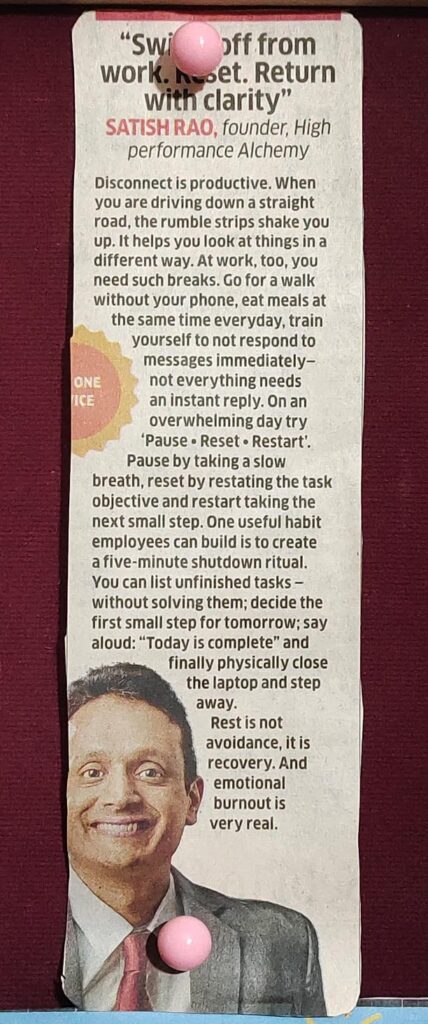
This small newspaper clipping has become a quiet but powerful reminder inside our organization. Not because it flatters us, but because it speaks the truth about what real high performance requires. It captures the philosophy behind everything we do in one-on-one coaching: sustainable success is not built by pushing harder, but by learning when and how to pause.
The Silent Crisis Among High Performers
High performers are often the people everyone relies on. They are capable, driven and dependable. They carry responsibility easily and take pride in delivering results. From the outside, their lives look impressive. From the inside, many of them feel constantly under pressure.
They live with a mind that rarely switches off. Even when they are not working, they are thinking about what needs to be done, what could go wrong or what they should have done better. Sleep becomes lighter. Joy becomes muted. Success starts to feel strangely hollow.
This is not because something is wrong with them. It is because their nervous system is stuck in a constant state of activation. The body does not know the difference between a physical threat and an overflowing inbox. It just knows it is never allowed to rest.
That is why Satish wrote in The Economic Times:
“Disconnect is productive… At work, too, you need such breaks.”
This simple sentence carries a powerful truth. When you never disconnect, you lose the very clarity and creativity you are trying so hard to protect. Space is not a luxury. It is a requirement for clear thinking.
The Rumble Strip Moment
In the same feature, Satish used a metaphor that many people instantly recognized:
“When you are driving down a straight road, the rumble strips shake you up. It helps you look at things in a different way.”
In life, rumble strips come in the form of burnout, restlessness, irritability, anxiety or a vague sense that something is off even when things are going well. They are not signs of weakness. They are signals from your system telling you that something needs to change.
Most people try to ignore these signals. They work harder, distract themselves or push through the discomfort. Over time, the signals get louder. Coaching helps you listen to those rumble strips early, understand what they are pointing to and respond with clarity instead of fear.
Why More Effort Stops Working
We are taught that if something is not working, we should try harder. But effort without recovery leads to tunnel vision. When you are constantly stressed, your brain becomes focused on survival rather than strategy. You become reactive instead of thoughtful. You rush instead of choosing.
This is why Satish introduced the Pause–Reset–Restart framework in his Economic Times article:
Pause • Reset • Restart
Pause by taking a slow, conscious breath.
Reset by restating what truly matters in that moment.
Restart by taking the next small, meaningful step.
This simple sequence helps the nervous system shift out of fight-or-flight and back into clarity. It is how elite performers stay grounded under pressure. Not by pushing harder, but by pausing wisely.
The Power of a 5-Minute Shutdown
Another insight Satish shared in the feature was the idea of a five-minute shutdown ritual. At the end of each workday, you take a few minutes to write down what is unfinished, decide what the first step will be tomorrow and consciously say, “Today is complete,” before closing your laptop.
This small practice sends a powerful signal to your nervous system: it is safe to rest now. Without it, many people carry their work into their evenings, their sleep and their relationships. Over time, this erodes their energy and their sense of presence.
Coaching helps people turn simple practices like this into consistent habits, because insight alone rarely creates change. Support and accountability do.
What One-on-One Coaching Really Does
People often come to coaching believing they need better time management or more discipline. What they usually discover is that what they really need is emotional steadiness and mental clarity. They need a space where they can slow down, reflect and understand the patterns that drive their behaviour.
One-on-one coaching provides:
- A safe place to pause
- A mirror to see yourself honestly
- Language for emotions you may have been ignoring
- Structure for the life and career you actually want
This is how people return with clarity. Not by fixing themselves, but by reconnecting with themselves.
Burnout Is Not a Personal Failure
Satish wrote something deeply important in The Economic Times:
“Rest is not avoidance, it is recovery. And emotional burnout is very real.”
Burnout does not mean you are weak. It means you have been strong for too long without support. Most high achievers were never taught how to set emotional boundaries, how to recover properly or how to stop without guilt. So they keep going until their body or mind forces them to stop.
Coaching helps you stop before the breakdown. It teaches you how to listen to your limits and work with them instead of against them.
The Real Outcome of Coaching
Yes, people become more productive. But what truly changes is how they feel inside their own lives. They become calmer, clearer and more confident. They make better decisions. They show up more fully in their work and their relationships.
When your nervous system is regulated, everything else improves. That is real high performance.
Are You at a Rumble Strip Right Now?
If you feel tired but wired, successful but unsatisfied, busy but unfocused, you are not broken. You are at a rumble strip. It is an invitation to slow down, reset and choose a more sustainable way forward.
An Invitation
When The Economic Times published that headline — “Switch off from work. Reset. Return with clarity.” — it captured something deeply human. We don’t need to escape our lives. We need to come back to them with presence, purpose and peace.
If this article resonated with you, it means part of you is ready for a reset. One-on-one coaching is where that reset becomes real.
Switch off. Reset. Return with clarity.
And let’s begin.