

7 Steps to Future-Proof Your Career and Life

7 Steps to Future-Proof Your Career and Life

The pace of change in today’s world is dizzying. Technologies are evolving, industries are being disrupted overnight and job roles that felt secure just a few years ago are now on the brink of extinction. At the same time, new opportunities are emerging for those who are ready to adapt.

So the real question is: are you preparing your brain, skills and mindset for the future?

Future-proofing your career and life isn’t about predicting the next trend or chasing every shiny new tool. It’s about building the mental flexibility, resilience and strategic awareness to adapt to whatever comes next. And neuroscience gives us powerful insights into how you can do exactly that.

Here are 7 steps to help you future-proof your career and life.


Neuroscience shows us that your brain is plastic — it changes and rewires itself based on what you experience, learn and practice. This is called neuroplasticity.

When you repeat the same routines, your brain strengthens those existing neural pathways. That feels safe, but it can also trap you in outdated thinking. To stay future-ready, you need to train your brain for adaptability by deliberately stepping into new, unfamiliar situations.

  • Learn a skill outside your comfort zone (e.g., a new technology, a creative hobby or even a language).
  • Switch up your daily routine — even small changes like taking a different route to work or changing your exercise type keep your brain flexible.
  • Embrace challenges as brain-training opportunities rather than threats.

Why it works: Novelty creates new neural pathways, strengthening your brain’s ability to adapt when real change hits.


The workplace of the future won’t just demand skills — it will demand emotional stamina. Neuroscience reveals that stress activates your amygdala (the fear centre), which hijacks your ability to think clearly and rationally. Chronic stress can shrink the hippocampus, which is vital for learning and memory.

To future-proof your career, you need to manage stress effectively and build emotional resilience.

  • Practice mindfulness or deep breathing for just 5 minutes a day. This calms the amygdala and strengthens the prefrontal cortex (the part of your brain responsible for decision-making).
  • Reframe setbacks as temporary and specific, not permanent and personal.
  • Develop micro-recovery habits: short walks, journaling or even 2-minute gratitude practices that reset your nervous system.

Why it works: Emotional resilience allows your brain to stay calm under pressure, making you more resourceful and reliable in uncertain environments.


In the past, careers were built on deep expertise in one area. Today, the half-life of skills is shrinking — many technical skills become outdated in less than five years. The new superpower is learning agility: the ability to quickly learn, unlearn and relearn.

Neuroscience explains that when you learn something new, your brain creates fresh synaptic connections. The more you stretch your learning capacity, the easier it becomes to acquire new skills in the future.

  • Commit to being a lifelong learner. Read widely, take online courses or join workshops regularly.
  • Learn “how to learn” — use techniques like spaced repetition and active recall to retain knowledge longer.
  • Pair old knowledge with new applications. For example, if you are good at communication, learn how AI tools can enhance it.

Why it works: Strengthening your brain’s learning circuits future-proofs you against disruption because you can always pivot and acquire what’s next.


No matter how advanced technology gets, one thing remains timeless: the need to communicate clearly, persuasively and authentically. Neuroscience shows that human connection activates oxytocin, which builds trust, while stories engage multiple areas of the brain, making your message memorable.

Future-ready leaders aren’t just experts — they are storytellers, listeners and bridge-builders.

  • Practice active listening — focus fully on the speaker rather than planning your reply.
  • Use storytelling in presentations and conversations to make ideas stick.
  • Strengthen your non-verbal communication: eye contact, tone and presence.

Why it works: Strong communication engages both the logical and emotional brain of others, ensuring your ideas are heard, trusted and acted upon.


One of the biggest threats to careers today is technological disruption. But here’s the truth: technology isn’t replacing people — it’s replacing repetitive, low-value tasks. The opportunity lies in learning how to use technology to amplify your strengths.

Neuroscience tells us that fear of technology triggers the amygdala, narrowing your thinking. But curiosity activates the brain’s dopamine pathways, making learning feel rewarding and motivating.

  • Experiment with emerging tools in your field (AI, automation, data visualization, etc.).
  • Ask: “How can this tool make me smarter, faster or more impactful?” instead of fearing it.
  • Stay informed about trends without becoming overwhelmed — focus only on what aligns with your goals.

Why it works: When you shift from fear to curiosity, your brain literally rewires itself to see technology as an ally rather than a threat.


The old idea of networking — collecting business cards or LinkedIn connections — won’t future-proof you. What matters is building a future-focused network that expands your perspective, gives you early access to opportunities and helps you see around corners.

Neuroscience research shows that social interactions release oxytocin and dopamine, which not only improve mood but also strengthen learning and memory. In short: your brain learns better with others.

  • Surround yourself with people from diverse industries, ages and cultures.
  • Join mastermind groups or communities where forward-thinking conversations happen.
  • Contribute value before you seek value — help others grow and your network will become a powerful safety net.

Why it works: A strong, future-focused network is like a brain extension — it gives you access to insights and opportunities you can’t generate alone.


Finally, the most overlooked aspect of future-proofing: authenticity. Neuroscience reveals that when you align your actions with your core values, your brain’s reward circuits light up, releasing dopamine and reinforcing confidence. Suppressing authenticity, however, activates stress circuits, draining energy and leading to burnout.

Your future success depends not just on skills, but on how aligned you are with who you truly are. Authenticity makes you resilient, trustworthy and adaptable — because you are not fighting yourself.

  • Identify your top 3 values and check if your current work aligns with them.
  • Ask: “Where am I showing up inauthentically?” and start adjusting.
  • Express your authentic voice in small, consistent ways — in conversations, choices and goals.

Why it works: When you live and work authentically, you unlock peak performance and long-term fulfillment — the ultimate form of future-proofing.


The future is uncertain, but your ability to thrive in it is not. By training your brain for adaptability, building resilience, strengthening communication and aligning with authenticity, you create a foundation that no disruption can shake.

Remember, future-proofing isn’t about controlling change. It’s about preparing your mind and skills to embrace it with clarity, creativity and confidence.

If you are ready to take the first step in future-proofing your career and life, start your journey here:


👉 https://www.highperformancealchemy.com/contact-us/


#CareerGrowth #FutureProof #Neuroscience #Adaptability #Resilience #Authenticity #Leadership #WorkSmart #Communication #KeepGrowing

The Power of Silence: How It Benefits Your Wellbeing (Especially in Mid-Career Chaos)

The Power of Silence: How It Benefits Your Wellbeing (Especially in Mid-Career Chaos)

In a world driven by notifications, noise and non-stop communication, silence seems like a luxury—or worse, a void. But for mid-career professionals juggling performance, family, financial responsibility and fears of uncertainty, silence isn’t emptiness. It’s fuel.

At this critical juncture in your career, silence could be the most powerful tool you are not using. It might just be the missing piece in your wellbeing puzzle.

Between back-to-back meetings, team escalations, KPI reviews, deadlines and family duties, the question is not “Can I afford to be silent?”—the question is “Can you afford not to?”

Silence is not withdrawal. It’s not weakness. It is a space where your brain processes, recovers, recalibrates and grows. Especially for professionals between the ages of 35–50, when career stakes rise and personal bandwidth tightens, silence is no longer optional. It is strategic.

Let’s look at what science says.

When you are silent—truly silent, without distractions—your brain doesn’t shut down. In fact, the opposite happens. According to research published in the journal Brain Structure and Function, two hours of silence per day prompted the development of new cells in the hippocampus—the region associated with learning, memory and emotion regulation.

Another study published in Frontiers in Human Neuroscience confirms that silence activates the brain’s default mode network (DMN)—a set of brain regions responsible for introspection, self-awareness and emotional insight.

These moments of rest allow you to:

  • Process unresolved conflicts.
  • Reflect on complex decisions.
  • Reduce emotional reactivity.
  • Access creative breakthroughs.

In short, silence is not passive. It’s neural nourishment.

As a mid-career professional, you are likely operating in high-performance zones without recovery. You are navigating leadership expectations, changing workplace cultures and internal fears about relevance, obsolescence or stagnation. Add personal responsibilities—and you are constantly in output mode.

Here’s how silence helps your brain and your career:

Studies have shown that just two minutes of silence is more relaxing than listening to relaxing music. Silence lowers blood pressure and cortisol levels, allowing your nervous system to move from fight-or-flight to rest-and-digest.

Silence stimulates the growth of gray matter, particularly in the prefrontal cortex, associated with decision-making and self-control. For a leader, this means better clarity under pressure and less impulsive communication.

Your brain processes around 6,000 thoughts per day. Constant stimuli mean constant switching. Silence helps reduce cognitive load and increases your brain’s ability to focus on deep work—an asset in the age of shallow attention.

You have built experience for years. But silence helps convert that experience into wisdom. When you are not reacting to external noise, you can tune into your internal guidance system—what most high-level performers call “gut instinct.”

Silence helps you listen better—not just to others, but to yourself. You become more attuned to emotional triggers, unresolved stressors and hidden fears. This builds inner stability, which then reflects in outer relationships.

Let’s clarify a few myths, especially for high-functioning professionals who equate silence with weakness or irrelevance:

  • Silence is not disengagement. It is engagement with yourself.
  • Silence is not laziness. It is intelligent restoration.
  • Silence is not spiritual fluff. It is a science-backed reset button.
  • Silence is not the absence of performance. It is the foundation of sustainable performance.

You don’t have to go to the Himalayas or switch off your phone for a week. Science shows even short, intentional silence can create massive shifts. Start with:

  • Block 10 minutes post-lunch or mid-afternoon.
  • Sit comfortably.
  • Eyes closed or open—no devices, no talking.
  • Let your thoughts wander. Don’t force stillness. Let silence do the work.
  • 10 minutes before logging in or out of work: no screens, no inputs.
  • Let your mind buffer. This improves emotional regulation between work/home transitions.
  • Resist the urge to jump in or give advice immediately.
  • Pause. Breathe.
  • Listen—not just to respond, but to understand.
  • Silence here builds trust, influence and depth in relationships.
  • Try spending the first 20–30 minutes of your day in quiet.
  • No emails, news or social media.
  • Reflect, journal, stretch or just be.
  • This gives your brain a calm runway before the chaos takes off.

One of our clients—a senior category manager in her 40s—came to us feeling chronically fatigued, reactive in meetings and unsure if her career was plateauing. She was always “on”—mentally, emotionally, professionally.

We didn’t suggest a sabbatical or a drastic move. Instead, we brought silence into her daily rhythm: 7 minutes mid-day, 10 minutes of silent reflection post meetings and silent journaling before bed.

In four weeks, her sleep improved. In six, her communication became calmer and more intentional. By eight, she was promoted to a larger portfolio—not because she worked harder, but because she showed up with more clarity, emotional control and creative leadership.

You don’t need another webinar or to-do list. You need space.

Space to listen.
Space to breathe.
Space to hear what’s really going on inside.
Space to reconnect with the most important conversation you are having: the one with yourself.

In silence, you will hear more than you ever imagined.

And your wellbeing will thank you.

At High Performance Alchemy, we integrate neuroscience, NLP and executive coaching to help professionals like you lead with clarity and communicate with impact—without burning out.

Want to experience how silence can become your superpower in career and life?

📩 Reach out to us: www.highperformancealchemy.com/contact-us

Let’s help you create space where your best thinking—and best self—can emerge.

#PowerOfSilence #MidCareerGrowth #NeuroscienceOfWellbeing #HighPerformanceAlchemy #SilentLeadership #EmotionalResilience #BrainBased #CareerWellbeing #ReclaimYourMind #SilenceIsStrength

The Unexpected Teachers : Why the People Who Trouble You Most Hold the Key to Your Success

The Unexpected Teachers : Why the People Who Trouble You Most Hold the Key to Your Success

“You will keep being tested by the same people until you learn the lesson they were sent to teach you.”

This powerful truth hides in plain sight, often buried beneath frustration, anger or pain.
The very people you feel trouble you to no end — the micromanaging boss, the critical parent, the dismissive colleague or the manipulative relative— may in fact be the messengers of your next level.

Strange?
Yes.
But neuroscience and behavioral psychology have a very rational explanation.
And success? It often hides in the last place you’d ever look — inside your triggers.

Let’s explore why.

Your brain is wired for repetition. The default mode network (DMN), a set of brain regions active during rest and self-reflection, often replays your past social conflicts, mental dialogues and negative experiences — especially unresolved ones.
Why?

Because your prefrontal cortex (in charge of insight and empathy) and amygdala (your fear/threat centre) are constantly scanning your environment to “make sense” of recurring pain and to close the loop on emotional uncertainty.

This means:

  • People who trigger you occupy disproportionate space in your mind.
  • Your brain reactivates the same loop until a new story is written — through awareness, reframing or healing.

In short:
The more someone troubles you, the more your brain believes there’s something important to resolve.

Carl Jung, the Swiss psychologist, once said:

“Everything that irritates us about others can lead us to an understanding of ourselves.”

When someone repeatedly gets under your skin, your brain flags them as a pattern breaker. But most of the time, we avoid introspection by focusing on blame.

Yet neuroscience shows your anterior cingulate cortex, which detects social errors and emotional pain, activates more when you judge others than when you reflect on yourself.
In plain terms?
Judging is easier than owning.

But the real key lies here:
What if they are not wrong — they are revealing something unhealed, untrained or unclaimed within you?

That micromanaging boss?
Maybe they are exposing your own discomfort with accountability or authority.

That overly dramatic colleague?
They might be mirroring parts of your emotional expression you have been taught to suppress.

That manipulative relative?
Could be revealing your boundaries — or the lack of them.

It’s not their behaviour alone.
It’s the charge it creates in your nervous system.

Once you notice a trigger, you have a choice.
You can react — or reflect.

When you reflect, your prefrontal cortex and insula light up.
These regions help with:

  • Emotional regulation
  • Self-awareness
  • Reframing perspectives

Through consistent reflection, you actually rewire your brain’s emotional response to these people. That’s neuroplasticity in action.

Your brain begins to learn:

“This situation/person no longer controls me. I have learned the lesson.”

And just like that, the energy shifts.
Often, so does the person — or they leave your life.

Unresolved emotional patterns don’t just cause discomfort — they leak cognitive energy.

Your working memory and decision-making faculties — housed in your prefrontal cortex — get clouded by emotional triggers and mental rehearsals.
This is why after a single tense interaction, your productivity drops. Your inner critic amplifies. Your confidence dips.

Now imagine the long-term cost:

  • Missed opportunities
  • Delayed decisions
  • Compromised relationships
  • Exhaustion without real progress

By learning from those who trouble you, you close the energy leaks.
You recover focusclarity and self-command — the true foundation of sustainable success.

In executive coaching and neuro-leadership sessions, a pattern consistently emerges:
The most resilientinfluential and high-performing individuals are not those who avoided difficult people —
But those who learned to engage with them differently.

They do three things differently:

  1. Pause before reacting. They let the prefrontal cortex lead, not the amygdala.
  2. Look for the lesson, not the enemy. Even in dysfunction, they ask: “What’s this here to teach me?”
  3. Upgrade boundaries without anger. They use self-respect, not resentment, to navigate relationships. 

Your ability to transform painful people into powerful teachers is your ultimate edge.
Because every time you master a trigger, you rise into a new version of yourself.

Real-Life Example: The Promotion Paradox

A client I once worked with — let’s call her Shweta — had been passed over for a promotion twice.
Her manager was controlling, dismissive and made her doubt her worth.
Shweta came to coaching not to change her manager — but to get unstuck.

As we explored her mental loops, she realized her fear of confrontation stemmed from childhood.
She always complied to avoid chaos. This manager was simply triggering the unfinished story.

Through NLP and neuroscience-based reframing, she learned:

  • To articulate her needs clearly
  • To hold boundaries without guilt
  • To challenge, not conform — respectfully

Within 4 months, the manager shifted. Within 6, she was promoted — by the same boss.
Not because he changed first — but because she did.

That’s the power of learning from the people who trouble you.
They are not the block.
They are the bridge.

Next time someone triggers you deeply, try this 5-minute exercise:

🧠 Step 1: Notice the Pattern

  • What exactly did they do or say?
  • What emotion did it evoke?
  • Where in your body do you feel it?

🧠 Step 2: Ask the Learning Question
“What lesson is this person trying to teach me — that I have been avoiding?”

🧠 Step 3: Respond from Power
Write one thing you will do differently in the next interaction.
(E.g., Speak up. Set a boundary. Stay calm. Exit early.)

Repeat this over time and watch your brain evolve.

You don’t have to love the people who test you.
But if you keep reacting the same way, they will remain in your life — or show up in new forms.

The brain only lets go when it learns.
And once it learns — success, peace and personal power flow naturally.

The people who trouble you most might be life’s unpaid teachers, showing up not to hurt you —
But to grow you.

Are you ready to learn?

If you are feeling stuck in emotional patterns or tired of reacting to the same people in the same way — let’s talk.
You don’t have to walk this journey alone.

🎯 Reach out at: https://www.highperformancealchemy.com/contact-us/

#EmotionalIntelligence #NeuroscienceOfSuccess #TriggersAsTeachers #RewireYourBrain#HighPerformanceAlchemy #GrowthThroughChallenge #PersonalPower #MindsetMastery#LeadershipStartsWithin

Beating Digital Burnout: A Neuroscience-Informed Approach to Protect Your Most Valuable Asset

Beating Digital Burnout: A Neuroscience-Informed Approach to Protect Your Most Valuable Asset

In today’s hyper-connected world, your brain is being stretched, strained and overloaded like never before. You wake up to notifications, spend your day buried in back-to-back video calls, juggle countless emails, respond to instant messages and often wind down by scrolling through social media — only to wake up and repeat the cycle.

If you feel mentally exhausted, emotionally drained and perpetually overwhelmed, you are not alone. What you are experiencing is not just tiredness — it could be digital burnout, a very real and very dangerous consequence of modern work-life realities.

And while most people dismiss this as “part of the job” or assume they can power through, the truth is, burnout doesn’t just sap your energy — it rewires your brain. Understanding the neuroscience behind burnout gives you the tools to fight it strategically — and reclaim your mental clarity, focus and peak performance.

Burnout is often associated with long hours and overwhelming workloads. But in today’s environment, it’s not just the workload — it’s the way technology keeps your brain perpetually engaged, stimulated and overstimulated.

Digital burnout occurs when your brain’s cognitive and emotional resources are depleted due to constant digital interactions — whether it’s emails, meetings, social media or the expectation to be always on.

But here’s the dangerous part: most people don’t realise burnout is creeping in — until their brain function, mental health and performance are already compromised.

Your brain is a remarkable organ — but it wasn’t designed for continuous, high-speed, digital overload. To understand how burnout unfolds, let’s look at what happens inside your brain:

The prefrontal cortex — your brain’s executive command centre — is responsible for decision-making, problem-solving and focus. Every time you switch tasks, respond to an email, jump on a call or check your notifications, this part of your brain works harder.

But it’s not limitless. Constant digital multitasking fatigues your prefrontal cortex, making it harder to concentrate, leading to brain fog, poor decision-making and mental exhaustion.

Your brain’s reward chemical, dopamine, is triggered by small bursts of satisfaction — like the buzz of a new message, a social media notification or a “like.”

In moderation, dopamine boosts motivation and focus. But constant digital stimulation hijacks this system, creating a dependence on shallow rewards while reducing your brain’s natural ability to experience deep satisfaction and motivation. Over time, this leads to restlessness, anxiety and difficulty engaging in meaningful work.

Cortisol, your stress hormone, plays an important role in keeping you alert in threatening situations. But in the modern world, your brain interprets every unanswered email, late-night work message and digital interruption as a threat.

This keeps your cortisol levels chronically elevated, impairing memory, suppressing your immune system and increasing irritability, anxiety and even depression.

Your brain’s Default Mode Network (DMN) is the system responsible for reflection, creativity and strategic thinking. But the DMN only activates during downtime — like quiet moments, walking or daydreaming. Constant digital distractions rob your brain of these essential moments, limiting creativity and big-picture thinking.

Unchecked, digital burnout impacts far more than just your mood — it damages your performance, relationships and long-term wellbeing.

Your ability to focus, solve problems and think strategically declines, leaving you stuck in reactive, shallow work.

With cortisol constantly elevated, your ability to manage stress, frustration and emotions diminishes, leading to poor decision-making and damaged professional relationships.

Your brain’s natural ability to bounce back from challenges is compromised, making small problems feel overwhelming and reducing your mental stamina.

Burnout doesn’t just stay in your head. It manifests physically through headaches, insomnia, low immunity and increased risk of chronic illness.

In an era where mental sharpness, emotional intelligence and resilience are essential for success, digital burnout is a silent career killer.

Fortunately, your brain is neuroplastic — it can rewire, recover and rebuild with the right strategies. Here’s how you can take a neuroscience-informed approach to protect your mental edge:

Your brain needs regular breaks to reset. Implement micro-recovery rituals every 90 minutes — even a 5-minute walk, breathing exercise or quiet moment without screens helps restore your cognitive resources. Research shows these short breaks significantly boost productivity and creativity.

Deliberately schedule periods of no digital stimulation. It can be 30 minutes a day or entire hours on weekends. This helps rebalance your dopamine system, reducing restlessness and improving your ability to engage in focused, meaningful work.

Leverage your brain’s natural rhythms by blocking 25-45 minute chunks for focused, distraction-free work. Turn off notifications, silence your phone and immerse yourself. This builds cognitive endurance and allows your prefrontal cortex to perform at its best.

Technology is a tool — not your master. Set clear boundaries:
✅ No emails or messages after a certain hour
✅ Disable non-essential notifications
✅ Protect your sleep environment from devices
✅ Communicate your boundaries to your team — most people will respect them if you set the tone

Sleep is when your brain consolidates memory, processes information and flushes out toxins. Poor sleep accelerates burnout. Invest in a consistent sleep routine, minimise blue light exposure in the evenings and create a wind-down ritual to signal your brain it’s time to rest.

Make space for reflection and creative thinking by protecting quiet time — walks, journaling or simply sitting in silence. These moments activate your Default Mode Network, enhancing strategic thinking, problem-solving and innovation.

Mindfulness practices have been shown to reduce cortisol levels, enhance emotional regulation and restore mental clarity. Even 5 minutes a day of conscious breathing can calm your nervous system and restore cognitive function.

The world isn’t slowing down — but you can choose how your brain interacts with it. Digital burnout is real, but it’s not inevitable. High performers don’t just work harder — they work smarter by protecting their mental bandwidth.

By applying neuroscience-informed strategies, you can beat burnout, reclaim your focus and sustain high performance — not just for today, but for the long run.

The question isn’t whether your brain is under constant digital siege — it’s what you are willing to do about it.

If you are ready to upgrade your mental resilience, reclaim your cognitive edge and perform at your highest level, let’s talk.


#DigitalBurnout #Neuroscience #PeakPerformance #BrainHealth #MentalResilience #LeadershipDevelopment #FocusMatters #ExecutiveCoaching #HighPerformanceAlchemy #CognitiveFitness #NeuroLeadership #EmotionalIntelligence

The Power of Cognitive Reframing: Your Secret Weapon to Staying Calm Amidst Chaos

The Power of Cognitive Reframing: Your Secret Weapon to Staying Calm Amidst Chaos

Staying calm when everything around you feels like it’s falling apart isn’t easy. You might have read self-help books, attended workshops or tried various techniques to manage stress, but when chaos strikes, the mind often defaults to panic. The noise, pressure and uncertainty build up, making it feel impossible to maintain any semblance of peace. The truth is, staying calm isn’t about having the right tools around you. It’s about mastering the one tool that you carry with you everywhere: your mind.

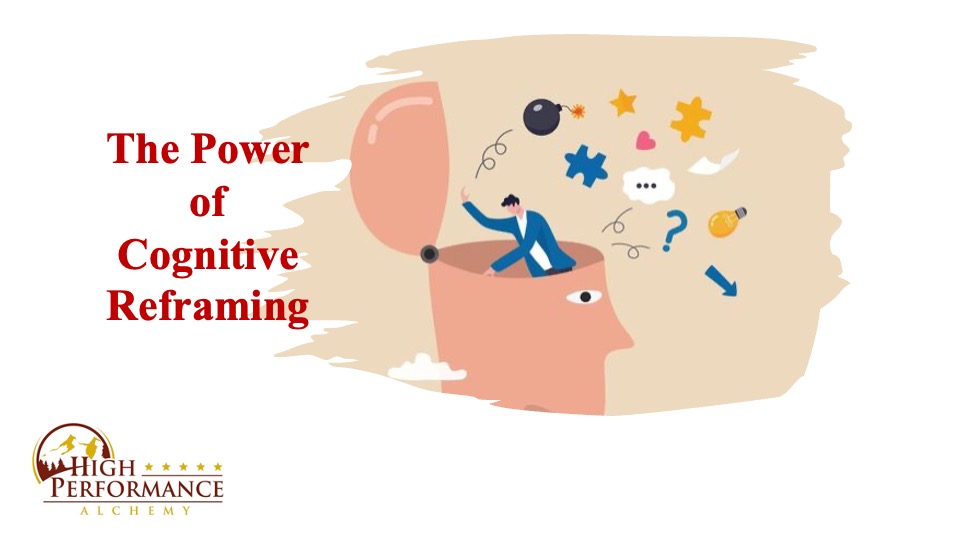
This is where cognitive reframing becomes a game-changer. If you have never heard of it before, cognitive reframing may be the most powerful mental shift you can make to navigate uncertainty with a steady, calm mind.

Imagine this: You are stuck in traffic, already running late for an important meeting. As your mind races, thoughts like, “Why does this always happen to me?” and “I’m going to ruin my entire day!” flood your brain. Stress builds, your heartbeat quickens and frustration takes over. Now, what if, instead of seeing this situation as a catastrophe, you reframed it? Instead of stressing out, you choose to see it as an opportunity. You might think, “Okay, this is unexpected, but maybe I can use this time to review my key points for the meeting.” Or, “This could be a great moment to catch up on that podcast I have been putting off.” You can even call ahead and inform them of your delay, so that you can focus on what’s within your control.

That shift in mindset, from helplessness to control, is cognitive reframing. It’s the process of consciously changing the way you interpret a situation to alter your emotional response. The event remains the same, but how you perceive it directly impacts whether you spiral into anxiety or remain calm.

Your brain is wired to react to perceived threats through the fight-or-flight response. This ancient survival mechanism was crucial for early humans facing life-threatening situations, like wild animals. However, in today’s world, it often kicks in during moments of stress, such as a tight deadline at work or a difficult conversation with a colleague. This stress response releases cortisol and adrenaline, which can overwhelm your system, making it difficult to think clearly or make rational decisions.

Cognitive reframing works by interrupting this automatic, panic-driven response. Instead of interpreting every stressful situation as a threat, you can consciously choose to assign a different meaning. Research in cognitive psychology shows that the way we frame our experiences directly impacts our emotional well-being. By shifting your perspective, you can reduce stress, increase resilience and regain a sense of control—even when external chaos remains unchanged.

Your brain has something called neuroplasticity, which means it has the ability to form new neural pathways. By practicing cognitive reframing, you train your brain to interpret challenges in healthier ways. Over time, this rewires your brain to respond with clarity, rather than panic, in stressful situations.

The more you practice reframing, the more natural it becomes. It’s like building muscle in your mind—each time you choose a more constructive interpretation of a stressful event, your brain strengthens that pathway, making it easier to stay calm next time.

It’s easy to read about cognitive reframing in theory, but how do you apply it in real-time when stress is mounting? Here’s how:

  1. Pause and Reflect:
    The next time you feel overwhelmed, take a moment to pause. Ask yourself, “What’s another way to view this situation?” For instance, instead of thinking, “This is the worst day ever,” try reframing it as, “This is a tough moment, but I have handled worse before.”
  2. Assess the Impact of Your Thoughts:
    Ask yourself whether your thoughts are helping or hurting you. Are your thoughts making you more anxious? If so, actively choose a perspective that keeps you grounded. For example, if your project at work falls apart last minute, you might initially feel frustration or panic. Reframing allows you to see it as an opportunity to problem-solve, learn adaptability and build resilience.
  3. Apply Compassion:
    We are often kinder and more rational when advising others. Use that same compassion on yourself. For example, if a close friend were going through a tough time, you’d probably remind them that they have faced challenges before and come out stronger. Why not offer that same advice to yourself in moments of stress?

Cognitive reframing is a skill that improves with practice. Like any muscle, it gets stronger the more you use it. The more you consciously shift your perspective, the easier it becomes to remain calm in the face of chaos.

One effective way to train your mind is through journaling. Set aside time each day to write down a stressful situation and actively reframe it. This exercise trains your brain to look for alternative, more positive perspectives, even in challenging moments. Over time, the process becomes more intuitive and your brain starts naturally interpreting stressful events with greater resilience.

Chaos will always be a part of life. The world is unpredictable and external circumstances often feel beyond our control. But how you engage with that chaos is entirely within your power. Cognitive reframing isn’t about pretending everything is fine or dismissing your emotions. It’s about choosing a perspective that serves you, rather than letting your emotions control you. It’s about regaining your peace, no matter what is happening around you.

The next time life throws you into uncertainty, remember this: you have the ability to decide how you will respond. You can choose to drown in the stress or you can rise above it with clarity and calm.

So, what’s one situation in your life that could use a little reframing right now?
If you are looking for personalized guidance on managing stress, increasing resilience or navigating leadership challenges, we are here to help. 

and let’s work together to bring clarity and calm into your life.

Remember, the power to reshape your response to stress is within your control—embrace cognitive reframing and transform chaos into clarity.

#CognitiveReframing #StressManagement #EmotionalResilience #LeadershipSkills #Mindfulness #PersonalDevelopment #CareerGrowth #StressRelief #EmotionalIntelligence #ChaosManagement #ProductivityTips #LifeCoaching #PositiveThinking #Neuroplasticity #SelfCare #OvercomingStress #PersonalGrowth #MentalHealth #CareerAdvice #MindsetMatters #ResilienceBuilding

When Workplace Manipulation Threatens Your Mental Health and Career

When Workplace Manipulation Threatens Your Mental Health and Career

The workplace is often compared to a chessboard, where every move can impact your growth, relationships and peace of mind. However, not every player follows the rules. Tricky or manipulative situations can creep into your professional life, leaving you feeling unsettled and questioning your decisions. Manipulation, if unchecked, don’t just hijack your mental health—they can derail your career prospects.

Let’s explore how these subtle dynamics work and more importantly, how to handle manipulation effectively.

Workplace manipulation often starts subtly. It could be a colleague who takes credit for your work, a manager who gaslights your concerns or a team member who subtly sabotages you while appearing supportive. Over time, these actions can chip away at your confidence and clarity.

Here’s the tricky part: manipulative behaviors often masquerade as normal workplace interactions. A seemingly casual “joke” might actually be undermining your credibility. A friendly “favour” may come with strings attached, locking you into a dynamic where you owe someone something without realizing it.

The result? You start questioning your abilities and second-guessing your decisions. This mental strain can lead to anxiety, stress and even burnout, making it harder to focus on your actual goals.

Manipulative tactics in the workplace thrive on emotional vulnerability. They target your need for validation, your fear of conflict or your desire to belong. Over time, these interactions create a toxic loop:

  • Self-Doubt: Constant manipulation makes you question your worth and competence.
  • Chronic Stress: Navigating these situations drains your emotional energy, leaving you exhausted.
  • Isolation: You may feel isolated as trust erodes between you and your colleagues.
  • Impostor Syndrome: Over time, you might start believing you are not capable, even when evidence suggests otherwise.

This doesn’t just affect your performance—it affects your ability to dream big and pursue meaningful career opportunities. When you are caught in the web of manipulation, your mental bandwidth is consumed by damage control instead of growth.

Manipulation can be insidious in how it undermines your career. For example:

  • Missed Opportunities: If someone takes credit for your work, you miss the recognition you deserve, which can impact promotions or new roles.
  • Damaged Reputation: Subtle rumors or miscommunications might paint an inaccurate picture of your capabilities.
  • Stagnation: Spending time dealing with manipulative behaviors means less time focusing on innovation, leadership or strategic growth.
  • Loss of Confidence: When manipulation erodes your self-belief, you may stop advocating for yourself in important conversations like performance reviews or new projects.

It’s a double-edged sword. While you are fighting to stay emotionally balanced, your career progression can feel like it’s on hold.

The good news? You can regain control. It starts with awareness and action.

  • Recognize the Behavior: Manipulation thrives in ambiguity. Pay attention to red flags—are you constantly second-guessing interactions with a particular colleague? Are you feeling drained after conversations with certain people?
  • Set Boundaries: Be clear about what’s acceptable and what’s not. For example, if someone takes credit for your work, gently but firmly correct the narrative in a group setting: “I’m glad the team values this idea—it was exciting to work on this project.”
  • Document Everything: If manipulation is impacting your work, keep a record of relevant interactions. Written evidence can be invaluable if you need to escalate concerns.
  • Build a Support Network: Seek out mentors, trusted colleagues or even external professional networks to provide perspective and advice.
  • Strengthen Emotional Resilience: Invest in practices that help you stay grounded, whether it’s mindfulness, therapy or even just regular exercise. When you are emotionally resilient, manipulative tactics lose their grip.
  • Know When to Escalate: If the behavior persists, don’t hesitate to involve HR or a higher authority. Use documented instances to back up your claims and remain factual, not emotional, in these discussions.

Manipulative workplace dynamics can feel overwhelming, but they don’t have to define your professional journey. By staying aware, setting boundaries and protecting your mental health, you can navigate these tricky situations without letting them derail your success.

Your career isn’t just about what you achieve—it’s also about how you feel along the way. Protect your peace, assert your value and move forward with confidence. Because no amount of manipulation can hold back someone who’s clear about their worth.

Don’t let manipulation or toxicity steal your potential—stand up, set boundaries and take charge of your mental health and career today. The sooner you act, the sooner you reclaim your path to success.

If you are experiencing manipulation at work, don’t hesitate to reach out for guidance on how to protect your career and well-being.

for personalized advice and strategies to reclaim your professional life. Let’s build a path to success together!

#WorkplaceManipulation #MentalHealthAtWork #CareerGrowth #EmployeeWellbeing #LeadershipSkills #CareerSuccess #Resilience #EmotionalIntelligence #WorkplaceStress #HealthyWorkplace #SelfAdvocacy #PersonalGrowth #BoundariesAtWork #ImpostorSyndrome #WorkplaceCulture #StressManagement #ToxicWorkplace #CareerDevelopment #ProfessionalGrowth