

Most people think career crises arrive loudly.
A meeting invite.
A calendar block with HR.
A sentence that begins with “This wasn’t an easy decision…”
But the truth is more unsettling.
Career crises usually begin long before the event — quietly, invisibly, inside your own thinking.
Not when layoffs happen.
Not when markets crash.
But when you stop questioning your assumptions.
The Illusion of “I’m Fine”
Ask professionals how they’re doing, and you’ll hear variations of the same answer:
“I’m fine.”
“Busy, but fine.”
“Things are okay.”
Yet beneath that surface calm, something else often exists:
- A low-grade anxiety you can’t fully explain
- A sense that your role feels narrower than it used to
- A hesitation to imagine the future too clearly
This isn’t dissatisfaction.
It’s disorientation.
And in times of widespread layoffs, disorientation is more dangerous than fear — because it delays action.
Layoffs Don’t Just Remove Jobs — They Expose Assumptions
When layoffs occur, people tend to ask tactical questions:
- How many people?
- Which departments?
- What severance?
But the more important questions are psychological:
- Why did I believe I had time?
- Why did I think performance alone was enough?
- Why did I stop actively shaping my career?
Layoffs don’t suddenly destabilise careers.
They reveal how static careers had already become.
That’s the uncomfortable part no one likes to admit.
The Career You’re In vs. The Career You’re Running
Here’s a distinction most professionals have never consciously made:
There is the career you are in —
And the career you are running.
Being in a career means:
- Responding to expectations
- Adapting to structures others designed
- Measuring success through external validation
Running your career means:
- Making intentional choices
- Understanding how you create value
- Preparing for change before it demands you do
Layoffs tend to hurt the first group far more than the second.
Not because they’re less capable — but because they surrendered authorship.
A Short Quiz: How Vulnerable Is Your Career Right Now?
Pause here. Answer honestly. No overthinking.
1. If your role disappeared tomorrow, would you immediately know your next strategic move — or would you need time “to think”?
2. Do you define your professional value mainly by your current title, or by capabilities that travel with you?
3. When industry news shifts, do you feel curious — or quietly threatened?
4. Could you clearly explain why you are valuable beyond your job description?
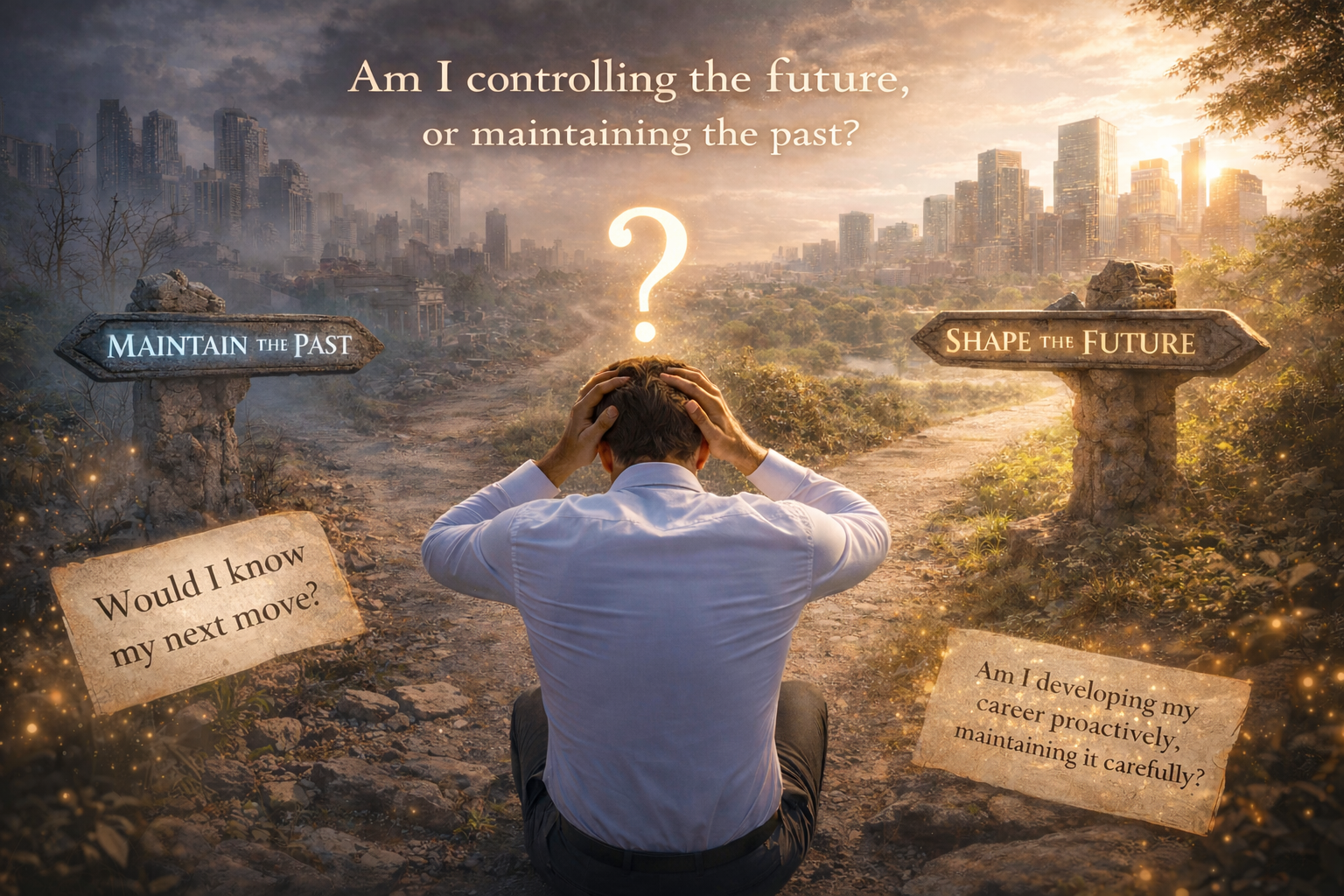
5. Are you developing your career proactively, or maintaining it carefully?
Now reflect — not on the answers themselves, but on how easy or uncomfortable they were.
Discomfort here is information.
Why So Many Intelligent People Drift Instead of Decide
Humans are remarkably good at adapting to slow change.
That’s usually a strength.
But in careers, it becomes a liability.
When change is gradual:
- You normalise dissatisfaction
- You postpone reflection
- You mistake familiarity for safety
Layoffs feel sudden only because internal recalibration never happened.
RRR exists to make that recalibration intentional instead of forced.
The Hidden Cost of Waiting for Clarity
Many professionals say:
“I just need a bit more clarity before I act.”
This sounds responsible.
It’s usually avoidance.
Clarity doesn’t arrive before action — it emerges from it.
Waiting for clarity in an unstable environment is like waiting for still water in a storm.
What you actually need is:
- Internal stability
- Decision confidence
- A mind trained to operate without certainty
That’s not a personality trait.
It’s a trained capacity.
RRR: A Different Kind of Career Intervention
RRR — Reset. Reclaim. Rewire is not designed to help you cope with layoffs.
It’s designed to help you outgrow dependence on circumstances altogether.
This is an important distinction.
RRR is a 12-week neuroscience-based coaching program that works at the level most career advice never reaches:
- How your brain responds to uncertainty
- How identity attaches to roles
- How decision-making collapses under threat
Rather than adding more tactics, RRR removes internal friction.
Reset: Interrupting the Mental Autopilot
Most professionals are not consciously choosing their career behaviour — they are repeating it.
Reset is about interruption.
During this phase, participants learn to:
- Identify stress-driven patterns
- Separate signal from noise
- Pause automatic reactions
This creates something rare in modern careers:
space to think clearly while the environment is unclear.
Reset isn’t rest.
It’s recalibration.
Reclaim: Redefining Where Your Security Comes From
Security is often misunderstood.
Many professionals believe security comes from:
- Being needed
- Being liked
- Being retained
In reality, security comes from:
- Knowing how you create value
- Being able to reposition that value
- Trusting your ability to adapt
Reclaiming means shifting the source of confidence inward — away from employers, structures, and titles.
This is where fear starts to loosen its grip.
Rewire: Training the Brain for a World Without Guarantees
Your brain was shaped in a world that rewarded predictability.
That world no longer exists.
Rewire focuses on helping professionals:
- Make decisions without full information
- Respond to change without panic
- Build confidence that isn’t conditional
This is done through neuroscience-backed practices that strengthen cognitive flexibility and emotional regulation.
The outcome isn’t boldness.
It’s steadiness.
The Question Most People Avoid Asking
Here’s the question that quietly defines your career trajectory:
“Am I actively shaping my future — or maintaining a version of my past?”
Maintenance feels safer.
Shaping feels risky.
But in unstable environments, maintenance is often the greater risk.
RRR exists for professionals who are ready to confront that reality — without drama, panic, or denial.
What Happens When You Stop Waiting
Professionals who go through RRR often report something unexpected.
Not just clarity.
Not just confidence.
But relief.
Relief from:
- Constant background anxiety
- The feeling of being “one decision away” from instability
- The pressure to appear certain while feeling unsure
When internal alignment returns, external uncertainty becomes manageable.
Revisit the Quiz — One More Time
Look back at the earlier questions.
Notice if your perspective has shifted even slightly.
That shift — however small — is evidence of something important:
You don’t need to wait for change to act.
You need a framework that allows you to act before change forces you to.
Reset. Reclaim. Rewire.
RRR is a 12-week neuroscience-based coaching program for professionals who want to stop drifting, stop waiting, and start engaging their careers with intention — even in uncertain times.
Learn more here:
👉 https://www.highperformancealchemy.com/rrr/
Layoffs don’t end careers.
Unexamined assumptions do.
The moment you question how you’ve been operating is the moment your career stops being fragile — and starts becoming intentional.