

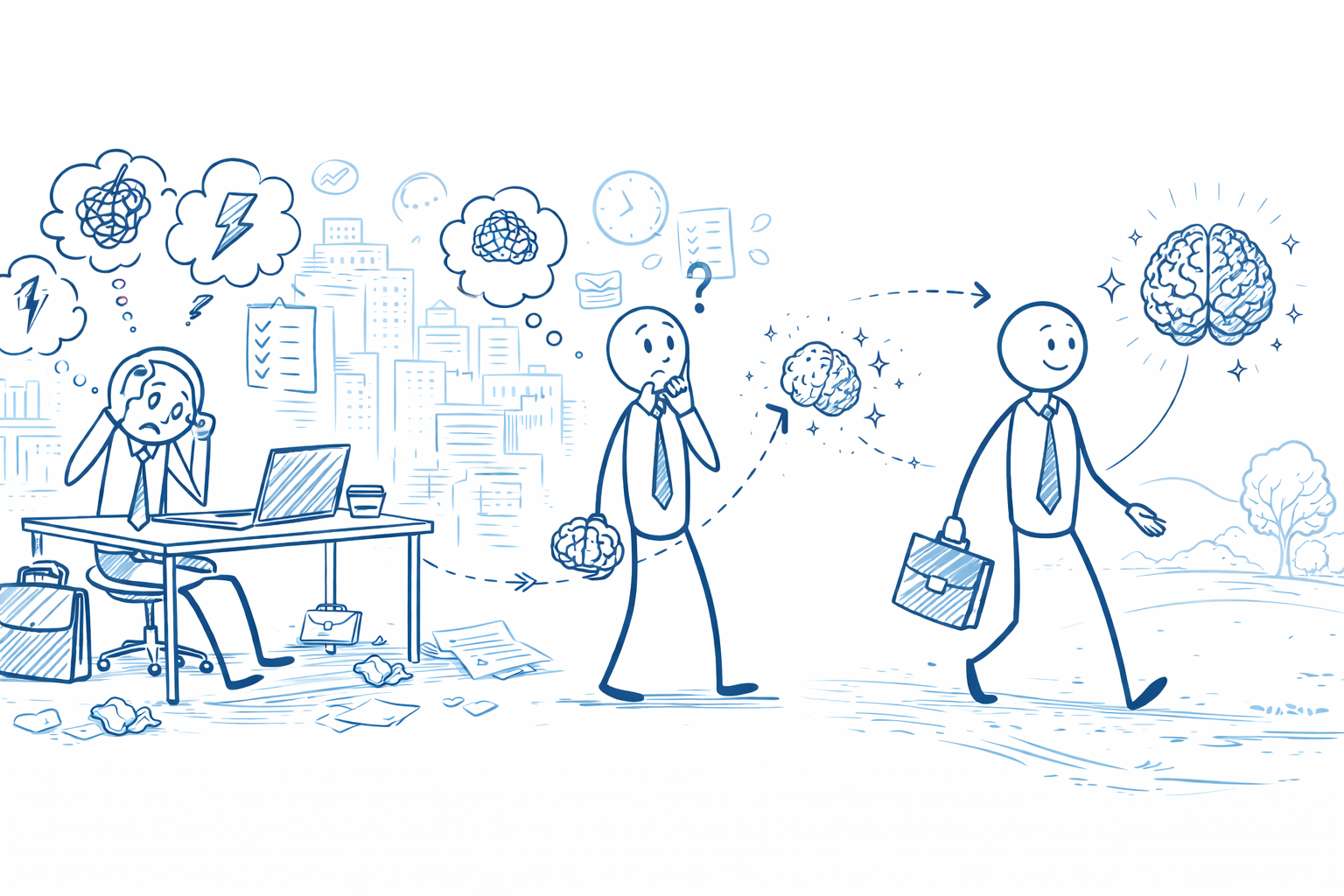
There’s a particular kind of stress that doesn’t announce itself loudly.
It doesn’t always look like panic.
It doesn’t necessarily stop you from performing.
In fact, from the outside, life may look perfectly “on track.”
Good role.
Decent pay.
Responsibilities that suggest seniority.
Yet somewhere underneath, there’s a steady mental hum:
What if this role disappears?
What if I’m replaced by someone cheaper, younger, faster?
What if the market turns again?
What if all this effort still isn’t enough?
For many Indian professionals—especially those in mid to senior roles, whether in India or the US—this hum has become part of daily life.
So common that it’s rarely questioned.
Not Burnout. Not Laziness. Something Else.
This isn’t about motivation.
It isn’t about ambition.
And it isn’t a personal failing.
It’s what happens when the brain spends long periods operating under uncertainty.
Layoffs.
Reorgs.
Visa pressure.
Performance reviews that feel opaque.
Markets that reward today and punish tomorrow.
Over time, the brain adapts—not by relaxing, but by staying alert.
And the tricky part?
This kind of stress doesn’t always feel like stress.
It often shows up as:
- constant background thinking
- difficulty switching off after work
- a sense of being “on” even during rest
- over-preparing, over-monitoring, over-correcting
Most professionals interpret this as being responsible, driven or realistic.
Few pause to ask a quieter question:
What is this doing to my brain?
The Invisible Load Nobody Tracks
Careers are tracked meticulously.
KPIs.
Skills.
Certifications.
Performance feedback.
But the internal load—the cognitive and neurological cost of carrying uncertainty for years—is almost never measured.
And without measurement, most people default to assumptions:
“This is just the phase I’m in.”
“Everyone feels this way.”
“Once I reach the next level, it will settle.”
Sometimes it does.
Often, it doesn’t.
Which is why we started with a simpler place—not solutions, not programs, not labels—but awareness.
A Simple Self-Check (No Interpretation Required)
We created a short, neuroscience-informed self-assessment called:
How Stressed Is Your Brain?
It’s not a personality test.
Not a diagnosis.
Not a productivity scorecard.
It’s a way to observe how your brain is currently responding to sustained pressure, uncertainty and cognitive load.
No answers are “good” or “bad.”
There’s nothing to pass or fail.
Just a snapshot.
👉 You can explore it here:
https://www.highperformancealchemy.com/rrr/
Most people finish it in under two minutes.
What happens after is more interesting.
What the Results Tend to Reveal
For many mid- to senior-level professionals, the results don’t feel dramatic.
They feel… clarifying.
They put language to things that were previously vague.
They explain patterns that didn’t quite make sense.
They separate external pressure from internal strain.
And for some, the results quietly raise another question:
If this is where my brain is now…
what happens if I keep going the same way for another 2–3 years?
This Is Where Choice Appears
At this point, people tend to diverge.
Some take the insight and simply become more conscious.
Some adjust expectations, boundaries or pace on their own.
Some realize they have been compensating with effort instead of recovery.
And some notice something else:
That their brain has been in a high-alert pattern for so long, it doesn’t know how to exit it anymore—even when circumstances improve.
This is usually when curiosity deepens.
Not panic.
Not urgency.
Just a quiet recognition:
Maybe this isn’t something I should brute-force alone.
Why We Built a 12-Week Program (And Why It’s Not for Everyone)
Our 12-week neuroscience-based coaching exists for people who:
- don’t want motivational hype
- aren’t looking for therapy
- and don’t need more “push”
It’s for those who want to retrain how their brain responds to pressure, uncertainty and responsibility—so performance doesn’t require constant internal strain.
But that decision shouldn’t be rushed.
Which is why the quiz comes first.
No funnel pressure.
No countdown timers.
No dramatic promises.
Just information.
Because the right time to act isn’t when someone tells you to.
It’s when you see clearly enough to decide.
One Last Thought
Job markets will continue to shift.
Roles will continue to change.
External certainty is increasingly rare.
What can change is how much invisible load your brain carries while navigating it all.
If you are curious where you stand right now, start there.
👉 How Stressed Is Your Brain?
https://www.highperformancealchemy.com/rrr/
Everything else can wait.
You Have Information Now. What You Do With It Is Up to You.
If you have completed the brain stress assessment, you now have something most professionals never pause to gather: visibility.
Not a label.
Not a verdict.
Just information.
For some, that awareness alone is enough.
They recalibrate, adjust quietly and move forward differently.
For others, the results surface a longer pattern.
That their brain has been operating under sustained pressure for years.
That coping has quietly replaced recovery.
That performance has continued — but at a higher internal cost.
Neither response is right or wrong.
A Question Worth Sitting With
If external uncertainty remains — the market, the role, the expectations — what would you want to change internally?
Not your ambition.
Not your work ethic.
But how your brain:
- processes pressure
- recovers from demand
- responds to uncertainty
- sustains clarity without constant vigilance
For many professionals, this is the first time that question even appears.
Why This Work Exists
The 12-week neuroscience-based coaching we offer is for those who decide — in their own time — that awareness isn’t the end point.
It’s the beginning.
The work isn’t about pushing harder.
It isn’t about fixing something “broken.”
And it isn’t about becoming someone else.
It’s about retraining how the brain operates under real-world conditions:
responsibility, ambiguity, expectations and change.
Some people arrive at that decision quickly.
Some take months.
Some never feel the need.
All of those paths are valid.
No Urgency. Just Timing.
There is no pressure to decide today.
No requirement to act immediately.
But there is one quiet truth worth acknowledging:
Brains rarely reset on insight alone.
Change happens when understanding is followed by intention.
If, after sitting with your results, you feel curious about what intentional retraining could look like — that’s when this work may be relevant.
If not, you still leave with clarity.
For now, let the information settle.
Everything else can wait.