

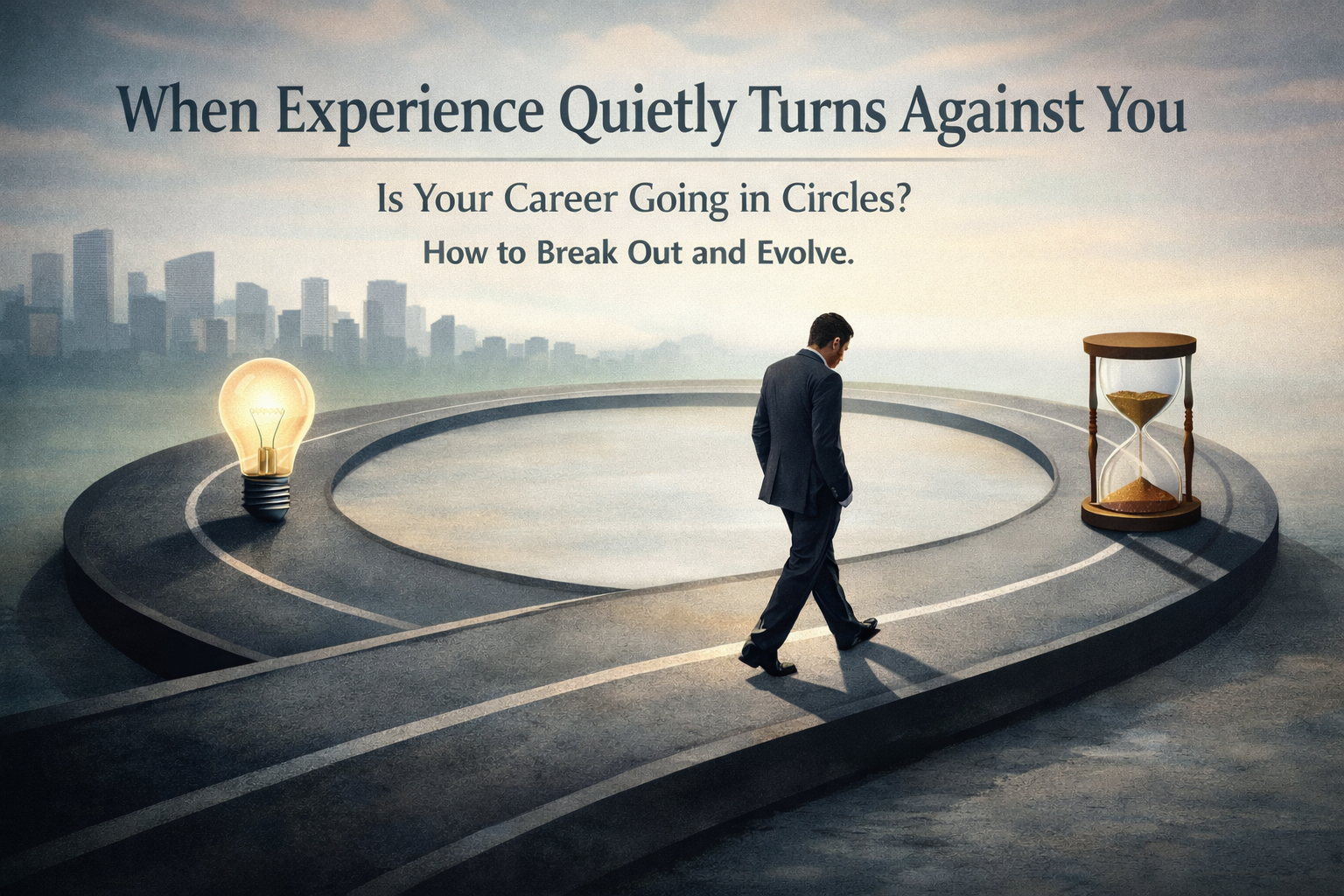
(And why many accomplished professionals don’t notice it until it’s late)
After about 15–20 years in a career, something subtle often begins to happen.
Not failure.
Not burnout.
Something quieter.
Experience sometimes starts repeating itself instead of evolving.
If you have been in your profession for fifteen or twenty years, you have probably already proven yourself many times over.
You have handled complex situations.
You have made difficult decisions.
You have built credibility.
When things become complicated, people often turn to you.
Your calendar is full.
Your responsibilities are significant.
Your judgement carries weight.
From the outside, everything appears exactly as it should.
Your career is progressing.
Your influence is growing.
Your work remains demanding.
But let me ask you something.
Have you ever noticed a moment when your work started feeling… familiar?
Not easier.
Just familiar.
Problems begin to resemble situations you have handled before.
Decisions come faster because you recognise the patterns.
Situations that once required deep thinking now feel almost instinctive.
At first, this feels like mastery.
After all, experience is supposed to make things easier.
But there is a subtle shift that sometimes happens in long careers — and most professionals never notice it while it is happening.
Experience sharpens your judgement.
But it can also quietly narrow the questions you ask.
Before reading further, try this quick diagnostic
Take a moment and answer these honestly.
Not as a leader.
Not as someone responsible for outcomes.
Just as a professional reflecting on your own growth.
1. When was the last time your thinking was seriously challenged?
Not your workload.
Your thinking.
When did a conversation, idea or experience force you to rethink how you approach leadership, strategy or decision-making?
If you cannot easily recall such a moment recently, that may be worth noticing.
Earlier in our careers this happens constantly.
Later in our careers it becomes surprisingly rare.
2. Are the problems you solve today genuinely new?
Or are they mostly variations of problems you solved years ago?
Experience helps you recognise patterns quickly.
But when everything begins to feel familiar, it may not mean the work has become easier.
It may simply mean your environment is no longer stretching your thinking.
3. Who regularly questions your assumptions?
Earlier in your career, feedback was everywhere.
Managers corrected you.
Peers challenged your ideas.
Mentors pointed out blind spots.
But something changes as professionals become more senior.
Fewer people question how you think.
Not necessarily because they agree.
But because hierarchy quietly discourages disagreement.
Over time this creates something many experienced professionals never notice:
A leadership echo chamber.
4. When did curiosity last replace certainty?
Think back to earlier stages of your career.
Curiosity probably drove much of your growth.
You asked questions.
You explored unfamiliar ideas.
You sought perspectives different from your own.
Success changes that dynamic.
Confidence gradually replaces curiosity.
Confidence helps you lead.
But curiosity is what keeps you evolving.
5. Do you still feel intellectually stretched by your work?
Or mostly responsible for it?
This is a subtle but important difference.
At some point in many careers, professionals stop being stretched intellectually and start becoming responsible for outcomes instead.
They guide others.
They make decisions.
They carry accountability.
All of this matters.
But it also means their own thinking is no longer being pushed into unfamiliar territory.
And when that happens, growth begins slowing — quietly.
A brief reflection
Consider the five questions above.
How many made you pause?
0–1 questions
Your thinking is probably still being stretched regularly.
2–3 questions
Something may have quietly shifted in how your work challenges you.
4–5 questions
You may be experiencing the pattern this article describes.
Not failure.
Not burnout.
Simply a stage where experience has begun operating on autopilot.
What the most adaptive professionals do differently
Some professionals notice this shift earlier than others.
And when they do, they make a deliberate decision.
They step outside their own thinking.
Not because they doubt their expertise.
But because they understand something many professionals realise too late:
Experience occasionally needs recalibration.
They pause.
They examine the patterns shaping their decisions.
They question assumptions that once felt permanent.
And in doing so, they reopen the same intellectual expansion that drove their earlier success.
The question most professionals rarely ask themselves
Here is the question that sits quietly underneath everything you have just read.
It is not always comfortable.
But it matters.
Are you still evolving at the same pace as the world around you?
Not working harder.
Not managing more responsibility.
Evolving.
Because the difference between long-term influence and quiet professional stagnation often comes down to one thing:
Whether you examine your thinking before circumstances force you to.
If this reflection felt familiar
If two or more of the earlier questions made you pause, it may be worth taking a closer look at how your thinking is evolving.
That is exactly why the RRR framework — Reset · Reclaim · Rewire — was created.
It helps experienced professionals step back and examine the thinking patterns, pressures and assumptions that quietly shape how they lead, decide and evolve.
You can explore it here:
https://www.highperformancealchemy.com/rrr
Sometimes the most important shift in a career does not come from doing more.
It comes from seeing your own thinking differently.
A final reflection
I’m curious about something.
If you have been in your field for 15+ years, when was the last time your thinking was genuinely stretched by your work?
Not your workload.
Your thinking.