

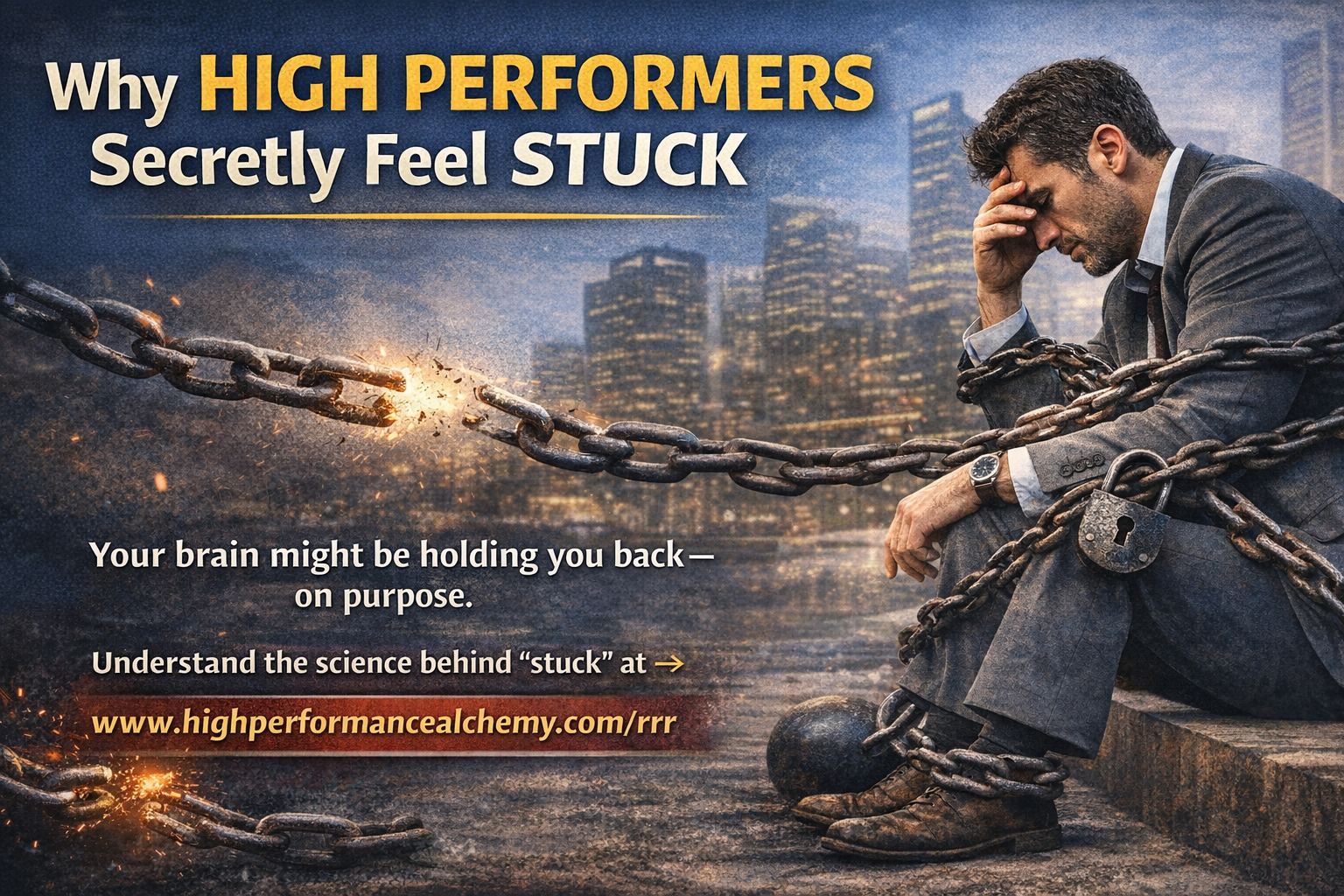
Have you ever had the unsettling thought:
“I know I’m capable of more… so why am I not moving?”
You’re not lazy.
You’re not ungrateful.
You’re not incapable.
And here’s the shocking part:
Your brain might actually be working against your progress — on purpose.
Feeling stuck isn’t a personality flaw. It’s a neurological pattern.
Let’s unpack what’s really happening when you feel frozen in your career, relationships or life — and why pushing harder often makes it worse.
The Silent Epidemic of High Performers
A 2023 global workplace report found that over 60% of mid-career professionals feel disengaged or “stagnant”, even when performing well externally.
Read that again.
Not failing.
Not struggling visibly.
Just… stuck.
You show up. You deliver. You’re respected.
And yet inside?
Flat. Hesitant. Paralyzed about the next move.
This is more common among high performers than you think.
Because the very brain that helped you succeed can become the one that keeps you frozen.
What “Feeling Stuck” Really Means
When clients describe feeling stuck, they rarely use dramatic language.
They say things like:
- “I know I should apply, but I haven’t.”
- “I want to change roles, but something stops me.”
- “I’m exhausted thinking about making a move.”
- “I’m waiting for clarity.”
Here’s the truth:
Stuck is not confusion. It’s a freeze response.
And freeze is biological.
What Happens in the Brain When You Feel Stuck
Let’s simplify the neuroscience.
Your brain has three major systems that influence behavior:
- Prefrontal Cortex (Thinking Brain)
Planning, strategy, vision, long-term decisions. - Limbic System (Emotional Brain)
Threat detection, memory, emotional tagging. - Autonomic Nervous System (Survival System)
Fight. Flight. Freeze.
When your brain perceives uncertainty or potential loss (status, identity, income, belonging), it doesn’t analyze opportunity.
It scans for danger.
Even positive change can trigger this.
Promotion?
Threat to competence.
Career switch?
Threat to identity.
Entrepreneurship?
Threat to stability.
When perceived threat increases, the amygdala activates. Stress hormones rise. Blood flow reduces to the prefrontal cortex.
Translation?
Your strategic thinking literally goes offline.
You don’t become incapable.
You become biologically protective.
And one of the brain’s favorite protection strategies?
Freeze.
The Freeze Response: The Most Misunderstood Reaction
Fight looks like aggression.
Flight looks like quitting.
Freeze looks like:
- Overthinking
- Endless researching
- Waiting for the “right time”
- Staying in a tolerable situation
- Procrastinating on important action
It feels passive.
But neurologically, it’s highly active survival.
A shocking research insight:
Studies on chronic workplace stress show prolonged uncertainty can keep the nervous system in low-grade freeze for months or years — leading to reduced risk tolerance and diminished initiative.
Not because someone lacks ambition.
Because their brain is conserving safety.
Why High Achievers Get Stuck Harder
Ironically, the more you have built, the scarier movement becomes.
You have:
- Reputation
- Salary stability
- Social proof
- Identity as “the capable one”
The cost of visible failure feels amplified.
So your brain calculates:
“Better the known discomfort than unknown risk.”
You don’t consciously think this.
Your nervous system does.
Case Study 1: “Arjun” – The Promotion He Wouldn’t Apply For
(Shared by one of our clients, name changed)
Arjun was a senior manager in a multinational firm.
Consistently high performer.
Strong peer relationships.
Leadership-ready.
His mentor encouraged him to apply for a Director role.
He didn’t.
Instead, he:
- Said he needed “more experience”
- Took on additional responsibilities without title change
- Spent 8 months preparing documents he never submitted
When explored deeper, Arjun admitted:
“If I apply and don’t get it, people will see I’m not ready.”
The logical brain knew he was qualified.
But his emotional brain associated visibility with risk.
Past memory: In early career, he once presented and was publicly criticized.
His brain encoded visibility = danger.
So it froze him.
Once he learned to regulate that threat response and separate past memory from present reality, he applied within 6 weeks.
He got the role.
The capability was always there.
The nervous system needed recalibration.
The Brain’s Bias Toward Predictability
Your brain prefers predictable pain over unpredictable possibility.
This is called uncertainty intolerance.
Neuroscientific studies show the brain can interpret ambiguity as more stressful than confirmed negative outcomes.
That means:
Not knowing if you’ll succeed
Feels worse than knowing you’ll stay stagnant
So staying feels safer.
Even when it’s slowly draining you.
Signs You’re in a Career Freeze (Not Just “Unmotivated”)
- You consume growth content but don’t act.
- You wait for perfect clarity before making decisions.
- You fantasize about change but feel tired thinking about execution.
- You delay conversations that could move you forward.
- You feel capable, yet strangely passive.
This is not laziness.
It’s protection.
Case Study 2: “Meera” – The Golden Handcuffs
(Shared by one of our clients, name changed)
Meera was earning well in a stable corporate role.
But she felt deeply unfulfilled.
She had an opportunity to transition into strategy — something aligned with her strengths.
She stalled for 18 months.
Her words:
“What if I leave comfort and can’t recreate this income?”
Her nervous system equated change with loss of security.
Even though data showed she had strong employability.
Her brain was prioritizing short-term safety over long-term fulfillment.
Through structured nervous system work and cognitive reframing, she ran a 3-month experiment internally instead of resigning immediately.
That reduced perceived threat.
Gradual exposure reduced freeze.
She transitioned successfully.
The key wasn’t motivation.
It was safety.
The Dopamine Myth
Many people assume:
“I just need more motivation.”
But motivation relies heavily on dopamine — the reward neurotransmitter.
Here’s the problem:
Chronic stress reduces dopamine sensitivity.
When you’re in prolonged stress or freeze, your brain doesn’t anticipate reward strongly.
So even exciting goals feel flat.
You’re not uninspired.
Your reward system is dampened.
This is why vision boards don’t work when the nervous system feels unsafe.
Identity: The Hidden Anchor
Another reason you feel stuck?
Identity rigidity.
If your identity is:
- “The reliable one”
- “The expert”
- “The stable provider”
- “The safe player”
Any change threatens that narrative.
Your brain defends identity as strongly as physical safety.
Because belonging equals survival.
Case Study 3: “Rohan” – The Invisible Ceiling
(Shared by one of our clients, name changed)
Rohan had plateaued at mid-management for 5 years.
Not because of performance.
But because he avoided visibility.
He declined speaking opportunities.
He avoided networking.
He stayed in execution roles.
When asked why, he said:
“I’m not the kind of person who pushes myself forward.”
That sentence revealed identity freeze.
Past experience: Growing up, being outspoken led to social rejection.
His nervous system coded:
Visibility = social threat.
Once he worked on safe visibility — small internal presentations, low-risk leadership settings — the freeze response reduced.
Within a year, he moved into a cross-functional leadership role.
He didn’t change personality.
He changed nervous system interpretation.
The Cost of Staying Stuck
Here’s the uncomfortable truth.
Chronic stagnation:
- Lowers confidence gradually
- Reduces cognitive flexibility
- Increases learned helplessness
- Trains the brain to avoid risk
The longer you stay frozen, the more normal it feels.
And that’s dangerous.
Because what starts as “just a phase” becomes identity.
So How Do You Break the Stuck Cycle?
Not with hustle.
Not with shame.
Not with forcing.
You need three things:
1. Regulation Before Strategy
Calm the nervous system first.
Breathing, somatic grounding, reducing perceived threat.
A calm brain thinks clearly.
2. Micro-Exposure to Risk
Don’t leap.
Experiment.
Small visible actions retrain the brain that movement ≠ danger.
3. Identity Expansion
Shift from:
“I am someone who avoids risk.”
To:
“I am someone who can learn new environments safely.”
Identity flexibility reduces freeze dramatically.
A Conversational Truth
If you’re reading this and thinking:
“This sounds like me.”
Let me tell you something directly.
You are not behind.
You are not broken.
You are likely neurologically protecting yourself from something your brain once learned was unsafe.
And protection is intelligent.
But long-term freeze is expensive.
The world is shifting rapidly.
Leadership expectations are evolving.
Career paths are nonlinear.
Stability now comes from adaptability — not position.
If your nervous system is locked in safety mode, growth feels threatening.
But here’s the powerful part:
The brain is plastic.
It rewires.
Patterns that kept you safe before do not have to run your future.
The Question That Matters
Ask yourself:
If I removed fear of loss, rejection or uncertainty…
What would I attempt?
Your answer isn’t delusion.
It’s information.
Underneath stuckness is often untapped expansion.
Final Thought
If you’ve seen yourself in these patterns — the hesitation, the delay, the silent plateau — understand this:
You are not lacking ambition.
You are not incapable of growth.
You are not “too late.”
You may simply be operating from a brain that is prioritizing protection over expansion.
And while protection once served you, staying frozen now comes at a cost — to your confidence, your potential and your trajectory.
The shift from stuck to strategic does not begin with pushing harder.
It begins with resetting the nervous system, reclaiming agency and rewiring the patterns that keep you safe but small.
If you’re ready to move from survival mode to deliberate growth, explore how you can Reset, Reclaim and Rewire here:
👉 https://www.highperformancealchemy.com/rrr/
Your next level may not require more effort.
It may require a safer, stronger internal foundation.