

Why Mid–Senior Leaders Stall — and How to Break Through
The Paradox of Success
At mid to senior level, leadership becomes paradoxical.
You have earned your position. You have delivered results. You are trusted. On paper, everything points upward.
And yet—something shifts.
Decisions feel heavier. Time feels tighter. The margin for error disappears. What once felt like momentum now feels like pressure.
This is the leadership plateau.
It’s not burnout. It’s not incompetence. It’s something far more subtle—and far more dangerous.
It’s the moment where capability continues to rise… but clarity does not.
The Pattern No One Talks About
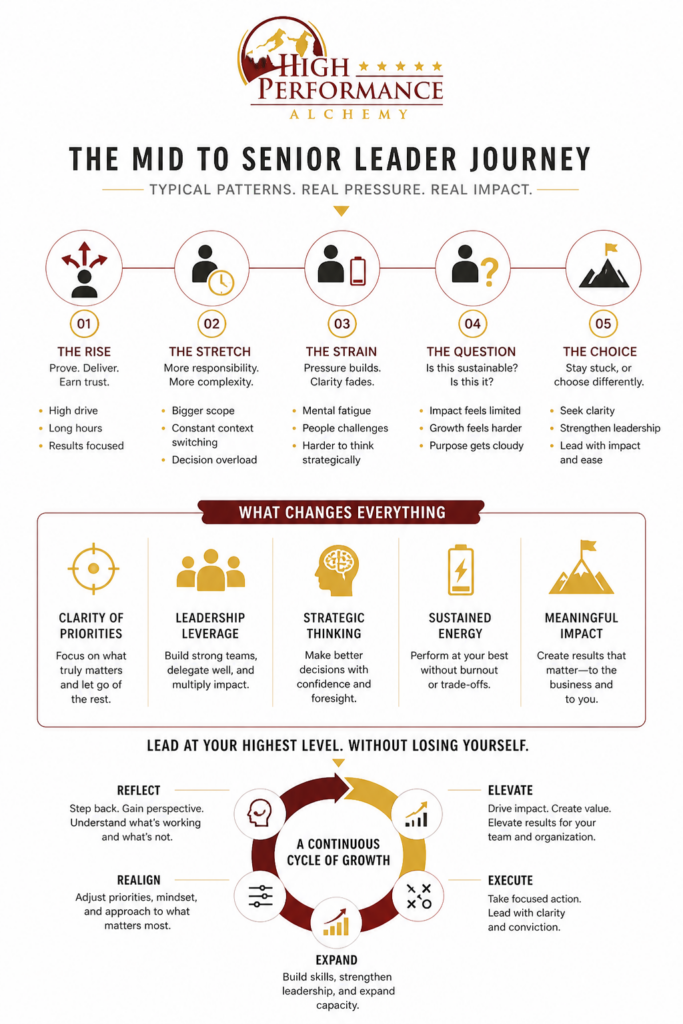
Across industries, roles and geographies, high-performing leaders tend to follow a remarkably similar trajectory:
1. The Rise
You prove yourself. You execute. You deliver consistently.
Your value is clear: you get things done.
2. The Stretch
You are given more scope. More responsibility. Bigger decisions.
Your calendar fills. Your visibility increases.
3. The Strain
The cracks begin to show—not externally, but internally.
You are juggling competing priorities, navigating ambiguity and making decisions with incomplete information.
4. The Question
A quiet but persistent thought emerges:
“Is this sustainable?”
“Am I actually operating at my best?”
5. The Choice
Stay in the cycle—or step out of it.
Most leaders never consciously make this choice. They default.
And that’s where performance plateaus.
The Real Problem Isn’t What You Think
Conventional thinking says leaders struggle because they lack skills.
Research—and real-world experience—suggests otherwise.
A study published in the Harvard Business Review found that as leaders move up, technical competence becomes less predictive of success, while cognitive clarity, emotional regulation and strategic focus become critical differentiators.
Similarly, McKinsey’s work on executive performance highlights that top leaders are not those who do more—but those who decide better, faster and with greater alignment.
So if it’s not skill…
What is it?
The Three Invisible Drains on Leadership Performance
1. Decision Saturation
Senior leaders make hundreds of decisions weekly—many of them high-stakes.
Over time, this leads to decision fatigue:
- Slower thinking
- Reduced confidence
- Over-reliance on familiar patterns
The result? Leaders either overthink… or default to autopilot.
Neither leads to breakthrough performance.
2. Cognitive Overload
You are not just managing tasks—you are managing:
- Stakeholder expectations
- Organizational politics
- Strategic ambiguity
- Team dynamics
Your brain is constantly context-switching.
Neuroscience research shows that frequent context switching can reduce productivity by up to 40% and significantly impair deep thinking.
At the senior level, this isn’t just inefficient—it’s costly.
3. Isolated Leadership
As you rise, your circle shrinks.
You have fewer peers you can speak candidly with.
Fewer spaces where you can think out loud without consequence.
So what happens?
You carry more—alone.
And that weight compounds over time.
What High-Performing Leaders Do Differently
The leaders who break through this plateau don’t work harder.
They operate differently.
They Prioritize Ruthlessly
They understand that not everything deserves attention.
They focus on what truly moves the needle—and let go of the rest.
They Create Thinking Space
They don’t just react. They step back.
They build intentional space for reflection, strategy and clarity.
They Leverage, Not Accumulate
They stop being the bottleneck.
They build teams, systems and structures that multiply their impact.
They Manage Energy, Not Just Time
They recognize that performance isn’t about hours worked—but about cognitive and emotional capacity.
The Role of Coaching: Not What You Think
There’s a misconception that coaching is about fixing problems.
At the senior level, it’s not.
It’s about unlocking performance that already exists—but isn’t fully accessed.
A study by the International Coaching Federation (ICF) found that:
- 86% of companies saw a positive ROI from coaching
- 70% of individuals improved work performance
- 80% reported increased self-confidence
But beyond the statistics, the real value lies in something less tangible:
Clarity.
What Actually Changes
When leaders engage in the right kind of coaching, five key shifts occur:
1. Clarity of Priorities
Leaders move from reacting to everything…
to focusing on what truly matters.
2. Stronger Leadership Leverage
They stop doing more—and start enabling more.
3. Sharper Strategic Thinking
They make decisions with greater confidence and foresight.
4. Sustained Energy
They perform at a high level—without constant depletion.
5. Meaningful Impact
Their work aligns not just with business goals—but with personal purpose.
Client Perspectives: What Leaders Actually Experience
“I didn’t realize how much mental noise I was carrying until it was gone.”
— VP, Technology
“The biggest shift wasn’t in what I did—it was in how I thought. Everything became clearer.”
— Director, Operations
“I stopped being the bottleneck. My team stepped up—and so did our results.”
— Senior Manager, Finance
“For the first time in years, I feel like I’m leading with intention, not just reacting.”
— Head of Strategy
The Cost of Staying the Same
It’s easy to normalize the plateau.
After all, you are still performing. Still delivering. Still progressing.
But over time, the hidden costs accumulate:
- Missed opportunities for strategic impact
- Reduced innovation and creativity
- Increased stress and fatigue
- Diminished leadership presence
And perhaps most importantly:
A growing gap between your current performance and your true potential
The Shift That Changes Everything
Breaking through isn’t about adding more.
It’s about removing what’s in the way.
- The noise
- The overload
- The unnecessary complexity
And replacing it with:
- Clarity
- Focus
- Intentional action
This isn’t a dramatic transformation.
It’s a series of precise, high-leverage shifts.
A Different Way Forward
For mid to senior leaders, the next level isn’t about climbing higher.
It’s about operating differently at the level you are already in.
It’s about:
- Thinking more clearly
- Leading more intentionally
- Performing more sustainably
Because at this stage, success isn’t defined by how much you do.
It’s defined by how effectively you think, decide and lead.
Most leaders don’t fail because they lack capability.
They stall because they are operating in systems—both external and internal—that no longer serve them.
The leaders who break through are the ones who recognize this early…
And choose to do something about it.
If you are at that point—the question isn’t whether you can do more.
It’s whether you are ready to operate at your true level.
Ready to break the plateau and lead at your true level?
Explore your next step→ https://highperformancealchemy.com/rrr/