

For most professionals, career progression is measured through visible metrics.
Larger teams.
Larger budgets.
Broader responsibilities.
Greater influence.
Yet the most significant shift in senior leadership is often invisible.
The nature of the problems changes.
Early-career success is largely driven by expertise.
Senior leadership success is increasingly driven by judgment.
And judgment is ultimately a function of thinking.
Not intelligence.
Not experience.
Thinking.
The ability to navigate ambiguity, challenge assumptions, integrate competing perspectives, anticipate second-order consequences and make high-quality decisions under uncertainty.
This is where many accomplished professionals encounter an unexpected challenge.
The very experience that helped them succeed can begin to constrain how they see.
The Paradox of Expertise
Research by Nobel Prize-winning psychologist Daniel Kahneman demonstrated that expertise often increases confidence faster than it increases accuracy.
As expertise grows, mental models become stronger.
Decisions become faster.
Patterns become easier to recognise.
This is essential for leadership.
However, expertise creates a hidden risk.
Leaders stop examining assumptions that have previously produced success.
The organisation changes.
Markets change.
Customers change.
Technology changes.
Yet the leader’s mental model often remains surprisingly stable.
This phenomenon is known as cognitive entrenchment.
The deeper the expertise, the harder it can become to see alternative possibilities.
The Boardroom Window
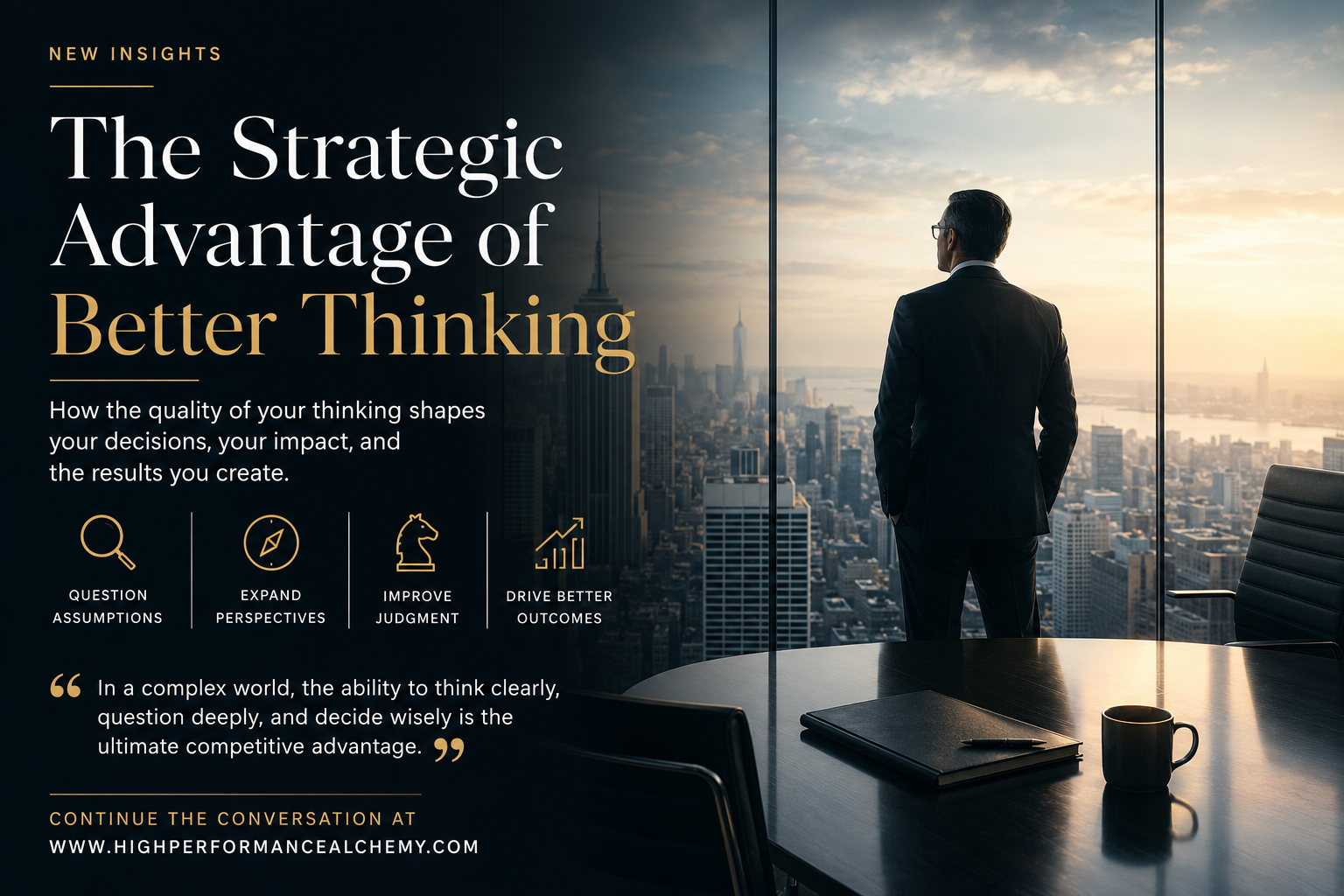
Imagine standing inside a glass boardroom overlooking a city skyline.
Every year, a thin layer of tint is added to the glass.
The change is imperceptible.
No single layer matters.
But after twenty years, the city appears fundamentally different.
Not because the city changed.
Because the lens changed.
Leadership experience works in much the same way.
Every success.
Every failure.
Every promotion.
Every crisis.
Adds another layer to how leaders interpret reality.
The challenge is that leaders rarely notice the lens itself.
They only notice what they see through it.
The Brain Does Not Seek Truth. It Seeks Efficiency.
Modern neuroscience suggests that the brain functions less like a camera and more like a prediction engine.
According to research from neuroscientist Karl Friston, the brain continuously generates predictions about reality and then looks for evidence that confirms those predictions.
This dramatically reduces cognitive effort.
It also creates vulnerability.
Leaders often believe they are evaluating reality objectively.
In practice, they may be evaluating reality through highly sophisticated assumptions built over decades.
The higher the stakes, the greater the risk.
Because strategic errors rarely emerge from lack of intelligence.
They emerge from unquestioned assumptions.
The Real Leadership Question
Most executives spend considerable time improving strategy, operations, talent and execution.
Far fewer invest equivalent effort in examining the quality of the thinking that drives those decisions.
Yet every strategy originates in thought.
Every decision originates in thought.
Every culture originates in thought.
Every transformation originates in thought.
Perhaps the most valuable question for any leader is not:
“What should I do next?”
But rather:
“What assumptions am I making that no longer deserve my confidence?”
Because the leaders who create extraordinary outcomes are rarely those with the most answers.
They are the ones who continually upgrade the quality of the questions they ask themselves.
In an increasingly complex world, better thinking may be the ultimate competitive advantage. Continue the conversation at