

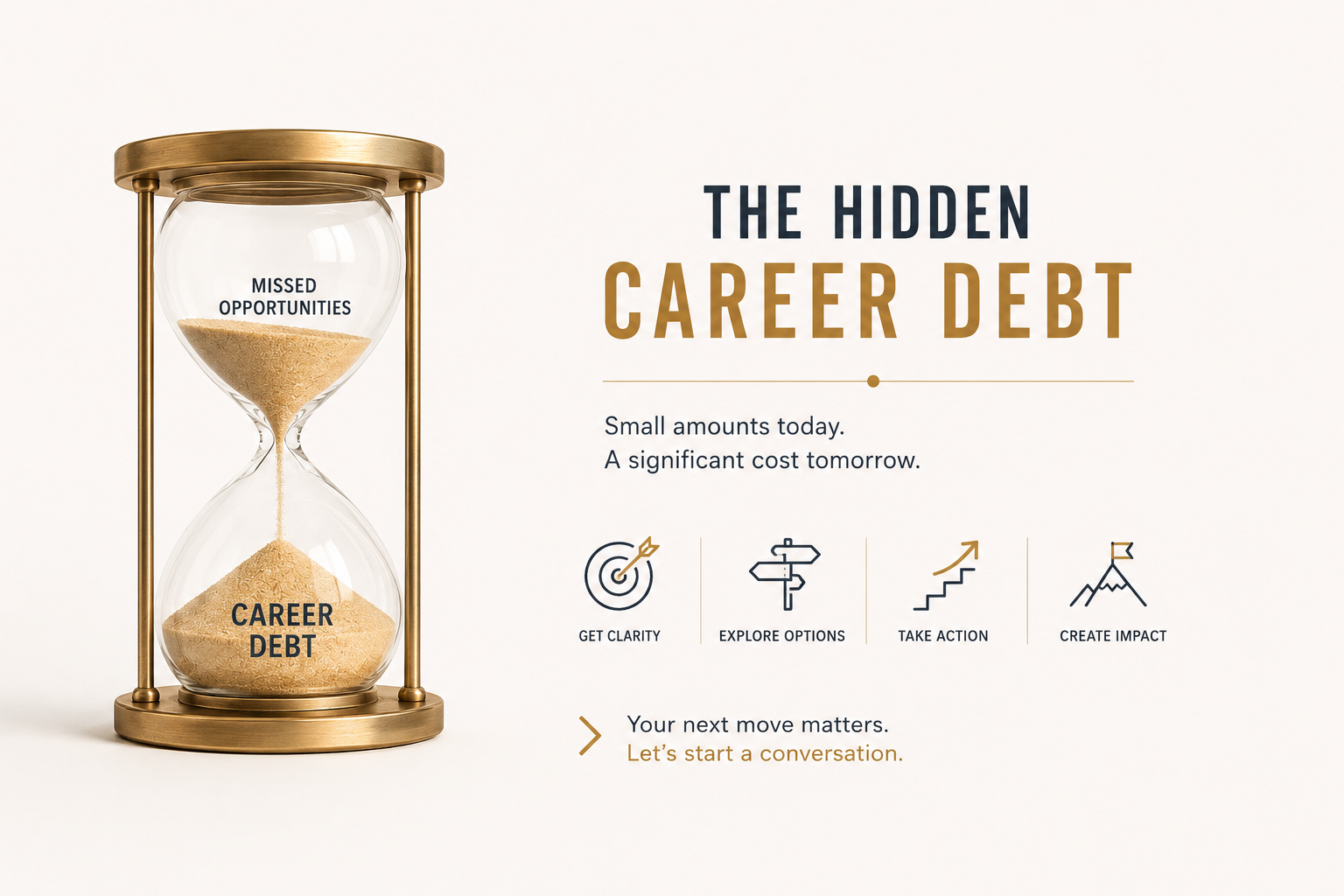
Most Mid-Senior Professionals Are Accumulating Without Realizing It
Imagine waking up one morning to discover that someone has been silently withdrawing money from your bank account for years.
Not enough to trigger an alert.
Not enough to cause immediate panic.
Just enough to slowly weaken your financial position until one day you realize that the balance you thought you had doesn’t exist.
Most people would call that a crisis.
Yet this is exactly what is happening to thousands of mid and senior professionals around the world.
The difference?
The account being drained isn’t financial.
It’s professional.
And the debt being accumulated isn’t visible on any statement.
It is Career Debt.
What Is Career Debt?
Career debt is the gap between where your career could be and where it actually is because of delayed decisions.
Every postponed conversation.
Every delayed application.
Every avoided networking opportunity.
Every leadership skill left undeveloped.
Every visibility opportunity ignored.
Every year spent hoping things will improve on their own.
All of these create small amounts of debt.
Individually they appear harmless.
Collectively they become expensive.
Just like financial debt compounds with interest, career debt compounds with time.
The longer you ignore it, the harder it becomes to recover.
Why This Problem Is Worse Than Ever Before
Ten years ago, many professionals could build successful careers by doing excellent work and waiting to be noticed.
The world rewarded expertise.
Today the rules have changed.
Organizations restructure faster.
Industries evolve quicker.
Technology disrupts entire functions.
AI is redefining expectations.
Leadership roles are becoming broader.
Business environments are more volatile.
Being competent is no longer enough.
The professionals who thrive are those who actively manage their careers.
Unfortunately, many experienced professionals are still operating with yesterday’s career strategy.
They continue to rely on visibility systems that no longer exist.
They wait for managers to initiate discussions.
They expect organizations to provide direction.
They assume loyalty guarantees security.
These assumptions are becoming increasingly dangerous.
The Four Sources of Career Debt
1. The Debt of Delay
This is the most common form.
You know you should do something.
You simply keep postponing it.
Examples include:
- Updating your professional profile
- Building industry relationships
- Learning emerging skills
- Exploring new opportunities
- Having difficult conversations
Months become years.
Years become missed opportunities.
The debt grows quietly.
2. The Debt of Comfort
Many professionals confuse comfort with stability.
Comfort feels safe.
Growth feels uncertain.
As a result, they remain in familiar environments long after those environments stop helping them grow.
The irony?
Comfort often creates greater risk than change.
Organizations evolve.
Markets evolve.
Technology evolves.
If you remain static while everything around you changes, your comfort zone slowly becomes a danger zone.
3. The Debt of Invisibility
One of the biggest surprises many professionals face is discovering that performance and visibility are not the same thing.
You may be delivering exceptional work.
But if key stakeholders don’t know your value, opportunities may pass you by.
Invisibility debt accumulates when professionals:
- Avoid networking
- Avoid self-advocacy
- Avoid speaking opportunities
- Avoid strategic relationships
- Avoid sharing expertise
They assume results will speak for themselves.
Sometimes they do.
Often they don’t.
4. The Debt of Uncertainty
This debt appears when professionals spend years reacting instead of deciding.
They wait for certainty before acting.
They wait for perfect timing.
They wait for complete clarity.
They wait for confidence.
The challenge is that certainty rarely arrives first.
Action often creates clarity.
Not the other way around.
Why Intelligent Professionals Get Stuck
Many people assume procrastination is a time management problem.
It often isn’t.
In reality, procrastination is frequently an emotional management problem.
The brain is designed to avoid uncertainty.
When faced with ambiguity, it naturally seeks comfort and familiarity.
This made sense thousands of years ago.
It is less helpful when navigating modern careers.
Your brain doesn’t distinguish between a tiger in the jungle and an uncertain career decision.
Both can trigger caution.
Both can activate avoidance.
Both can encourage delay.
As a result, highly capable professionals sometimes postpone actions that could significantly improve their future.
Not because they lack intelligence.
Not because they lack ambition.
But because uncertainty feels uncomfortable.
The Cost Nobody Calculates
Most professionals calculate the cost of making a mistake.
Few calculate the cost of doing nothing.
Let’s consider a simple example.
Suppose a professional delays exploring a new opportunity for two years.
During that period they might lose:
- Higher compensation
- Better learning opportunities
- Expanded leadership exposure
- Stronger professional networks
- Increased visibility
- Improved confidence
The financial impact may be measurable.
The opportunity impact is often much larger.
Yet because these losses are invisible, they rarely receive attention.
Career debt thrives in invisibility.
The New Career Equation
For decades, the formula was simple:
Work Hard + Stay Loyal = Career Growth
For many professionals, that equation no longer works consistently.
A more relevant equation today may be:
Capability + Visibility + Adaptability + Intentional Action = Sustainable Career Growth
Notice what’s missing.
Waiting.
Hope is not a strategy.
Avoidance is not a strategy.
Wishful thinking is not a strategy.
Intentional action is.
A Different Way to Think About Career Security
Most people define career security incorrectly.
They believe security comes from:
- A company
- A title
- A manager
- A department
- An organization
True career security comes from something else.
It comes from your ability to create value in changing environments.
It comes from adaptability.
It comes from relationships.
It comes from learning.
It comes from self-awareness.
It comes from the confidence that you can navigate uncertainty.
When professionals build these capabilities, they become less dependent on circumstances and more capable of shaping outcomes.
The Career Debt Audit
Take a moment and ask yourself:
What important career conversation have I been postponing?
What opportunity have I delayed exploring?
What skill have I intended to develop but haven’t?
What relationship should I be nurturing?
What visibility opportunity have I avoided?
What decision have I been waiting too long to make?
Your answers may reveal where your career debt is accumulating.
Awareness is the first step.
Action is the second.
The Best Time to Act
There is a popular saying that the best time to plant a tree was twenty years ago.
The second-best time is today.
The same applies to careers.
You cannot recover yesterday’s missed opportunities.
You cannot rewrite previous decisions.
You cannot reclaim lost time.
But you can decide what happens next.
You can reduce career debt.
You can build career assets.
You can create momentum.
You can move from reacting to designing.
The future rarely changes because people wait.
It changes because people act.
Final Thought
The biggest threat to most careers today is not AI.
It is not economic uncertainty.
It is not organizational change.
It is not competition.
The biggest threat is the silent accumulation of career debt caused by delayed action.
Every postponed decision has a cost.
Every avoided conversation has a cost.
Every opportunity ignored has a cost.
The question is not whether you are accumulating career debt.
The question is whether you are aware of it.
And more importantly—
What will you do about it today?
If you find yourself uncertain about your next career move, leadership journey or professional direction, start by having a conversation.
Sometimes clarity is not found by thinking longer.
It is found by thinking differently.
You can learn more or start a confidential conversation here: