

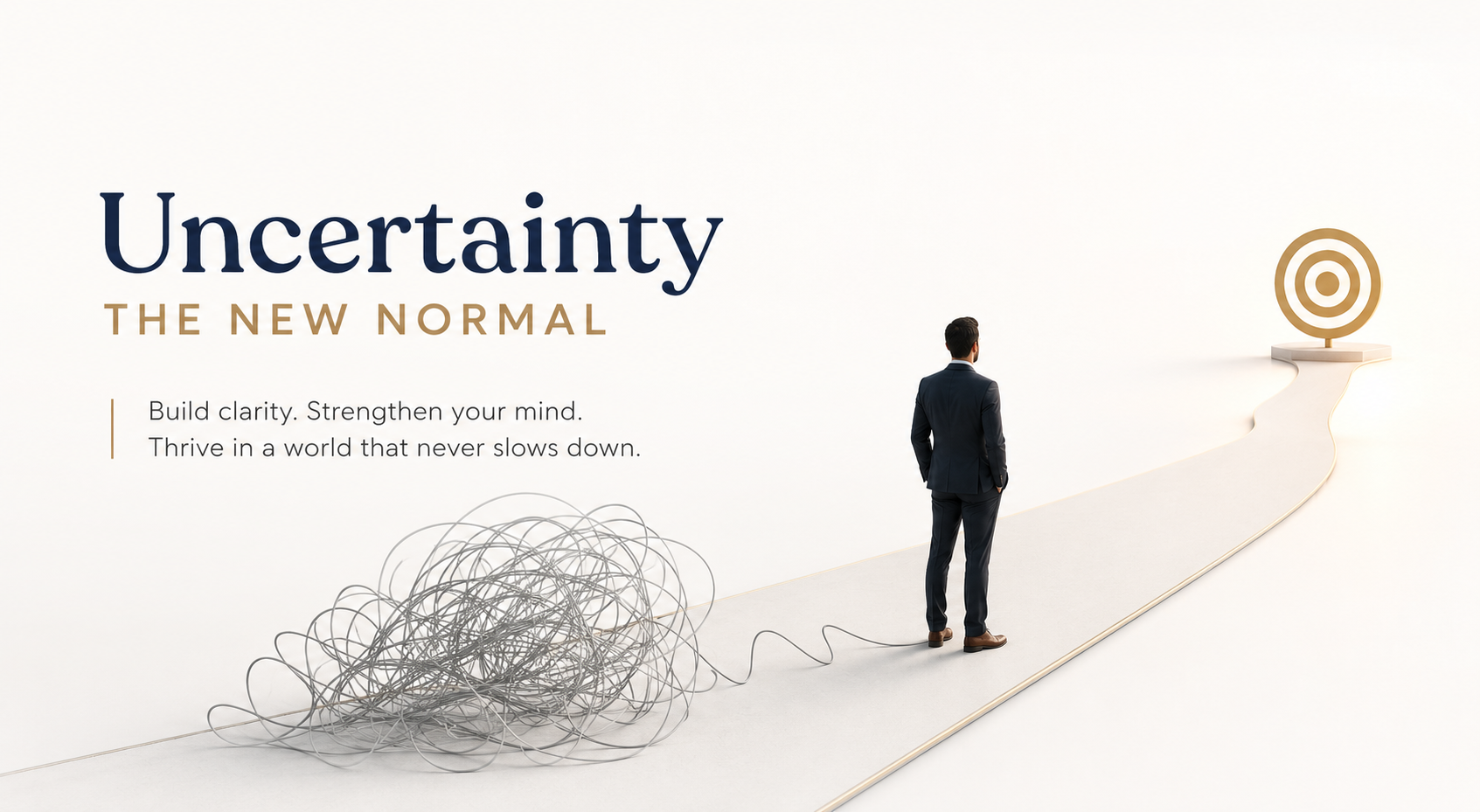
There was a time when uncertainty arrived in waves.
A recession.
A merger.
A difficult boss.
A career setback.
You dealt with it, recovered and eventually things settled down.
That pattern no longer exists.
Today, uncertainty doesn’t visit occasionally.
It stays.
Markets shift overnight. Artificial intelligence changes job descriptions faster than organisations can rewrite them. Entire industries are restructuring. Promotions take longer. Expectations keep increasing while resources keep shrinking.
Many professionals are waiting for things to “become normal again.”
But what if this is normal?
The New Workplace Doesn’t Reward Experience Alone
Twenty years ago, experience itself created security.
Today, experience is only the starting point.
Organisations increasingly reward people who can:
- Learn quickly.
- Make decisions despite incomplete information.
- Adapt without losing confidence.
- Influence others during change.
- Remain emotionally composed under pressure.
Notice something?
None of these are technical skills.
They are human capabilities.
And human capabilities become the true competitive advantage when technical knowledge becomes easier to acquire.
The Brain Was Never Designed For Constant Uncertainty
This is where neuroscience becomes fascinating.
Your brain is fundamentally a prediction machine.
Every second, it tries to answer one simple question:
“What happens next?”
The more predictable your environment, the less energy your brain needs.
When uncertainty becomes constant, your brain starts working overtime.
It scans for threats.
It overthinks.
It creates worst-case scenarios.
It struggles to prioritise.
It seeks certainty—even if that certainty is inaccurate.
This isn’t weakness.
It’s biology.
The problem is that the modern workplace continuously feeds uncertainty faster than the brain evolved to process it.
Why Smart Professionals Sometimes Make Poor Decisions
People often assume that pressure creates better performance.
Occasionally it does.
Continuous pressure doesn’t.
When stress becomes chronic, several things begin to happen.
You postpone important conversations.
You avoid difficult decisions.
You become busier but accomplish less.
You react rather than respond.
You confuse movement with progress.
You start protecting your current position instead of preparing for your future one.
Ironically, the more uncertain the world becomes, the more people cling to familiar habits.
Unfortunately, yesterday’s habits rarely solve tomorrow’s problems.
The Hidden Cost Nobody Talks About
Most professionals calculate financial risk.
Few calculate cognitive risk.
Think about it.
How many opportunities have disappeared because:
- You delayed applying for a role.
- You didn’t speak confidently in a leadership meeting.
- You hesitated to build your personal brand.
- You stayed in a role simply because it felt safer.
- You avoided networking because you were “too busy.”
None of these decisions appear dramatic.
Yet over five years, they quietly reshape an entire career.
The biggest cost of uncertainty isn’t what happens around you.
It’s how uncertainty slowly changes the way you think.
Why Coaching Matters More Today Than Ever
Professional coaching is often misunderstood.
Many imagine motivational conversations.
Others imagine someone giving advice.
Neither captures what effective coaching actually does.
A skilled coach doesn’t remove uncertainty.
A coach helps you function effectively within it.
That difference is enormous.
The goal isn’t to predict the future.
The goal is to build someone who can handle multiple possible futures.
A coach becomes a thinking partner.
Someone who notices patterns you no longer see.
Someone who asks questions your brain has stopped asking.
Someone who interrupts unhelpful assumptions before they become permanent beliefs.
Someone who helps you make decisions from clarity instead of fear.
Coaching Isn’t About Fixing You
One of the biggest misconceptions is that coaching is only for people who are struggling.
Look closely at high-performing athletes.
Elite CEOs.
Olympic champions.
Top performers.
Most already perform well.
They work with coaches because performance eventually becomes limited by thinking—not knowledge.
The higher you rise professionally, the fewer people challenge your assumptions honestly.
Feedback becomes filtered.
People hesitate to disagree.
Blind spots quietly expand.
Coaching restores something incredibly valuable:
Objective reflection.
The Leadership Skill of the Future
Technical expertise will always matter.
But increasingly, organisations will promote people who can create certainty for others while navigating uncertainty themselves.
Teams don’t simply need answers.
They need confidence.
They need calm.
They need leaders who think clearly when everyone else is overwhelmed.
That doesn’t happen accidentally.
It develops intentionally.
A Different Question
Perhaps the better question is no longer:
“Will uncertainty reduce?”
Perhaps the question should be:
“Am I becoming the kind of professional who can thrive regardless of what changes next?”
Because uncertainty isn’t waiting for anyone.
The professionals who continue growing won’t necessarily be the smartest.
They will be the ones who continually upgrade how they think, decide, communicate and lead.
In a world where uncertainty has become the operating system, investing in your own thinking may be one of the safest career decisions you can make.
If you are navigating career uncertainty, leadership transitions or simply want to strengthen the way you think and perform under pressure, explore neuroscience-informed coaching and practical insights at