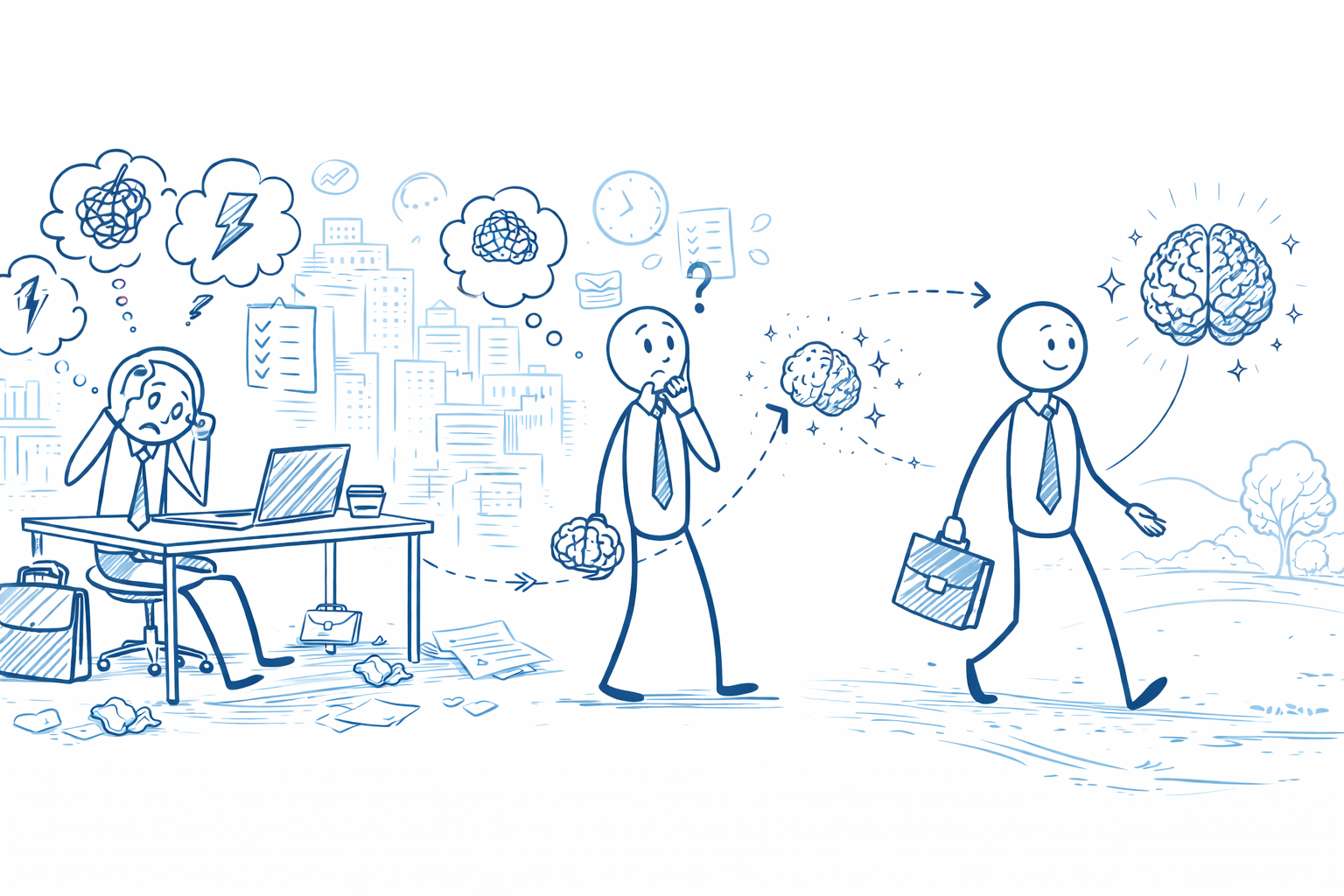

The Uncomfortable Truth About Career Survival in an Age of Uncertainty

The Uncomfortable Truth About Career Survival in an Age of Uncertainty

Something unsettling is happening in the professional world right now.

And if you are a mid-to-senior professional, you can probably feel it.

The rules that built your career are quietly disappearing.

For years the formula seemed predictable.

Work hard.
Build expertise.
Climb steadily.
Stay relevant.

But suddenly the ground feels unstable.

Companies that looked invincible are laying off thousands.

Entire roles are being automated or restructured.

Experienced professionals with 15–25 years of expertise are waking up to something they never expected to worry about again:

Career insecurity.

Not because they failed.

But because the world changed faster than the systems they relied on.

If you listen carefully to conversations in boardrooms, leadership calls and private coffee meetings, a pattern is emerging.

It usually sounds like this:

“Things feel unpredictable.”

“AI is changing everything.”

“Restructuring is happening again.”

“I need to future-proof my career.”

But underneath those polite phrases is a deeper emotion.

Fear.

Fear of becoming irrelevant.

Fear of being replaced by younger, cheaper or automated talent.

Fear of suddenly discovering that decades of experience no longer guarantee stability.

Many professionals don’t say it out loud, but internally they are asking a question that once seemed unthinkable:

“What if everything I have built can disappear faster than I imagined?”

This question is not irrational.

Look around.

Industries are transforming at a pace never seen before.

Technology cycles that once took decades now happen in months.

And organizations are constantly restructuring in response to market shocks, AI disruption and economic uncertainty.

The result is a professional environment that feels like permanent instability.

Most people respond to uncertainty in predictable ways.

They double down on effort.

They work longer hours.

They attend more courses.

They collect more certifications.

They stay constantly busy.

It feels responsible.

It feels proactive.

But here’s the uncomfortable truth:

Many of the people losing jobs today were extremely hardworking.

Many were highly skilled.

Many had strong track records.

The problem wasn’t effort.

The problem was operating on outdated assumptions about how careers actually work.

For decades, professional success was based on stability.

Now success is based on adaptability.

And adaptability doesn’t come from working harder.

It comes from upgrading how you think, decide and operate.

Most professionals believe their career is driven by external factors.

Their company.

Their industry.

Their manager.

Market conditions.

But in reality, something much more powerful determines the trajectory of your professional life.

Your internal operating system.

This includes:

Your mental models.
Your habits.
Your decision patterns.
Your relationship with uncertainty.
Your ability to adapt under pressure.

These invisible factors determine how you respond when the world changes.

Some people freeze.

Some people panic.

Some people double down on outdated strategies.

And a very small group does something different.

They reset their thinking.

They reclaim control of their direction.

They rewire how they operate.

There is a moment that separates professionals who stagnate from those who evolve.

It is the moment they stop reacting and start reflecting.

This moment is uncomfortable.

Because it forces you to ask difficult questions.

Questions like:

“Am I still operating on assumptions that no longer work?”

“Am I optimizing a system that is already outdated?”

“Have I been so busy performing that I stopped redesigning how I perform?”

Most professionals never ask these questions.

They stay inside the noise.

Meetings.

Deadlines.

Email.

Firefighting.

Constant activity that creates the illusion of progress.

But sometimes the most powerful move in a career is not acceleration.

It is Resetting.

Resetting means stepping outside the noise long enough to see clearly again.

Not quitting.

Not disengaging.

Just creating space to evaluate the bigger picture.

Because if you don’t reset occasionally, you may spend years climbing a ladder that is leaning against the wrong wall.

Once professionals reset, something surprising often happens.

They realize how much control they have slowly surrendered.

Over time many professionals unknowingly give away the most valuable resources they have.

Their attention.

Their time.

Their strategic thinking.

Their autonomy.

They become reactive.

Responding to demands.

Responding to crises.

Responding to other people’s priorities.

Without realizing it, they become highly efficient operators inside someone else’s agenda.

This is where the second shift becomes critical.

Reclaiming.

Reclaiming your attention.

Reclaiming your direction.

Reclaiming your ability to think strategically rather than react constantly.

This is not about rebellion.

It is about intentionality.

Because professionals who don’t reclaim control of their direction eventually discover that someone else has decided it for them.

Sometimes that realization comes in the form of a restructuring email.

Or a sudden conversation with HR.

Resetting creates clarity.

Reclaiming restores control.

But lasting transformation happens through something deeper.

Rewiring.

Rewiring means upgrading the mental models and behavioral patterns that quietly shape your results.

Many professionals try to solve modern career challenges with outdated thinking.

They believe experience alone guarantees relevance.

They assume stability will eventually return.

They hope that working harder will automatically produce security.

But the professionals thriving in uncertain environments operate differently.

They continuously evolve how they think.

They update their assumptions.

They design systems that allow them to adapt quickly.

Instead of reacting to disruption, they position themselves ahead of it.

This is not about becoming someone else.

It is about upgrading the internal architecture that drives your decisions.

Because once the architecture changes, your trajectory changes.

We are entering an era where professional success will depend less on static expertise and more on dynamic capability.

The ability to learn quickly.

The ability to pivot intelligently.

The ability to operate calmly in uncertain environments.

The ability to continuously redesign how you create value.

Professionals who master these capabilities will thrive.

Those who rely solely on past formulas may struggle.

Not because they lack intelligence.

Not because they lack dedication.

But because the environment changed faster than their operating system.

If you are a mid-to-senior professional navigating this uncertain landscape, the most important question is not:

“Will the market stabilize?”

Or

“Will my company remain secure?”

Those are external variables you cannot fully control.

The more powerful question is this:

“Am I evolving as fast as the world around me?”

If the answer is yes, uncertainty becomes opportunity.

If the answer is no, uncertainty becomes stress.

These three shifts form the foundation of a powerful transformation process.

Reset the noise and regain clarity.

Reclaim control of your attention, direction and decisions.

Rewire the internal systems that determine how you operate in a rapidly changing world.

This approach is not about temporary motivation.

It is about upgrading how you think, perform and adapt.

Because in the years ahead, professionals who redesign their internal operating system will have a profound advantage.

Right now thousands of professionals are feeling the pressure of uncertainty.

Some will react with fear.

Some will wait for stability to return.

And a few will use this moment to fundamentally upgrade how they operate.

Those are the professionals who will not just survive disruption.

They will lead the next phase of it.

If you are ready to explore what that transformation could look like for you, start here:

https://www.highperformancealchemy.com/rrr

Your next level of professional resilience and performance may not come from working harder.

It may come from thinking differently.
Why High Performers Secretly Feel Stuck

Why High Performers Secretly Feel Stuck

Have you ever had the unsettling thought:

“I know I’m capable of more… so why am I not moving?”

You’re not lazy.
You’re not ungrateful.
You’re not incapable.

And here’s the shocking part:

Your brain might actually be working against your progress — on purpose.

Feeling stuck isn’t a personality flaw. It’s a neurological pattern.

Let’s unpack what’s really happening when you feel frozen in your career, relationships or life — and why pushing harder often makes it worse.

A 2023 global workplace report found that over 60% of mid-career professionals feel disengaged or “stagnant”, even when performing well externally.

Read that again.

Not failing.
Not struggling visibly.
Just… stuck.

You show up. You deliver. You’re respected.

And yet inside?

Flat. Hesitant. Paralyzed about the next move.

This is more common among high performers than you think.

Because the very brain that helped you succeed can become the one that keeps you frozen.


When clients describe feeling stuck, they rarely use dramatic language.

They say things like:

  • “I know I should apply, but I haven’t.”
  • “I want to change roles, but something stops me.”
  • “I’m exhausted thinking about making a move.”
  • “I’m waiting for clarity.”

Here’s the truth:

Stuck is not confusion. It’s a freeze response.

And freeze is biological.


Let’s simplify the neuroscience.

Your brain has three major systems that influence behavior:

  1. Prefrontal Cortex (Thinking Brain)
    Planning, strategy, vision, long-term decisions.
  2. Limbic System (Emotional Brain)
    Threat detection, memory, emotional tagging.
  3. Autonomic Nervous System (Survival System)
    Fight. Flight. Freeze.

When your brain perceives uncertainty or potential loss (status, identity, income, belonging), it doesn’t analyze opportunity.

It scans for danger.

Even positive change can trigger this.

Promotion?
Threat to competence.

Career switch?
Threat to identity.

Entrepreneurship?
Threat to stability.

When perceived threat increases, the amygdala activates. Stress hormones rise. Blood flow reduces to the prefrontal cortex.

Translation?

Your strategic thinking literally goes offline.

You don’t become incapable.

You become biologically protective.

And one of the brain’s favorite protection strategies?

Freeze.


Fight looks like aggression.
Flight looks like quitting.

Freeze looks like:

  • Overthinking
  • Endless researching
  • Waiting for the “right time”
  • Staying in a tolerable situation
  • Procrastinating on important action

It feels passive.

But neurologically, it’s highly active survival.

A shocking research insight:
Studies on chronic workplace stress show prolonged uncertainty can keep the nervous system in low-grade freeze for months or years — leading to reduced risk tolerance and diminished initiative.

Not because someone lacks ambition.

Because their brain is conserving safety.


Ironically, the more you have built, the scarier movement becomes.

You have:

  • Reputation
  • Salary stability
  • Social proof
  • Identity as “the capable one”

The cost of visible failure feels amplified.

So your brain calculates:

“Better the known discomfort than unknown risk.”

You don’t consciously think this.

Your nervous system does.


(Shared by one of our clients, name changed)

Arjun was a senior manager in a multinational firm.

Consistently high performer.
Strong peer relationships.
Leadership-ready.

His mentor encouraged him to apply for a Director role.

He didn’t.

Instead, he:

  • Said he needed “more experience”
  • Took on additional responsibilities without title change
  • Spent 8 months preparing documents he never submitted

When explored deeper, Arjun admitted:

“If I apply and don’t get it, people will see I’m not ready.”

The logical brain knew he was qualified.

But his emotional brain associated visibility with risk.

Past memory: In early career, he once presented and was publicly criticized.

His brain encoded visibility = danger.

So it froze him.

Once he learned to regulate that threat response and separate past memory from present reality, he applied within 6 weeks.

He got the role.

The capability was always there.

The nervous system needed recalibration.


Your brain prefers predictable pain over unpredictable possibility.

This is called uncertainty intolerance.

Neuroscientific studies show the brain can interpret ambiguity as more stressful than confirmed negative outcomes.

That means:

Not knowing if you’ll succeed
Feels worse than knowing you’ll stay stagnant

So staying feels safer.

Even when it’s slowly draining you.


  • You consume growth content but don’t act.
  • You wait for perfect clarity before making decisions.
  • You fantasize about change but feel tired thinking about execution.
  • You delay conversations that could move you forward.
  • You feel capable, yet strangely passive.

This is not laziness.

It’s protection.


(Shared by one of our clients, name changed)

Meera was earning well in a stable corporate role.

But she felt deeply unfulfilled.

She had an opportunity to transition into strategy — something aligned with her strengths.

She stalled for 18 months.

Her words:

“What if I leave comfort and can’t recreate this income?”

Her nervous system equated change with loss of security.

Even though data showed she had strong employability.

Her brain was prioritizing short-term safety over long-term fulfillment.

Through structured nervous system work and cognitive reframing, she ran a 3-month experiment internally instead of resigning immediately.

That reduced perceived threat.

Gradual exposure reduced freeze.

She transitioned successfully.

The key wasn’t motivation.

It was safety.


The Dopamine Myth

Many people assume:

“I just need more motivation.”

But motivation relies heavily on dopamine — the reward neurotransmitter.

Here’s the problem:

Chronic stress reduces dopamine sensitivity.

When you’re in prolonged stress or freeze, your brain doesn’t anticipate reward strongly.

So even exciting goals feel flat.

You’re not uninspired.

Your reward system is dampened.

This is why vision boards don’t work when the nervous system feels unsafe.


Another reason you feel stuck?

Identity rigidity.

If your identity is:

  • “The reliable one”
  • “The expert”
  • “The stable provider”
  • “The safe player”

Any change threatens that narrative.

Your brain defends identity as strongly as physical safety.

Because belonging equals survival.


(Shared by one of our clients, name changed)

Rohan had plateaued at mid-management for 5 years.

Not because of performance.

But because he avoided visibility.

He declined speaking opportunities.
He avoided networking.
He stayed in execution roles.

When asked why, he said:

“I’m not the kind of person who pushes myself forward.”

That sentence revealed identity freeze.

Past experience: Growing up, being outspoken led to social rejection.

His nervous system coded:

Visibility = social threat.

Once he worked on safe visibility — small internal presentations, low-risk leadership settings — the freeze response reduced.

Within a year, he moved into a cross-functional leadership role.

He didn’t change personality.

He changed nervous system interpretation.


Here’s the uncomfortable truth.

Chronic stagnation:

  • Lowers confidence gradually
  • Reduces cognitive flexibility
  • Increases learned helplessness
  • Trains the brain to avoid risk

The longer you stay frozen, the more normal it feels.

And that’s dangerous.

Because what starts as “just a phase” becomes identity.


Not with hustle.

Not with shame.

Not with forcing.

You need three things:

1. Regulation Before Strategy

Calm the nervous system first.
Breathing, somatic grounding, reducing perceived threat.

A calm brain thinks clearly.

2. Micro-Exposure to Risk

Don’t leap.
Experiment.

Small visible actions retrain the brain that movement ≠ danger.

3. Identity Expansion

Shift from:
“I am someone who avoids risk.”

To:
“I am someone who can learn new environments safely.”

Identity flexibility reduces freeze dramatically.


If you’re reading this and thinking:

“This sounds like me.”

Let me tell you something directly.

You are not behind.

You are not broken.

You are likely neurologically protecting yourself from something your brain once learned was unsafe.

And protection is intelligent.

But long-term freeze is expensive.

The world is shifting rapidly.

Leadership expectations are evolving.
Career paths are nonlinear.
Stability now comes from adaptability — not position.

If your nervous system is locked in safety mode, growth feels threatening.

But here’s the powerful part:

The brain is plastic.

It rewires.

Patterns that kept you safe before do not have to run your future.

Ask yourself:

If I removed fear of loss, rejection or uncertainty…

What would I attempt?

Your answer isn’t delusion.

It’s information.

Underneath stuckness is often untapped expansion.

If you’ve seen yourself in these patterns — the hesitation, the delay, the silent plateau — understand this:

You are not lacking ambition.
You are not incapable of growth.
You are not “too late.”

You may simply be operating from a brain that is prioritizing protection over expansion.

And while protection once served you, staying frozen now comes at a cost — to your confidence, your potential and your trajectory.

The shift from stuck to strategic does not begin with pushing harder.
It begins with resetting the nervous system, reclaiming agency and rewiring the patterns that keep you safe but small.

If you’re ready to move from survival mode to deliberate growth, explore how you can Reset, Reclaim and Rewire here:

👉 https://www.highperformancealchemy.com/rrr/

Your next level may not require more effort.
It may require a safer, stronger internal foundation.

A Conversation You May Not Realise You have Been Needing

A Conversation You May Not Realise You have Been Needing

Let’s start somewhere honest.

Not with strategy.
Not with productivity hacks.
Not with “5 ways to optimise your morning.”

Let’s start with you.

Because if you are reading this, there’s a reasonable chance you are not at the beginning of your career. You are not figuring out how to write your first résumé. You are not learning the basics of professional life.

You are experienced.
Capable.
Accomplished — by most external measures.

And yet…

Something feels off.

Not necessarily broken.
Not dramatic.
Just… misaligned.

A quiet friction you can’t fully explain.

Maybe you have built a solid career.

You have worked hard.
Delivered results.
Handled pressure.
Earned trust.
Accumulated expertise.

From the outside, your trajectory makes sense.

But internally?

You might be thinking things like:

  • Why does this feel heavier than it used to?
  • Why am I busy all the time but oddly unsatisfied?
  • Why do decisions that once felt easy now drain me?
  • Why do I feel restless even when things are “fine”?

Here’s something important:

This is not a failure of competence.

It’s often a signal of evolution.

Because the challenges at your level are rarely about skill deficits. They are about something deeper and more complex:

Identity. Energy. Direction. Meaning.

Early in your career, growth is straightforward.

Learn more.
Do more.
Prove more.

Effort → Results → Progress.

But later?

Growth becomes paradoxical.

Because now you have:

  • More responsibility
  • More expectations
  • More complexity
  • More people depending on you
  • More consequences attached to your choices

And less of something else:

Less space.

Less mental space.
Less reflective space.
Less emotional space.

You are constantly responding.

Deadlines.
Meetings.
Escalations.
Emails.
Targets.
Politics.
Change.

You are moving fast…

…but are you moving intentionally?

There comes a stage where external success and internal experience start diverging.

You may be:

✔ Performing well
✔ Being recognised
✔ Holding a senior title
✔ Leading teams
✔ Earning well

Yet simultaneously feeling:

✖ Disconnected
✖ Fatigued
✖ Uncertain
✖ Understimulated
✖ Or strangely stuck

This tension is subtle.

It doesn’t announce itself loudly.

It whispers.

Through reduced enthusiasm.
Through decision fatigue.
Through cynicism creeping in.
Through the sense that you are operating below your potential — even if you are objectively “doing great.”

When was the last time you truly paused?

Not a vacation.
Not a weekend.
Not collapsing into Netflix exhaustion.

I mean a real pause:

A deliberate step back to examine:

  • How you are thinking
  • What you are prioritising
  • What’s driving your decisions
  • Whether your patterns still serve you

Because here’s the uncomfortable truth:

Sometimes, it creates inertia.

The Invisible Weight of Autopilot

At senior levels, autopilot becomes sophisticated.

You are not careless.
You are efficient.

You have built mental shortcuts, behavioural patterns, decision frameworks.

They once helped you succeed.

But patterns age.

What once accelerated you can later constrain you.

And the tricky part?

They feel normal.

Until one day you notice:

“I’m reacting more than choosing.”

“I’m managing more than creating.”

“I’m surviving more than growing.”

Reset does not mean quitting your job.

It does not mean blowing up your life.

It does not mean dramatic reinvention.

Reset is quieter and more powerful.

It’s the intentional act of stepping out of unconscious momentum.

Of interrupting default thinking.

Of asking:

  • Is this still aligned with who I am now?
  • Are my assumptions still valid?
  • Am I solving the right problems?
  • Am I living in reaction or design?

Reset is cognitive and emotional.

It’s not about doing less.

It’s about seeing differently.

Because awareness without ownership quickly becomes frustration.

You recognise the misalignment…

…but nothing changes.

That’s why the next step matters:

Somewhere along the way, many professionals slowly outsource their agency.

Not consciously.

But through phrases like:

“I don’t really have a choice.”
“This is just how my industry works.”
“At my level, this is the reality.”
“It’s too late to change direction.”
“I’m stuck with this path now.”

Let’s gently challenge that.

Because while constraints are real…

Reclaim is about recognising:

  • Where you still have choice
  • Where you have normalised dissatisfaction
  • Where fear has disguised itself as logic
  • Where comfort has disguised itself as stability

Reclaim is not rebellion.

It’s authorship.

This distinction matters.

Powerlessness says:
“I can’t.”

Patterned says:
“I have been operating from habits, beliefs and neural wiring that can change.”

Because your brain is not fixed.

Your mindset is not permanent.

Your behavioural responses are not destiny.

They are trainable.

Which leads us to:

Rewiring sounds exciting in theory.

In practice?

It’s uncomfortable.

Because rewiring means:

  • Letting go of familiar mental loops
  • Replacing identity narratives
  • Changing how you interpret stress
  • Updating how you make decisions
  • Redefining success internally

It means acknowledging that:

Your exhaustion may not just be workload.
Your frustration may not just be organisational.
Your stagnation may not just be circumstantial.

Some of it may live in how your brain has learned to operate.

At your stage, transformation is psychologically different.

You are not building from scratch.

You are editing a complex system:

Your career
Your reputation
Your identity
Your financial commitments
Your social positioning
Your self-concept

Which is why simplistic advice feels insulting.

“Just follow your passion.”
“Just think positive.”
“Just hustle harder.”

You know better.

You need depth.
Nuance.
Intelligence.
Respect for complexity.

Let’s remove another misconception.

Transformation does not require becoming someone else.

It often involves becoming more fully yourself.

Less constrained by outdated conditioning.

Less driven by unconscious fear.

Less trapped in inherited definitions of success.

More aligned.
More intentional.
More internally coherent.

A Quiet Question Worth Asking

Not “What should I do next?”

But:

Because careers don’t stagnate only due to external barriers.

They stagnate when internal models stop evolving.

Growth at This Level Is Subtle

It’s not about learning a new technical skill.

It’s about:

  • Expanding cognitive flexibility
  • Strengthening emotional regulation
  • Reframing pressure
  • Recovering clarity
  • Re-energising motivation
  • Redesigning priorities
  • Updating identity

It’s internal architecture work.

And yes — it’s neuroscience.

Not in a trendy buzzword way.

But in a very real sense:

Your brain wires itself around repeated thoughts, reactions and behaviours.

Change the patterns → Change the wiring → Change the experience.

Feeling stuck does not necessarily mean:

❌ You are in the wrong career
❌ You have made bad choices
❌ You lack ambition
❌ You have “lost your edge”

It may mean:

✔ Your environment has changed
✔ Your priorities have evolved
✔ Your identity is shifting
✔ Your old strategies no longer fit

Being stuck is often a transition signal, not a verdict.

Let’s name something rarely spoken out loud.

At mid-to-senior levels, change carries a different fear:

“What if I destabilise everything I have built?”

“What if I make the wrong move at this stage?”

“What if I lose status, income, credibility?”

“What if it’s too late?”

So you delay.

Rationalise.

Optimise around discomfort instead of addressing it.

Stay “successful but misaligned.”

What if you don’t reset?

What if you don’t reclaim?

What if you don’t rewire?

Then five years pass.

Ten years.

And the quiet friction becomes chronic disengagement.

Not burnout.

Not collapse.

Just a slow erosion of aliveness.

It’s about:

How you think
How you interpret pressure
How you relate to uncertainty
How you define success
How you manage energy
How you construct meaning

Because two professionals can have identical roles…

…and completely different internal experiences.

Many people wait for crisis.

Burnout.
Job loss.
Health scare.
Severe dissatisfaction.

But the most powerful transformations often start earlier.

At the whisper stage.

When something inside says:

“There must be a better way to experience this.”

Imagine:

  • Feeling mentally clear again
  • Making decisions with confidence instead of overthinking
  • Experiencing pressure without constant internal tension
  • Feeling engaged rather than drained
  • Operating from intention rather than reaction

Not by changing everything externally.

But by upgrading your internal operating system.

Not as motivational slogans.

But as a structured progression:

Reset your thinking
Reclaim your agency
Rewire your patterns

This is the essence behind frameworks designed specifically for professionals navigating complexity, leadership and transition.

If you are curious about exploring this kind of deeper recalibration, you may find this perspective valuable:

👉 https://www.highperformancealchemy.com/rrr/

(Not as a sales pitch —
but as an intellectual and professional resource.)

You have spent years building your career.

Optimising performance.
Delivering outcomes.
Meeting expectations.

But have you invested the same level of intention into:

Your mindset?
Your cognitive patterns?
Your internal clarity?
Your psychological flexibility?

Because at your level…

How you think is no longer a soft skill.

It’s a strategic advantage.

Not:

“How do I push harder?”

But:

“How do I think better, choose better and experience my professional life differently?”

If that question resonates — even slightly —
you are already in the reset.

#Leadership #ProfessionalGrowth #Mindset #CareerEvolution #SeniorLeaders #ResetReclaimRewire

Executive Career Drift: The Hidden Risk Facing High Performers

Executive Career Drift: The Hidden Risk Facing High Performers

In leadership circles, career risk is typically framed around visible failure: declining performance, missed targets, reputational damage or organizational disruption. Yet among experienced professionals and senior leaders, the greater threat is rarely dramatic failure. It is career drift — subtle, gradual and often invisible to both the individual and the organization.

Career drift does not announce itself through crisis. It emerges quietly, while results are still being delivered and credibility remains intact. Responsibilities continue. Compensation remains stable. Performance reviews stay positive. From the outside, everything appears to be working. Internally, however, a different story may be unfolding.

Career drift occurs when professional progression continues without intentional alignment. A leader may remain highly competent, respected and productive, yet increasingly disconnected from clarity, energy and strategic direction. Over time, the role no longer reflects full capability. Decision-making becomes reactive rather than deliberate. Motivation fluctuates. Work that once stimulated begins to exhaust.

This state is particularly dangerous because it feels rational. Nothing is broken. There is no urgent reason to change. Stability creates comfort and comfort reduces the perceived need for recalibration. High performers, conditioned to endure pressure and deliver consistently, often normalize the early signals of drift.

Why High Performers Are Especially Vulnerable

Senior professionals rarely stagnate due to lack of skill, intelligence or discipline. They stagnate because success itself generates inertia. Reliability is rewarded. Predictability is valued. Leaders become trusted anchors within complex systems. The more effective one becomes, the more difficult it feels to disrupt a functioning trajectory.

High performers are frequently characterized by resilience, accountability and a strong tolerance for sustained pressure. These qualities drive achievement but can also obscure misalignment. Endurance replaces reflection. Output replaces recalibration. Progress is assumed because performance remains strong.

Additionally, identity lock-in plays a critical role. As careers advance, professional identity becomes deeply intertwined with role, reputation and organizational standing. Change begins to feel like risk rather than evolution. Leaders may hesitate to question direction, not from complacency but from perceived responsibility and investment.

The Illusion of Stability

Career drift often hides behind the appearance of stability. Strong performance ratings, consistent income and organizational trust reinforce the belief that all is well. Yet stability without intentional direction can quietly erode strategic agency.

Leaders experiencing drift may notice subtle but persistent shifts: reduced excitement for challenges that once energized, increasing cognitive fatigue, diminished creative engagement or a growing sense of constraint. These signals are rarely dramatic. They accumulate gradually, making them easy to rationalize.

“I’m just tired.”“It’s been a demanding quarter.”“This phase will pass.”

While such explanations are sometimes accurate, they can also mask deeper misalignment. Drift thrives in environments where reflection is postponed and discomfort is minimized.

Early Indicators Leaders Often Overlook

Executives rarely describe themselves as drifting. Instead, they articulate vague dissatisfaction: feeling busy yet unclear about long-term direction, effective yet underutilized, successful yet unfulfilled. Because outcomes remain acceptable, these concerns are often deprioritized.

Common indicators include:- Sustained performance paired with declining enthusiasm- Increasing effort required to maintain previous levels of engagement- A narrowing risk appetite- A sense that growth has slowed despite continued output- Persistent restlessness without a defined cause

These signals are not signs of weakness or lack of ambition. They frequently reflect cognitive fatigue, identity stagnation and diminished alignment between role and capability.

The Compounding Cost of Drift

Unchecked drift produces cumulative consequences. Strategic agency erodes as decisions become shaped more by circumstance than intent. Energy depletion increases as misalignment elevates cognitive load. Identity stagnation sets in as professional self-concept ceases to evolve. Opportunity narrowing follows as reduced risk tolerance limits adaptive moves.

Perhaps most critically, delayed recalibration makes reinvention progressively more difficult. Drift subtly reshapes perception, redefining what feels realistic or attainable. Over time, leaders may adjust expectations downward, accepting constraint as inevitability.

Why “Pushing Harder” Fails

Experienced leaders often respond to early drift by increasing intensity: more discipline, more productivity, more effort. Yet drift is rarely solved through greater output. When the underlying issue involves alignment and internal orientation, increased effort amplifies exhaustion rather than restoring momentum.

Because the problem is not performance. It is direction.

Without recalibrating how one thinks, decides, evaluates risk and defines progress, additional effort becomes unsustainable. Leaders may feel trapped in cycles of overextension, mistaking endurance for advancement.

Interrupting Drift Requires a Reset

Effective course correction requires structured reflection and deliberate rewiring. Leaders must reassess direction, reclaim agency and rewire limiting cognitive patterns that sustain stagnation. This process is not about motivation or quick fixes. It is about recalibrating internal frameworks that govern decision-making and professional identity.

Frameworks designed for Reset. Reclaim. Rewire. (RRR) emphasize intentional interruption of drift dynamics. By creating space for clarity, leaders can realign effort with direction, restore strategic agency and re-engage growth pathways previously constrained by habit, fatigue or identity lock-in.

A Leadership Reality Few Discuss

Careers rarely collapse dramatically at senior levels. They flatten quietly. Through comfort. Through obligation. Through gradual drift. The absence of crisis delays intervention, allowing misalignment to compound beneath the surface of acceptable performance.

For leaders, drift is not a motivational issue. It is a strategic one. And like any strategic risk, early recognition and measured intervention determine long-term outcomes.

Final Perspective

The defining question for experienced professionals is not “Am I performing?” but “Am I still progressing in alignment with my highest value and capability?” Sustained success without intentional direction is not stability. It is vulnerability.

Career drift is preventable. But prevention requires awareness, reflection and the willingness to reset internal orientation before stagnation becomes structural.

Leaders routinely evaluate market risks, operational risks and financial risks.

Few assess trajectory risk.

If that question feels relevant, click on the link below …

👉 https://www.highperformancealchemy.com/rrr/

Because trajectory rarely changes by chance.


The Great Migration of Jobs and Companies

The Great Migration of Jobs and Companies

 Why the Economy Feels Harder Than Ever—and What You Must Do Next

The world of work used to feel stable.

You picked a path, gained skills, built experience and, with some effort and momentum, expected your professional life to progress.

Not anymore.

Today, it feels like the ground isn’t just shifting—it’s sloshing under your feet.

Layoffs. Restructures. Companies pulling back. Offices closing. Investment dollars tightening.

Fears are rising that roles will never come back.

And the most unsettling part?

Even countries once viewed as growth hubs—like India—are now facing new friction in jobs, corporate operations and movement of companies.

In this moment of global economic restructuring, your old career assumptions have become liabilities.
But if you sense something deeper is going on, you are not wrong.

This isn’t just a hiring slowdown. It’s a systemic recalibration of how value is created, distributed and sustained.

Let’s explore why it feels this way — with real trends shaking confidence — then unpack how you can actually thrive in this new landscape.


The story most people notice is layoffs — and yes, they are happening in record numbers.

Hundreds of major companies have been scaling back, restructuring or announcing layoffs as part of global strategic shifts. Recent tracking data shows thousands of layoffs and hiring freezes across industries worldwide. 

From tech giants to traditional corporations, job cuts aren’t isolated to a few sectors — they are widespread.

This trend has scratched away the layer of predictability the workforce once relied on.

In India specifically, even though many global companies haven’t left entirely, they have restructured operations or shifted focus due to economic and infrastructural pressures — signalling how fragile the design of jobs and corporate presence can be. 

Similarly, reports of U.S. and global layoffs — tens of thousands of roles disappearing — show that job security is no longer assured by scale, reputation or past performance alone. 

This matters because when corporate footprints shift, employment ecosystems shift too.
It’s not only the roles that are lost — it’s the predictability of future roles.


You might think “no big brand is leaving India,” but reality is more nuanced.

Local corporate shifts — like IT firms relocating operations from one city to another due to infrastructure frustrations — show that the calculus of where jobs exist is now deeply tied to efficiency, cost and operational momentum.

This might seem like a small story — companies moving within India — but it’s symbolic of a much larger trend:

Companies are optimizing for agility and resilience, not loyalty to a place or narrative.

Whether it’s a global firm restructuring operations or a regional company relocating due to tax and infrastructural burden, the message is the same:

If your work, team or career depends on old geographic anchors — you are exposed.

The social contract between employer and employee — where longevity once meant security — has been quietly dissolved.


Here’s what most people still aren’t fully conscious of:

Jobs are no longer primarily about careers.
They are about adaptability within systems that have become volatile by design.

In the past, jobs were predictable because markets were stable, industries moved slowly and roles evolved over years, not months.

Today:

  • Automation is reshaping roles before you finish writing your résumé.
  • AI is redefining what qualifies as meaningful contribution.
  • Corporate priorities pivot overnight based on global conditions and competitive pressures.

These aren’t future trends — they are happening now.

Layoffs, reorganizations and internal redesigns aren’t signs of temporary trouble — they are evidence of systemic reconfiguration

Work is being redesigned — not just reduced.


When companies downsize or restructure, two things happen that matter more than you think:

1. Confidence fractures.
People begin questioning their value, relevance and future.

2. The rules of progression disappear.
The familiar path — education → experience → promotion → security — no longer exists as a reliable trajectory.

Even long-tenured professionals are being uprooted or repositioned because their skillsets no longer align with what the organization needs today — not last year, not five years ago.

This creates an internal dynamic where people aren’t just anxious about unemployment — they are anxious about identity loss.

The “being good at your job” metric used to open doors.

Now, it merely qualifies you to compete for an even more uncertain opportunity.


Here’s the turning point most people miss:

This isn’t just a job market problem.

It’s an adaptation problem.

And the difference between people who get stuck and those who thrive is this:

— One group waits for conditions to improve.
— The other learns to operate within the new conditions.

When companies move or reshape operations, you can either see it as evidence that “jobs are disappearing… life is harder than ever”… or you can see it as evidence that value is being redefined — and those who understand the new currency will thrive.

Because here’s the truth:

The world still needs work, innovation and value creation.
The nature of work is just different.


In this environment:

  • Skills alone aren’t enough.
  • Experience isn’t enough.
  • Certificates aren’t enough.

What matters are three things:

1. Speed of Adaptation

The ability to learn something relevant before your career momentum runs out.

2. Meaningful Contribution

Work that changes outcomes — not just completes tasks.

3. Visible Impact

Results that others can see, measure and reward.

When the market shifted, the old currency of “time in role” was replaced with these new value levers.

This is the new professional ecosystem.


At first glance it looks like:

➡️ Layoffs
➡️ Companies relocating or restructuring
➡️ Hiring freezes
➡️ Increased unpredictability

But underneath that surface lies:

⬆️ New work models
⬆️ Faster decision cycles
⬆️ More dynamic global value flows
⬆️ Opportunities for those who can think systems, not jobs

The world isn’t eliminating work —
It’s transforming how work works.

Traditional career thinking — linear, stable, hierarchal — is obsolete.

The people who thrive will be those who build:

🔹 Systems of value creation
🔹 Networks that aren’t tied to one job
🔹 Skills that can shift fluidly across domains
🔹 Identity that isn’t tied to a title

That’s where opportunity now lives.


This isn’t about chasing old security.

It’s about crafting resilience.

The era of predictable job progression is gone.

If you want an edge, you must learn to:

✅ Reset your assumptions about jobs and stability
✅ Reclaim your agency over your own value creation
✅ Rewire how you design your professional identity

This is why traditional career advice feels tone-deaf.

It was never designed for this sort of upheaval.

You need a framework that helps you operate inside the new reality — not wallow in nostalgia for the old one.


Reset • Reclaim • Rewire isn’t another career seminar.

It’s a strategic orientation.

It helps you:

✨ See patterns behind the chaos
✨ Build systems of value that aren’t dependent on external stability
✨ Create work that adapts as fast as opportunity itself

It’s not about finding a job.

It’s about building your own leverage inside work ecosystems that no longer guarantee consistency.

You don’t wait for opportunities to return.

You build the conditions that make opportunities come to you.


Every historic shift in work has produced:

• People who thrived because they adapted first
• People who struggled because they waited for conditions to improve

This moment — with layoffs, with corporate restructures, with movement of companies and roles — is another inflection point in the history of work.

And it rewards:

🔥 adaptability
🔥 emergence
🔥 strategic self-direction

Not compliance
Not inertia
Not waiting

You have a choice:

Stay in survival mode or step into a new operating system designed for this era.

If you are ready to:

🔹 Decode what’s coming next
🔹 Turn uncertainty into advantage
🔹 Build professional momentum that doesn’t collapse when the market shifts

Then you need a framework that understands the nature of change itself — not just the symptoms.

That’s what RRR is for.


Explore RRR → https://www.highperformancealchemy.com/rrr/

The future won’t belong to those who cling to old assumptions.

It will belong to those who reset, reclaim and rewire what work means — and how they create value within it.

The Question Most Professionals Never Ask (But Probably Should)

The Question Most Professionals Never Ask (But Probably Should)

There’s a particular kind of stress that doesn’t announce itself loudly.
It doesn’t always look like panic.
It doesn’t necessarily stop you from performing.
In fact, from the outside, life may look perfectly “on track.”

Good role.
Decent pay.
Responsibilities that suggest seniority.

Yet somewhere underneath, there’s a steady mental hum:

What if this role disappears?
What if I’m replaced by someone cheaper, younger, faster?
What if the market turns again?
What if all this effort still isn’t enough?

For many Indian professionals—especially those in mid to senior roles, whether in India or the US—this hum has become part of daily life.
So common that it’s rarely questioned.

This isn’t about motivation.
It isn’t about ambition.
And it isn’t a personal failing.

It’s what happens when the brain spends long periods operating under uncertainty.

Layoffs.
Reorgs.
Visa pressure.
Performance reviews that feel opaque.
Markets that reward today and punish tomorrow.

Over time, the brain adapts—not by relaxing, but by staying alert.

And the tricky part?

This kind of stress doesn’t always feel like stress.

It often shows up as:

  • constant background thinking
  • difficulty switching off after work
  • a sense of being “on” even during rest
  • over-preparing, over-monitoring, over-correcting

Most professionals interpret this as being responsible, driven or realistic.

Few pause to ask a quieter question:

What is this doing to my brain?

Careers are tracked meticulously.

KPIs.
Skills.
Certifications.
Performance feedback.

But the internal load—the cognitive and neurological cost of carrying uncertainty for years—is almost never measured.

And without measurement, most people default to assumptions:

“This is just the phase I’m in.”
“Everyone feels this way.”
“Once I reach the next level, it will settle.”

Sometimes it does.
Often, it doesn’t.

Which is why we started with a simpler place—not solutions, not programs, not labels—but awareness.

We created a short, neuroscience-informed self-assessment called:

It’s not a personality test.
Not a diagnosis.
Not a productivity scorecard.

It’s a way to observe how your brain is currently responding to sustained pressure, uncertainty and cognitive load.

No answers are “good” or “bad.”
There’s nothing to pass or fail.

Just a snapshot.

👉 You can explore it here:
https://www.highperformancealchemy.com/rrr/

Most people finish it in under two minutes.

What happens after is more interesting.

For many mid- to senior-level professionals, the results don’t feel dramatic.

They feel… clarifying.

They put language to things that were previously vague.
They explain patterns that didn’t quite make sense.
They separate external pressure from internal strain.

And for some, the results quietly raise another question:

If this is where my brain is now…
what happens if I keep going the same way for another 2–3 years?

At this point, people tend to diverge.

Some take the insight and simply become more conscious.
Some adjust expectations, boundaries or pace on their own.
Some realize they have been compensating with effort instead of recovery.

And some notice something else:

That their brain has been in a high-alert pattern for so long, it doesn’t know how to exit it anymore—even when circumstances improve.

This is usually when curiosity deepens.

Not panic.
Not urgency.
Just a quiet recognition:

Maybe this isn’t something I should brute-force alone.

Our 12-week neuroscience-based coaching exists for people who:

  • don’t want motivational hype
  • aren’t looking for therapy
  • and don’t need more “push”

It’s for those who want to retrain how their brain responds to pressure, uncertainty and responsibility—so performance doesn’t require constant internal strain.

But that decision shouldn’t be rushed.

Which is why the quiz comes first.

No funnel pressure.
No countdown timers.
No dramatic promises.

Just information.

Because the right time to act isn’t when someone tells you to.
It’s when you see clearly enough to decide.

Job markets will continue to shift.
Roles will continue to change.
External certainty is increasingly rare.

What can change is how much invisible load your brain carries while navigating it all.

If you are curious where you stand right now, start there.

👉 How Stressed Is Your Brain?
https://www.highperformancealchemy.com/rrr/

Everything else can wait.

If you have completed the brain stress assessment, you now have something most professionals never pause to gather: visibility.

Not a label.
Not a verdict.
Just information.

For some, that awareness alone is enough.
They recalibrate, adjust quietly and move forward differently.

For others, the results surface a longer pattern.

That their brain has been operating under sustained pressure for years.
That coping has quietly replaced recovery.
That performance has continued — but at a higher internal cost.

Neither response is right or wrong.

A Question Worth Sitting With

If external uncertainty remains — the market, the role, the expectations — what would you want to change internally?

Not your ambition.
Not your work ethic.

But how your brain:

  • processes pressure
  • recovers from demand
  • responds to uncertainty
  • sustains clarity without constant vigilance

For many professionals, this is the first time that question even appears.

The 12-week neuroscience-based coaching we offer is for those who decide — in their own time — that awareness isn’t the end point.

It’s the beginning.

The work isn’t about pushing harder.
It isn’t about fixing something “broken.”
And it isn’t about becoming someone else.

It’s about retraining how the brain operates under real-world conditions:
responsibility, ambiguity, expectations and change.

Some people arrive at that decision quickly.
Some take months.
Some never feel the need.

All of those paths are valid.

There is no pressure to decide today.


No requirement to act immediately.

But there is one quiet truth worth acknowledging:

Brains rarely reset on insight alone.


Change happens when understanding is followed by intention.

If, after sitting with your results, you feel curious about what intentional retraining could look like — that’s when this work may be relevant.

If not, you still leave with clarity.

For now, let the information settle.

Everything else can wait.

The RRR Advantage

The RRR Advantage

For many professionals, mid-life was supposed to feel secure.

Years of experience.
Hard-earned credibility.
A career that finally felt stable.

Yet today, even the most capable professionals find themselves quietly anxious — wondering how long stability will last, whether their skills are still relevant and what would happen if the ground suddenly shifted beneath them.

If you are feeling this way, you are not failing.
You are responding to a world of work that has fundamentally changed.

And that is exactly why this moment is the most powerful time to embrace RRR — Reset, Reclaim and Rewire.

Many mid-career professionals live with a background hum of worry:

  • What if my role is eliminated?
  • What if I am replaced by technology or someone cheaper?
  • What if my experience no longer protects me?

These thoughts rarely get spoken aloud. Instead, they show up as anxiety, overworking, restlessness, burnout or a constant need to “prove value.” From the outside, everything looks fine. Inside, there’s tension — a sense that the rules have changed and no one gave us the playbook.

This fear is not irrational.
It is a natural response to volatility, disruption and accelerating change.

But fear left unaddressed becomes limiting — narrowing our thinking, draining our energy and quietly shaping decisions from a place of self-protection rather than possibility.

When uncertainty rises, most advice focuses on surface-level solutions:

  • Update your résumé
  • Learn new technical skills
  • Network harder
  • Push through
  • Stay positive

While useful, these strategies overlook the deeper issue: the internal cost of chronic uncertainty.

Neuroscience shows us that prolonged stress and fear reduce creativity, adaptability, decision-making and confidence — exactly the capabilities needed to thrive in today’s world of work.

Future-proofing a career isn’t just about what we do.
It’s about how we think, regulate and respond.

That’s where RRR is different.

RRR — Reset, Reclaim, Rewire — is a neuroscience-based professional development framework designed for mid-life professionals navigating uncertainty, change and career anxiety.

It works at the level where real transformation happens: the brain, nervous system, habits and identity.

Reset

We interrupt outdated thinking patterns driven by fear, pressure and survival mode — creating space for clarity and strategic perspective.

Reclaim

We reconnect with confidence, purpose and professional identity that isn’t dependent on titles, roles or external validation.

Rewire

We build new mental and emotional pathways that support resilience, relevance, adaptability and sustainable performance.

RRR doesn’t ask us to start over.
It helps us evolve forward — intentionally.

There’s a cultural myth that reinvention belongs to the young. In reality, mid-life is where reinvention is most powerful.

1. Experience Becomes Strategic Leverage

Mid-life professionals often worry that experience has become baggage. RRR reframes experience as wisdom — something to be refined, modernized and strategically applied.

The issue is not experience.
It’s operating with outdated mental models in a new environment.

RRR helps us keep what’s valuable and release what no longer serves.

2. Fear Is Information — Not a Verdict

Fear of job loss or irrelevance isn’t weakness. It’s a signal.

RRR teaches us how to understand fear through a neuroscience lens — calming threat responses, expanding perspective and restoring cognitive flexibility. When the nervous system is regulated, clarity returns. Decisions improve. Confidence stabilizes.

Fear stops running the show.

3. Job Security Has Changed Forever

Security no longer comes from tenure alone. It comes from:

  • Adaptability
  • Learning agility
  • Emotional resilience
  • Strategic self-awareness

RRR helps build internal security — the kind that doesn’t disappear with restructuring, reorgs or market shifts.

When security is internal, anxiety loses its grip.

Many professionals keep pushing forward without pausing to reset — until burnout, disengagement or forced change makes the decision for them.

Common signs include:

  • Constant overthinking
  • Difficulty making decisions
  • Loss of motivation or joy
  • Feeling stuck despite effort
  • Living in “what if” scenarios

RRR interrupts this cycle before it becomes a breaking point.

Uncertainty erodes confidence when identity becomes tied solely to roles or outcomes we can’t fully control.

RRR helps us reclaim:

  • A grounded sense of professional identity
  • Confidence rooted in capability, not circumstances
  • Purpose that extends beyond job titles

This reclaimed confidence is calm, steady and resilient — not performative or fragile.

The future belongs to professionals who can:

  • Learn continuously
  • Adapt quickly
  • Think strategically
  • Regulate stress
  • Lead with clarity

RRR focuses on rewiring habits and thought patterns that support these skills, including:

  • Cognitive flexibility
  • Emotional regulation
  • Strategic decision-making
  • Resilience under pressure

These are not “soft skills.”
They are career survival skills — and competitive advantages.

One of the most profound shifts professionals experience through RRR is the move from anxiety to agency.

Instead of asking:

  • What if I lose my job?

We begin asking:

  • How do I want to position myself next?
  • What kind of work environment supports my best performance?
  • How do I want my experience to matter now?

Agency restores choice.
Choice restores confidence.
Confidence restores momentum.

Many professionals say they will reset once things stabilize.

But stability is no longer guaranteed — and waiting keeps fear in control.

The most empowered professionals act before crisis forces change, not after.

RRR is proactive, not reactive.

Future-proofing doesn’t mean predicting what’s coming next.
It means becoming equipped to thrive no matter what comes.

Through RRR, professionals develop:

  • Emotional resilience
  • Clear professional direction
  • Confidence that isn’t externally dependent
  • The ability to navigate change without losing themselves

That is the real advantage.

Mid-life is not decline.
It is not the beginning of the end.

It is a pivot point — where experience meets intention.

RRR offers a way forward that is grounded, strategic and deeply human.

If fear of job loss, anxiety about relevance or exhaustion from uncertainty has been quietly shaping your career decisions, it may be time to pause — not to retreat, but to reset.

RRR is an invitation to:

  • Reset outdated patterns
  • Reclaim confidence and clarity
  • Rewire how we think, lead and grow

The world of work will keep changing.

The question is not if — but how prepared we choose to be.

The RRR advantage is not about fixing what’s broken.
It’s about unlocking what’s already within us.

And there has never been a better time to begin.

Let me say this clearly — nothing you are experiencing means you are failing. What we are hearing is someone capable who has been carrying uncertainty alone for too long.

Right now, the real problem isn’t your skills or experience. It’s that your thinking has no safe place to land. When everything feels uncertain, the brain stays in protection mode — which makes every decision feel heavier than it needs to be.

What we do in our work is very specific. 

  • We don’t motivate. 
  • We don’t give generic advice. 
  • We help you think clearly again — without panic, without pressure.

That’s why we start with a private RRR Career Reset Session. It’s a focused, one-on-one conversation where we identify what’s actually driving the anxiety, separate real risk from imagined risk and leave you with a clear next step.

There’s no obligation beyond that session. Some people use it for clarity and move on. Others realize they don’t want to carry this alone anymore and continue with us.

The only real question is this:
Do you want to keep managing this uncertainty on your own — or would it help to have structured, calm support while you navigate what’s next?

Click on the below link when you are ready!

https://www.highperformancealchemy.com/rrr

You are Not Stuck. Your Brain Hit the Emergency Brake.

You are Not Stuck. Your Brain Hit the Emergency Brake.

Let’s cut the polite neuroscience talk.

If you are reading this, there’s a good chance you are doing something strange lately:

You are busy, but nothing is moving.
You are thinking, but no decision lands.
You are capable, but somehow… paused.

And the worst part?

You don’t even know how it happened.

One day you were sharp, decisive, ahead of the curve.
The next, everything felt heavier. Slower. Muted.

You didn’t collapse.
You didn’t fail.

You froze.

Not metaphorically.
Neurologically.

Your brain has three core responses to threat:
Fight.
Flight.
Freeze.

Everyone talks about the first two.

Freeze is the one no one warns you about — because it doesn’t look dramatic. It looks like competence with the engine off.

Freeze is what happens when the brain decides:

“Any move right now could make things worse.”

So it shuts things down.

Not consciously.
Not politely.

Instantly.

Here’s the part no leadership book tells you:

The moment uncertainty crosses a certain threshold — job risk, financial exposure, reputational pressure, identity threat — your thinking brain loses authority.

Your amygdala takes over.

And your amygdala does not care about:

  • Strategy decks
  • Long-term vision
  • Logic
  • Experience
  • Your résumé

It only cares about not dying.

In modern life, “not dying” translates to:

  • Don’t make the wrong move
  • Don’t overextend yourself
  • Don’t choose too soon
  • Don’t commit
  • Don’t be seen failing

So instead of moving forward…

You stall.

This is why freeze is so dangerous for executives.

It disguises itself as:

  • “I’m just gathering more data”
  • “I’m waiting for the right timing”
  • “I need more clarity”
  • “I’m being cautious”

But underneath?

Your nervous system has pulled the handbrake.

And the longer it stays on, the harder it is to release.

Freeze doesn’t announce itself.

It leaks into your life quietly.

You start:

  • Delaying conversations that matter
  • Avoiding decisions that define direction
  • Replaying scenarios instead of acting
  • Losing creative sharpness
  • Feeling oddly disconnected from wins and losses

You might even still be performing — on paper.

But internally?

You feel like you are operating at 60% and pretending it’s 100%.

That internal split is exhausting.

Here’s the uncomfortable truth:

Freeze hits leaders and high achievers harder than average performers.

Why?

Because your identity is built on:

  • Being effective
  • Being capable
  • Being decisive
  • Being the one others rely on

When uncertainty threatens that identity, the threat is existential.

Your brain doesn’t hear:

“This is a tough season.”

It hears:

“Who you are might not survive this.”

That’s when freeze activates at full force.

If someone tells you to:

  • Be more confident
  • Push through
  • Stay positive
  • Hustle harder

They don’t understand what’s happening inside your nervous system.

Freeze doesn’t respond to inspiration.

It responds to safety signals.

Until your brain senses:

  • Control
  • Predictability
  • Agency

it will not release you back into clarity.

No matter how smart you are.

The freeze response releases only when the brain receives evidence that movement is safe.

Not promises.
Not affirmations.

Evidence.

That evidence comes from:

  • Small, controlled actions
  • Clear boundaries
  • Regulated physiology
  • Honest acknowledgment of fear
  • External structure when internal structure is compromised

One deliberate action — small but real — can do more than weeks of thinking.

Because action changes the nervous system.

Most executives try to think their way out of freeze.

That’s like trying to steer a car when the wheels are locked.

The order is wrong.

The sequence is:

  1. Regulate the nervous system
  2. Restore agency
  3. Then regain clarity

Reverse the order and you stay stuck.

Here’s the reframe that changes everything:

Freeze doesn’t mean you are broken.

It means:

  • An old operating system no longer works
  • The stakes have outgrown your current internal wiring
  • Your nervous system needs an upgrade

Freeze appears right before transformation — or collapse.

The difference is intervention.

Freeze thrives in isolation.

When you carry everything silently, your brain assumes:

“No support exists. Danger confirmed.”

That keeps the alarm on.

The fastest way to release freeze is co-regulation — a safe, structured space where your nervous system can downshift and recalibrate.

Not venting.
Not advice.

Strategic nervous system recalibration.

This Is the Moment Most People Miss

Most people wait until:

  • Burnout
  • Breakdown
  • Forced change
  • Loss of role or identity

Before they act.

But you are here before that point.

Which means this moment can become:

  • A reset
  • A recalibration
  • A return to clarity on a deeper level

Or…

It becomes the chapter you look back on and think:

“That’s when I stopped trusting myself.”


You don’t need:

  • More discipline
  • More pressure
  • More self-criticism
  • More pretending you are fine

You need:

  • Your nervous system back on your side
  • Your decision-making capacity restored
  • Your internal authority returned

That doesn’t happen by accident.

It happens by design.

This Is the Part Where You Decide

If something in this hit uncomfortably close — good.

That discomfort is awareness breaking through freeze.

You have two options now:

Option 1

Keep waiting for clarity to arrive on its own.

Option 2

Interrupt the freeze response intentionally and reclaim your agency.

The second option requires support, structure and neuroscience-informed intervention — not because you are failing, but because you are at a critical threshold.

Reaching out isn’t an admission of struggle.

It’s an executive decision.

One that says:

“I’m not letting my nervous system dictate my future.”

If you are ready to:

  • Release freeze
  • Regain clarity
  • Move forward without forcing
  • Lead from regulation instead of survival

Then don’t wait for another month of stalled momentum.

Reach out.

Not because you are stuck —
but because you are ready to move again.

And this time, from a place of power, not pressure.

https://www.highperformancealchemy.com/rrr

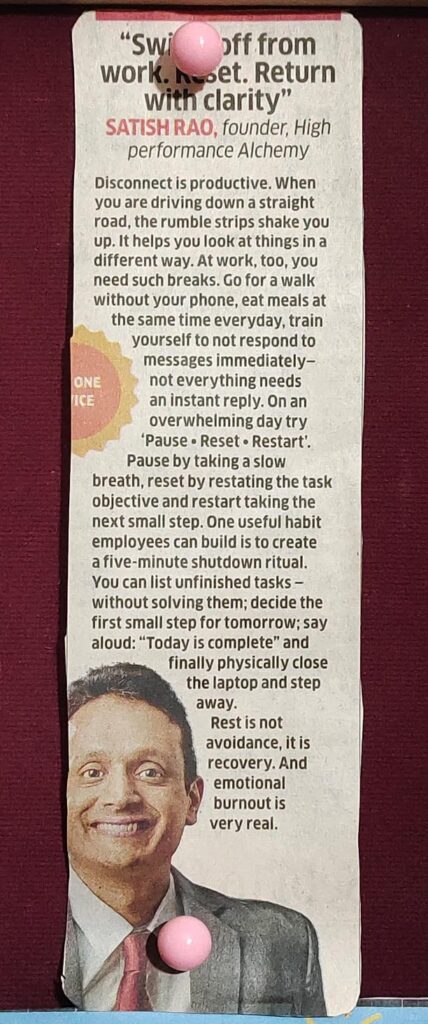
Switch Off to Rise Higher: 

Switch Off to Rise Higher: 

In a world that celebrates speed, hustle and endless productivity, slowing down feels almost rebellious. We are taught to measure our worth by how busy we are, how full our calendars look and how quickly we respond to demands. That is why, when The Economic Times featured Satish Rao, our founder, the headline quietly cut through the noise:

It wasn’t a catchy slogan designed for social media. It wasn’t another productivity hack. It was a deeply grounded insight that came from decades of working with leaders, executives, entrepreneurs and high performers across industries who all shared a common invisible struggle: they were successful, but they were exhausted.

This small newspaper clipping has become a quiet but powerful reminder inside our organization. Not because it flatters us, but because it speaks the truth about what real high performance requires. It captures the philosophy behind everything we do in one-on-one coaching: sustainable success is not built by pushing harder, but by learning when and how to pause.

High performers are often the people everyone relies on. They are capable, driven and dependable. They carry responsibility easily and take pride in delivering results. From the outside, their lives look impressive. From the inside, many of them feel constantly under pressure.

They live with a mind that rarely switches off. Even when they are not working, they are thinking about what needs to be done, what could go wrong or what they should have done better. Sleep becomes lighter. Joy becomes muted. Success starts to feel strangely hollow.

This is not because something is wrong with them. It is because their nervous system is stuck in a constant state of activation. The body does not know the difference between a physical threat and an overflowing inbox. It just knows it is never allowed to rest.

That is why Satish wrote in The Economic Times:

“Disconnect is productive… At work, too, you need such breaks.”

This simple sentence carries a powerful truth. When you never disconnect, you lose the very clarity and creativity you are trying so hard to protect. Space is not a luxury. It is a requirement for clear thinking.

In the same feature, Satish used a metaphor that many people instantly recognized:

“When you are driving down a straight road, the rumble strips shake you up. It helps you look at things in a different way.”

In life, rumble strips come in the form of burnout, restlessness, irritability, anxiety or a vague sense that something is off even when things are going well. They are not signs of weakness. They are signals from your system telling you that something needs to change.

Most people try to ignore these signals. They work harder, distract themselves or push through the discomfort. Over time, the signals get louder. Coaching helps you listen to those rumble strips early, understand what they are pointing to and respond with clarity instead of fear.

We are taught that if something is not working, we should try harder. But effort without recovery leads to tunnel vision. When you are constantly stressed, your brain becomes focused on survival rather than strategy. You become reactive instead of thoughtful. You rush instead of choosing.

This is why Satish introduced the Pause–Reset–Restart framework in his Economic Times article:

Pause by taking a slow, conscious breath.
Reset by restating what truly matters in that moment.
Restart by taking the next small, meaningful step.

This simple sequence helps the nervous system shift out of fight-or-flight and back into clarity. It is how elite performers stay grounded under pressure. Not by pushing harder, but by pausing wisely.

Another insight Satish shared in the feature was the idea of a five-minute shutdown ritual. At the end of each workday, you take a few minutes to write down what is unfinished, decide what the first step will be tomorrow and consciously say, “Today is complete,” before closing your laptop.

This small practice sends a powerful signal to your nervous system: it is safe to rest now. Without it, many people carry their work into their evenings, their sleep and their relationships. Over time, this erodes their energy and their sense of presence.

Coaching helps people turn simple practices like this into consistent habits, because insight alone rarely creates change. Support and accountability do.

People often come to coaching believing they need better time management or more discipline. What they usually discover is that what they really need is emotional steadiness and mental clarity. They need a space where they can slow down, reflect and understand the patterns that drive their behaviour.

One-on-one coaching provides:

  • A safe place to pause
  • A mirror to see yourself honestly
  • Language for emotions you may have been ignoring
  • Structure for the life and career you actually want

This is how people return with clarity. Not by fixing themselves, but by reconnecting with themselves.

Satish wrote something deeply important in The Economic Times:

“Rest is not avoidance, it is recovery. And emotional burnout is very real.”

Burnout does not mean you are weak. It means you have been strong for too long without support. Most high achievers were never taught how to set emotional boundaries, how to recover properly or how to stop without guilt. So they keep going until their body or mind forces them to stop.

Coaching helps you stop before the breakdown. It teaches you how to listen to your limits and work with them instead of against them.

Yes, people become more productive. But what truly changes is how they feel inside their own lives. They become calmer, clearer and more confident. They make better decisions. They show up more fully in their work and their relationships.

When your nervous system is regulated, everything else improves. That is real high performance.

If you feel tired but wired, successful but unsatisfied, busy but unfocused, you are not broken. You are at a rumble strip. It is an invitation to slow down, reset and choose a more sustainable way forward.

When The Economic Times published that headline — “Switch off from work. Reset. Return with clarity.” — it captured something deeply human. We don’t need to escape our lives. We need to come back to them with presence, purpose and peace.

If this article resonated with you, it means part of you is ready for a reset. One-on-one coaching is where that reset becomes real.

And let’s begin.


👉 https://www.highperformancealchemy.com/rrr/

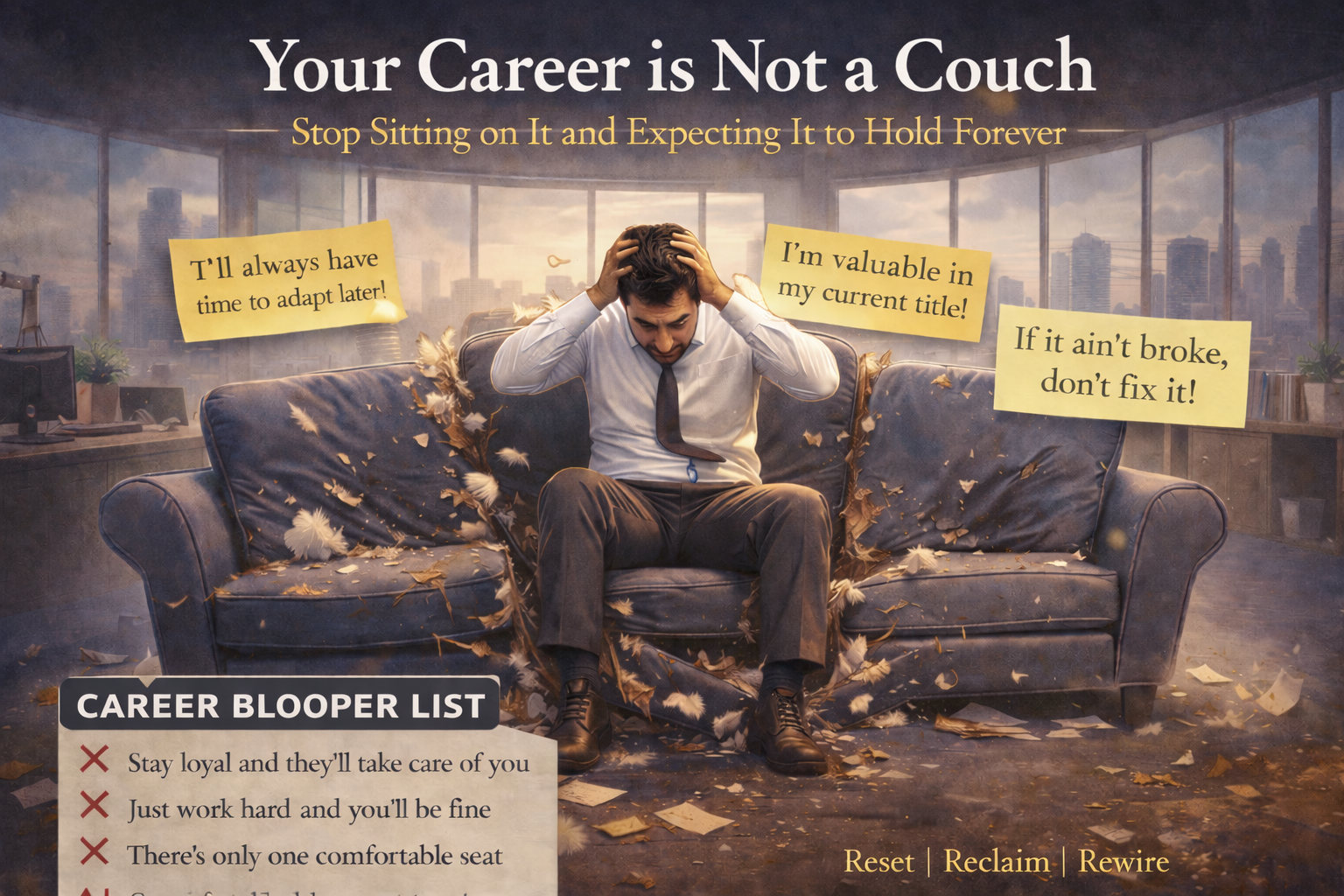
Your Career Is Not a Couch: Stop Sitting on It and Expecting It to Hold Forever

Your Career Is Not a Couch: Stop Sitting on It and Expecting It to Hold Forever

Let’s start with an uncomfortable observation.

Most professionals treat their careers the way they treat a sturdy old couch.

They sit on it every day.
They trust it to hold their weight.
They assume it’ll still be there tomorrow.

Until one day… it collapses.

And everyone says, “That was unexpected.”

It wasn’t.

Layoffs today don’t announce themselves with sirens. They slide into inboxes disguised as:

  • “Reorganisations”
  • “Strategic realignments”
  • “Efficiency initiatives”
  • “Cost optimisation”

And while companies issue polite statements, professionals are left replaying one question in their heads:

“Was there something I should have seen coming?”

The honest answer, more often than not, is yes — but not in the way people think.

Layoffs don’t usually expose incompetence.
They expose assumptions.

Assumptions like:

  • “I’m doing good work, so I’m safe.”
  • “I’ll know when it’s time to prepare.”
  • “If things change, I’ll adapt then.”

These assumptions worked in slower, more predictable times.

They don’t work now.

Which is why RRR — Reset. Reclaim. Rewire. exists: not to scare professionals, but to wake them up gently before panic becomes necessary.

HUMOUR CORNER 😌

  • You refresh LinkedIn but never update your own profile
  • You say “I should network more” at least once a year
  • You think “learning on the job” will always be enough
  • You believe loyalty will be remembered during layoffs
  • You assume your manager will warn you in advance

If you smiled uncomfortably — good. That’s awareness knocking.

Here’s the irony: high performers are often more vulnerable, not less.

Why?

Because success can lull people into:

  • Over-identifying with one role
  • Under-investing in adaptability
  • Avoiding uncomfortable reflection

When the external system changes faster than internal thinking, shock follows.

RRR doesn’t begin with resumes or job searches.
It begins where the real work lives: inside the mind.

Before we go further, pause and answer mentally:

  • If your role disappeared next month, would you have clarity or confusion?
  • Do you know why you’re valuable beyond your current job title?
  • Are you actively building options — or preserving comfort?

If the answers feel fuzzy, you’re not failing.

You’re human.

But humans do better with structure.

(Read Slowly)

  • Job security is not promised — even to top performers
  • Companies optimise for survival, not individual careers
  • Past success does not automatically translate into future relevance
  • Waiting for certainty is often a form of avoidance
  • Stability today does not guarantee stability tomorrow

This isn’t pessimism.
It’s situational awareness.

So What Actually Helps? (Hint: Not Panic)

When uncertainty rises, people usually respond in one of three ways:

  1. Freeze — “I’ll just keep my head down”
  2. Frenzy — “I need to do everything now”
  3. Avoid — “I’ll think about this later”

None of these create long-term career strength.

What does work is a structured internal reset — which brings us to RRR.

Reset
Means stepping out of constant background stress so you can think clearly again.
When the nervous system calms, strategic thinking returns.

Reclaim
Means taking ownership of your career identity instead of outsourcing it to titles, managers, or organisations.

Rewire
Means training your brain to operate confidently in uncertainty — not waiting for stability to come back.

RRR is a 12-week neuroscience-based coaching program because meaningful change requires time, repetition, and integration — not motivation alone.

Use this as a mirror, not a scorecard.

Mindset & Identity

☐ I can explain my value beyond my job description
☐ I don’t tie my self-worth entirely to my role
☐ I’m comfortable questioning my assumptions

Skills & Adaptability

☐ My skills are relevant beyond my current organisation
☐ I actively learn, not only when forced
☐ I understand how my industry is changing

Strategy & Agency

☐ I have more than one possible career path
☐ I don’t rely on a single employer for validation
☐ I make proactive career decisions

Emotional Resilience

☐ I manage stress without denial or panic
☐ I can sit with uncertainty without freezing
☐ I recover quickly from setbacks

The more boxes you tick, the less fragile your career is — regardless of market conditions.

  • “Just work hard and you’ll be fine”
  • “Stay loyal and they’ll take care of you”
  • “You’ll always have time to pivot later”
  • “One company is enough for a lifetime”
  • “If it’s not broken, don’t fix it”

Careers today don’t break loudly.
They erode quietly.

Waiting feels comfortable because it avoids immediate discomfort.

But waiting has a hidden cost:

  • Fewer options
  • Less confidence
  • More reactive decisions later

Proactive reflection is uncomfortable once.
Forced change is uncomfortable many times.

RRR helps professionals choose the first kind of discomfort.

If any of these feel familiar, pay attention:

  • You feel uneasy but can’t name why
  • You sense change but keep postponing reflection
  • You’re busy but not intentionally building your future
  • You rely on “being needed” as security

These aren’t red flags.
They’re early signals.

Signals are only useful if you respond to them.

Professionals who take ownership early report:

  • Clearer decision-making
  • Reduced background anxiety
  • Stronger confidence under uncertainty
  • Greater career flexibility

Not because the world becomes stable — but because they do.

RRR doesn’t promise immunity from layoffs.
It builds capacity to navigate whatever comes next.

Your career is not a couch.

It’s a moving system in a moving world.

You don’t need fear.
You don’t need urgency.
You don’t need to panic.

You need clarity, agency, and adaptability.

That’s exactly what Reset. Reclaim. Rewire. is designed to cultivate.

👉 Learn more here: https://www.highperformancealchemy.com/rrr/

Are you maintaining comfort —
or building capability?

The answer determines far more than your next job.