
The Invisible Forces That Break Systems (And the Ones That Sustain Them)

The Invisible Forces That Break Systems (And the Ones That Sustain Them)

History rarely announces itself while it’s happening.

There are moments—quiet, almost forgettable at the time—that later reveal themselves as turning points. Not because they were dramatic, but because they exposed something deeper. Something structural. Something most people weren’t looking at.

One such moment happened in 1831.

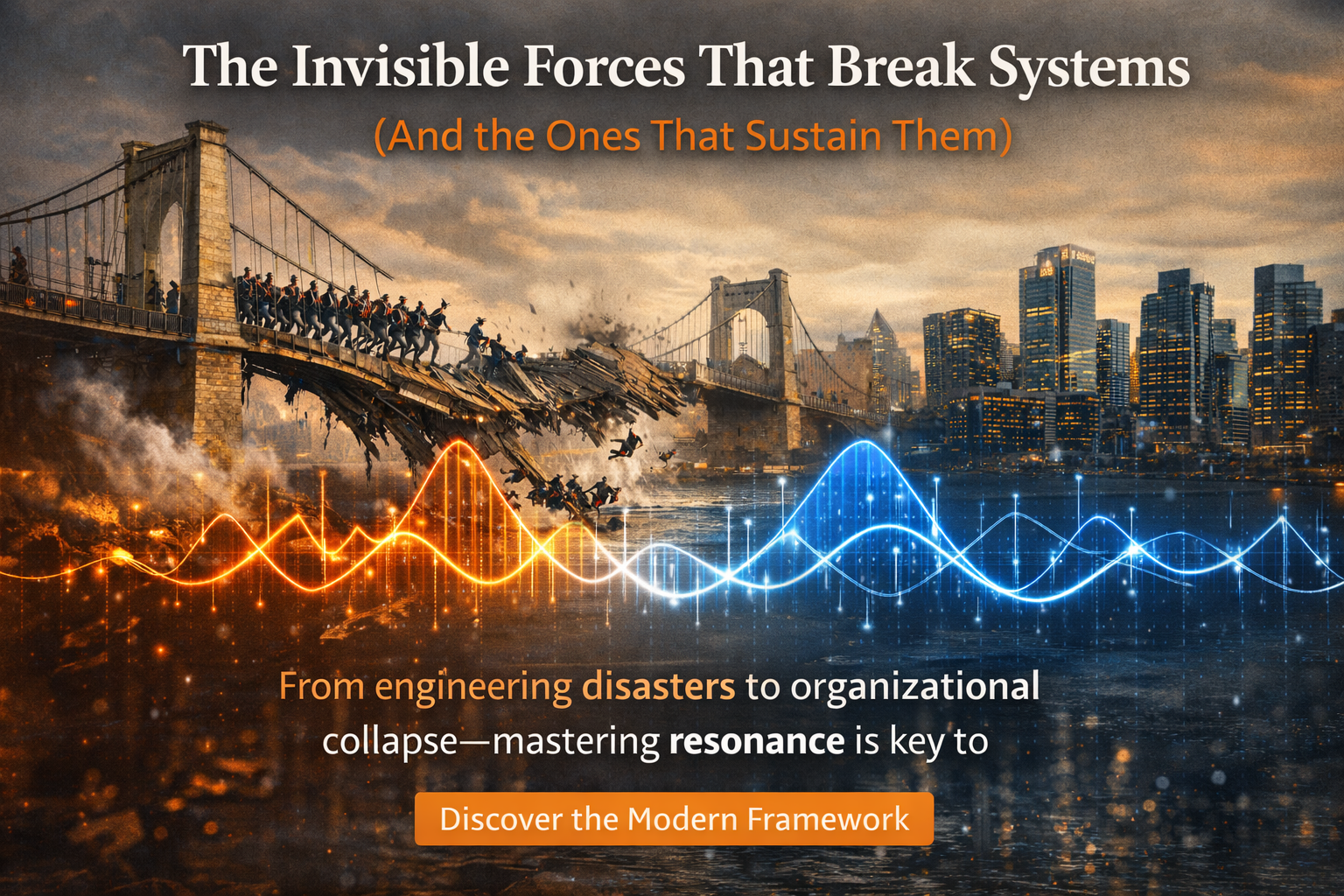
A group of soldiers marched across a suspension bridge in England. They were disciplined, synchronized, precise—the embodiment of order. Halfway across, the bridge began to vibrate. Subtly at first. Then visibly. Then catastrophically.

It collapsed.

Not because the materials were inferior.
Not because the engineers were careless.

But because of something far more subtle: the soldiers were marching in rhythm with the bridge’s natural frequency. Each step added a small amount of energy. Individually insignificant. Collectively, devastating.

The solution, once understood, was almost laughably simple: break the rhythm. From that point forward, soldiers were instructed to march out of step when crossing bridges.

A minor behavioral change prevented structural failure.

It’s tempting to treat this as an isolated engineering curiosity. It isn’t.

Nearly two decades later, in France, another bridge collapsed under eerily similar circumstances. This time, the stakes were higher. Hundreds of soldiers were crossing during a storm. The bridge was already under stress—oscillating under wind forces.

Their movements—uncoordinated at first—began to synchronize unconsciously as they tried to stabilize themselves.

The result: over 200 lives lost.

Again, not a single-point failure.
A system failure driven by alignment of forces.

At first glance, these are engineering stories.

But if you look closely, they are not about bridges.

They are about systems under load.
They are about feedback loops.
They are about alignment—both constructive and destructive.

And most importantly, they are about invisible forces.

This is where the analogy becomes uncomfortably relevant.

Because modern organizations are not mechanical systems—but they behave like them in critical ways.

Every organization develops rhythms.

  • Decision-making cadence
  • Communication patterns
  • Incentive structures
  • Cultural norms around urgency and response

Individually, these feel benign. Even efficient.

But over time, they synchronize.

And when they do, they create amplification effects.

Sometimes positive—momentum, clarity, execution speed.

But often, dangerously negative.

  • Teams reinforcing bad assumptions
  • Leaders unintentionally amplifying pressure cycles
  • Performance metrics driving short-term behavior at long-term cost
  • Escalation loops that intensify instead of resolve

No single action causes failure.

But the system begins to resonate with its own internal pressures.

One of the most persistent myths in leadership is that performance problems are solved by increasing effort.

Push harder.
Move faster.
Demand more.

In stable systems, that can work.

In resonant systems, it accelerates failure.

Because when a system is already oscillating, adding more force—no matter how well-intentioned—doesn’t stabilize it.

It amplifies the oscillation.

This is why you see high-performing teams suddenly burn out.
Why successful organizations drift into dysfunction.
Why strategies that once worked begin to fail without obvious cause.

The issue isn’t effort.

It’s alignment.

The executives who navigate this well operate differently.

They don’t just look at:

  • Metrics
  • Outputs
  • Execution timelines

They look at patterns.

They ask:

  • What rhythms are emerging in this system?
  • Where are feedback loops reinforcing themselves?
  • What pressures are compounding silently?
  • Where might synchronization be creating risk instead of efficiency?

This is a fundamentally different lens.

It shifts leadership from reactive to systemic.

In 1940, the Tacoma Narrows Bridge in Washington State collapsed in dramatic fashion. Unlike earlier incidents, this one was captured on film.

The bridge didn’t simply break.

It twisted. Oscillated. Undulated in the wind like a ribbon.

Engineers had accounted for strength.

What they underestimated was aeroelastic flutter—a feedback loop between wind forces and structural response.

The bridge didn’t fail because it wasn’t strong enough.

It failed because it was dynamically unstable.

Strength vs Stability

This distinction matters more than most executives realize.

  • Strength is about capacity
  • Stability is about behavior under stress

Organizations often optimize for strength:

  • More resources
  • More talent
  • More aggressive targets

But they neglect stability:

  • How decisions propagate
  • How pressure distributes
  • How teams respond under sustained load

A strong but unstable system is fragile.

A stable system, even with constraints, is resilient.

When organizational rhythms are misaligned, the symptoms don’t appear immediately.

They show up as:

  • Slower decision-making despite more meetings
  • Increased effort with diminishing returns
  • Talent fatigue without clear burnout signals
  • Strategic drift despite clear goals

These are not execution problems.

They are systemic ones.

And they are notoriously hard to diagnose because they don’t originate in a single place.

They emerge from interaction.

The instruction given to soldiers—break step—seems simple.

But applied to leadership, it becomes profound.

Breaking step means:

  • Interrupting harmful cycles
  • Introducing asymmetry into rigid systems
  • Challenging synchronized thinking
  • Creating space for variation and recovery

It’s not about disorder.

It’s about preventing destructive alignment.

In practice, this might look like:

  • Slowing down a decision process that’s accelerating blindly
  • Rotating perspectives in leadership discussions
  • Redesigning incentives that reinforce short-term loops
  • Creating deliberate pauses in high-pressure cycles

These are subtle moves.

But they change the system’s behavior.

Modern organizations operate in environments that are:

  • Faster
  • More interconnected
  • More feedback-driven

This increases the likelihood of resonance effects.

What once took years to build can now emerge in weeks.

Cultural patterns, market responses, internal dynamics—they synchronize rapidly.

Which means:

Small misalignments scale faster.
Hidden stresses accumulate quicker.
Failures, when they happen, feel sudden—but are anything but.

The lesson from bridges is not about engineering.

It’s about recognizing that:

Systems fail not just because of what they are made of—but because of how they behave over time.

Human systems—organizations, teams, leadership structures—are even more complex.

They contain:

  • Emotions
  • Incentives
  • Perception biases
  • Informal networks

Which makes their “resonance patterns” harder to see—but more impactful.

Most executive frameworks focus on:

  • Strategy
  • Execution
  • Performance optimization

Few focus deeply on:

  • System dynamics
  • Feedback behavior
  • Rhythm alignment

Yet these are often the underlying drivers of success or failure.

The difference between organizations that scale sustainably and those that don’t is rarely visible in their strategies.

It’s visible in how their systems behave under pressure.

If you step back and look at your own organization:

  • Where are rhythms reinforcing themselves?
  • Where might alignment be creating hidden risk?
  • What cycles are accelerating without intervention?

And perhaps most importantly:

Where might you need to “break step”?

Understanding these dynamics isn’t intuitive.

It requires a different lens—a way of seeing performance not just as output, but as a function of system behavior.

That’s exactly what this explores in more depth:

👉 https://highperformancealchemy.com/rrr/

If you are leading complex systems—and at your level, you are—the ability to recognize and shape these invisible forces isn’t optional.

It’s the difference between systems that scale…
and systems that eventually collapse under their own rhythm.

You are Not Safe Just Because You Have a Job

You are Not Safe Just Because You Have a Job

This title isn’t just there for context. It’s pointing to a shift that’s already affecting how you are being evaluated—whether you have noticed it yet or not.

Layoffs aren’t just happening because companies are struggling.

They are happening because companies are filtering differently.

And if you are still employed, this matters more to you than to someone already laid off.

Because right now, you are being silently assessed.

Not in reviews.
Not in feedback meetings.

In real time.

They start with replaceability.

And replaceability today has nothing to do with how hard you work.

It’s about this:

👉 When things get unclear… do you create clarity?
👉 When things break… do you think or just execute?
👉 When direction shifts… do you adapt or wait?

If your value is execution—

You are exposed.

Because execution is getting cheaper, faster and easier to replace.

“I’m doing well. I’m delivering. I’m safe.”

That used to be enough.

It’s not anymore.

Because the benchmark has moved.

You are not being compared to your peers.

You are being compared to:

  • People who think better under pressure
  • People who don’t need clarity to move forward
  • People who challenge direction without creating friction

And increasingly—

You are being compared to systems.

There’s always a moment.

A meeting where:

  • The data doesn’t make sense
  • The timeline is unrealistic
  • The direction feels off

Everyone sees it.

No one says it.

What do you do in that moment?

That’s your real performance.

Do you stay quiet?
Do you push forward anyway?
Or do you slow things down and rethink the problem?

That’s the difference between:

Being useful
and
Being critical

And only one of these survives the cuts.

This is where most mid-to-senior professionals get caught off guard.

You have seen a lot.
Handled pressure.
Delivered outcomes.

So you assume you will be fine.

But here’s the shift:

Experience helps in familiar situations.

Layoff decisions happen in unfamiliar ones.

Where:

  • The business model is changing
  • AI is replacing chunks of work
  • Leaders don’t have clear answers either

In those moments—

Your experience doesn’t save you.

Your thinking does.

You have seen this.

Someone who isn’t the strongest technically…

Still stays.

Still gets trusted.

Still grows.

Why?

Because when things get messy—they don’t.

They bring clarity.

They ask better questions.

They don’t panic.

They don’t wait.

They think.

That’s what people mean when they say:

“We need people who can think.”

When things get uncertain—

Do you actually think better?

Or do you:

  • Rush to conclusions
  • Wait for direction
  • Stick to what’s worked before
  • Avoid challenging decisions

This isn’t about intelligence.

It’s about how you respond under pressure.

And most people get this wrong about themselves.

That’s the problem.

No one tells you:

“You defaulted to safe thinking.”
“You avoided the real issue.”
“You didn’t challenge when it mattered.”

You just continue.

Until one day—

You are no longer needed.

Not based on your experience.

Not based on your last appraisal.

But based on how you operate when things are unclear, pressured and moving fast.

Do you:

Create clarity
or wait for it?

Think better
or just faster?

Respond
or react?

If you don’t have a clear answer—

That’s the risk.

You can check this here:

https://highperformancealchemy.com/rrr/#quiz

It’s not a “quiz.”

It shows you how you actually respond when things get uncomfortable.

Take it.

Don’t overthink it.

And if you are willing—share your score.

Most people won’t.

Which tells you everything.

If your result shows a gap—

Good.

Now you know.

Because right now, you still have something most people don’t:

Time.

Time to change how you think.
Time to sharpen how you respond.
Time to become harder to replace.

There’s an option to book a call there.

Not a pitch.

Just a conversation to understand what your result actually means for you.

Having a job right now doesn’t mean you are safe.

It means you are being evaluated.

Continuously.

Quietly.

And the people who stay won’t be the ones who worked the hardest.

They will be the ones who thought better when it mattered.

When the World Feels Unstable, Standing Still Is the Biggest Risk

When the World Feels Unstable, Standing Still Is the Biggest Risk

This is one of those moments when uncertainty isn’t just background noise.
It becomes the environment.

Right now, across industries and geographies, that environment is loud.

Geopolitical tensions are rising.
Markets are tightening.
Layoffs are becoming patterns, not exceptions.

And in the middle of all this, something quieter—but far more dangerous—is happening:

People are freezing.

Not physically.
Not visibly.

But mentally.

Uncertainty doesn’t just affect outcomes.

It changes how you think.

You start second-guessing decisions you once made with clarity.
You hesitate before speaking, even when you know you are right.
You begin to measure your actions—not for impact, but for safety.

And slowly, without realizing it, your world starts shrinking.

This is how uncertainty works.

It doesn’t always break you dramatically.
It reshapes you quietly.

You become more cautious.
More reactive.
Less willing to take risks.

And on the surface, it looks responsible.

But underneath, something else is happening:

You are stepping back from your own potential.

“I should just be grateful I still have a job.”

It sounds reasonable.
It sounds grounded.

But in the current environment, it comes with a hidden cost.

Because gratitude, when mixed with fear, often turns into compliance.

You stop asking difficult questions.
You stop challenging assumptions.
You stop thinking beyond the immediate.

Your focus narrows to survival.

And survival thinking is, by design, short-term.

It protects you in the moment…
but it prevents you from positioning yourself for what’s next.

A Reality That’s Hard to Accept

Recently, we worked with someone who made what looked like a strong, well-calculated move.

A new role.
A new geography.
Better visibility.

Everything suggested progress.

And for a while, it seemed like it was.

But then the environment shifted.

The expectations changed.
The internal dynamics became unclear.
The support they assumed would be there… wasn’t.

What initially felt like momentum slowly turned into friction.

But here’s the part that made it harder:

They couldn’t accept it.

Because accepting it meant questioning a decision they had already justified—to themselves and to others.

So instead of confronting the misalignment…

They stayed.

They continued to perform.
They stayed busy.
They stayed externally “on track.”

But internally, they were stuck.

This isn’t rare.

In fact, it’s far more common than people admit.

Because for high-performing professionals, acknowledging that something isn’t working is not just uncomfortable—it challenges identity.

Life Doesn’t Pause When You Do

This is where most people get caught off guard.

When things feel uncertain, the natural instinct is to pause.

To wait.
To observe.
To hold position until things become clearer.

But the world doesn’t operate that way anymore.

It doesn’t slow down while you figure things out.

It moves.

Industries evolve.
Expectations shift.
Opportunities redistribute.

And while all of this is happening, many capable professionals are doing one thing:

Waiting for clarity.

But clarity rarely arrives before movement.

It emerges through it.

This Isn’t a Normal Phase

Let’s be clear—this isn’t just another cycle.

The psychological load right now is different.

There is a constant undercurrent of questions:

“What if I’m next?”
“What if this role disappears?”
“What if I made the wrong move?”

And when these questions remain unresolved, they don’t just sit in the background.

They influence behavior.

They shape how you show up.
How you communicate.
How you make decisions.

Over time, they redefine your professional identity—without you consciously choosing it.

Losing a job is visible.
It’s immediate.

But the deeper risk is far less obvious.

It’s the gradual erosion of:

Confidence.
Clarity.
Strategic thinking.

When that happens, even if your role remains intact…

Your effectiveness doesn’t.

And in today’s environment, relevance is not guaranteed by position.

It’s sustained by how you think, adapt and respond.

If this resonates—even slightly—it’s worth pausing here.

Not to react. But to assess.

Because most people don’t realize where they actually stand until it’s too late.

If you want a clearer view of where you are right now, this will help:


https://highperformancealchemy.com/rrr/#quiz

In response to uncertainty, most professionals instinctively try to compensate.

They do more.

More courses.
More certifications.
More networking.
More output.

But effort without direction doesn’t create progress.

It creates noise.

And eventually, exhaustion.

Because the issue isn’t a lack of capability.

It’s a lack of alignment.

Traditional advice focuses on external action:

Upgrade your skills.
Expand your network.
Increase visibility.

All of this is useful.

But none of it addresses the internal disruption caused by uncertainty.

And that’s where the real shift needs to happen.

Not louder.
Not faster.

But deeper.

Not as a slogan.
As a sequence.

A way to navigate environments where external stability can’t be guaranteed.

Right now, many professionals are operating in a constant low-grade stress state.

Not overwhelmed enough to stop.

Not calm enough to think clearly.

This is what makes it dangerous.

Because it feels normal.

But in this state:

Your thinking narrows.
Your decisions become defensive.
Your creativity declines.

Reset isn’t about stepping away from work.

It’s about stepping out of reactive mode.

Creating enough mental space to observe instead of immediately respond.

Because without that space, every decision you make is influenced by pressure—not clarity.

This is the most uncomfortable step.

Because it requires you to confront how much of your identity is tied to your role.

Your title.
Your organization.
Your current environment.

When things are stable, this feels natural.

But when uncertainty rises, it becomes fragile.

Reclaiming is about recognizing:

Your value is not defined by your current context.

It is defined by how you think.
How you solve problems.
How you adapt when conditions change.

If you don’t consciously reclaim this…

You begin to negotiate your worth based on external validation.

And in unstable environments, that validation is inconsistent at best.

This is where transformation actually happens.

Rewiring is not about becoming someone else.

It’s about changing how you engage with complexity.

How you interpret uncertainty.
How you make decisions under pressure.
How you respond when things don’t go as planned.

Most people wait to feel ready before they change.

But in reality, readiness comes after action—not before it.

Rewiring is about moving forward without needing perfect clarity.

Because in today’s world, clarity is not a prerequisite.

Adaptability is.

Most professionals will not do this work.

Not because they lack intelligence or experience.

But because it requires confronting uncomfortable realities:

That they might be stuck.
That their current approach isn’t working.
That waiting is not a strategy.

And facing this requires a level of honesty that many postpone.

Nothing dramatic.

No immediate collapse.

Just a slow, almost invisible drift.

You continue doing what you have always done.
Thinking how you have always thought.
Responding the same way to new challenges.

And over time…

The gap between where you are and where you could be begins to widen.

Quietly.

You don’t need to start over.

You don’t need to discard everything you have built.

But you do need to evolve.

Intentionally.

Because the environment already is.

You can wait.

Hope things stabilize.
Hope clarity emerges.
Hope the situation improves.

Or you can engage.

Not in panic.
Not with forced urgency.

But with awareness.

Life moves forward.

Whether you move with it…
or choose to stay where you are.

And That’s the Hardest Part to Accept

That staying still is also a decision.

One that feels safe in the moment…

But carries a cost over time.

That’s not a signal to retreat.

It’s a signal to recalibrate.

Quietly.
Deliberately.

Before the environment forces you to.

Reset. Reclaim. Rewire.

Not because it sounds compelling.

But because in a world that won’t slow down…

It’s how you stay relevant.

And more importantly—

How you move ahead of it.

Explore the full framework here:


https://highperformancealchemy.com/rrr/

The Leadership Reset No One Prepared You For

The Leadership Reset No One Prepared You For

If you are reading this, you are likely carrying more than your title suggests.

Not just targets.
Not just teams.
But the invisible weight of navigating a world that refuses to slow down.

Let’s talk—just you and me—for a moment.

Because whether you sit in a corner office of a global enterprise or lead a scrappy* team in a scaling startup, something has fundamentally shifted. And deep down, you already know it.

(*A scrappy startup is a resource-constrained but highly driven company that survives and grows through hustle, creativity and speed rather than structure.)

This isn’t about “keeping up” anymore.

This is about reinventing how you operate as a leader.

For years, leadership came with a promise:

Gain experience → Build expertise → Rise → Stabilize

But here’s the uncomfortable truth:

That model is broken.

Experience is depreciating faster than ever.
Expertise is getting outdated in months.
And stability? It’s become a myth.

What you are dealing with now isn’t just change.

It’s continuous disruption layered with human fatigue.

And depending on where you sit—your challenges look very different.

Let’s unpack that.


You might be leading a large team, managing multiple stakeholders and operating within systems that took decades to build.

From the outside, it looks powerful.

From the inside, it often feels… slow.

You are navigating:

  • Endless alignment meetings
  • Decision paralysis masked as “process”
  • Pressure to adopt AI without breaking legacy systems
  • Teams that are silently overwhelmed but still “performing”

And here’s the paradox:

You are expected to move faster
Inside a system designed to move carefully.

So what happens?

You become the bridge.

Between old and new.
Between caution and urgency.
Between performance and people.

And that bridge starts to crack.

Not visibly.
But internally.

You might notice it as:

  • Mental fatigue despite doing “less” tangible work
  • Increasing frustration with bureaucracy
  • A quiet sense that your leadership toolkit isn’t enough anymore

You are not failing.

You are operating in a system that hasn’t caught up with reality.


Now let’s shift.

If you are in a startup—especially one scaling fast—your world looks completely different.

There’s no shortage of speed.

In fact, speed is the problem.

You are dealing with:

  • Constant pivots
  • Undefined roles
  • High expectations with limited resources
  • A team that looks to you for clarity you don’t always have

And then there’s the AI factor.

Suddenly, everything you thought was your competitive edge is being commoditized.

So you push harder.

Move faster.
Decide quicker.
Stretch further.

And again—another paradox:

You are expected to create stability
Inside an environment that thrives on instability.

So what happens?

You become the shock absorber.

Taking hits from investors, markets and internal chaos—while projecting confidence.

And over time, that creates:

  • Decision fatigue
  • Emotional exhaustion
  • A creeping fear of making the “wrong” call in a high-stakes environment

You are not overwhelmed because you are incapable.

You are overwhelmed because you are operating at the edge of uncertainty—every single day.


And then there’s the middle.

Often overlooked.
Often misunderstood.

Mid-sized organizations are in a unique tension:

  • Too big to move like a startup
  • Too small to absorb shocks like an enterprise

You are likely dealing with:

  • Scaling challenges without scalable systems
  • Cultural drift as the company grows
  • Pressure to professionalize without losing agility
  • Leaders at different maturity levels pulling in different directions

And here’s the real challenge:

Identity.

Who are you as an organization?

A startup?
An enterprise?
Something in between?

Because your answer to that question shapes every decision.

And if that identity isn’t clear—leadership becomes fragmented.

You might feel:

  • Pulled between structure and speed
  • Frustrated by inconsistent decision-making
  • Stretched trying to “fix” both people and systems

You are not stuck.

You are in a transition phase that requires a completely different leadership mindset.


Now here’s where it gets interesting.

Despite all these differences—there’s one thread connecting all of you:

Your capacity is being tested like never before.

Not your intelligence.
Not your experience.
Not your strategy.

Your capacity.

Your ability to:

  • Think clearly under constant pressure
  • Stay grounded amid uncertainty
  • Make decisions without complete information
  • Lead humans who are also overwhelmed

This is where most leadership frameworks fall short.

They give you tools.

But they don’t expand your capacity to use those tools under pressure.

And that’s why even the best leaders are feeling… stretched.


Here’s the perspective shift that changes everything:

Leadership is no longer about what you do.
It’s about how you operate.

Let that sink in.

Because you can have:

  • The best strategy
  • The smartest team
  • The latest technology

And still struggle—if your internal operating system isn’t designed for this level of complexity.

So the real question becomes:

What version of you is leading right now?

The reactive version?
The overwhelmed version?
The high-performing but exhausted version?

Or a version that can actually thrive in this environment?


This is where most people expect another list of tips.

That’s not what you need.

You don’t need more hacks.

You need a shift in how you fundamentally engage with pressure, performance and leadership.

Think of it in three movements:

1. Reset

Not a vacation.
Not a break.

deliberate pause to recalibrate how you are operating.

Because right now, many leaders are running on outdated mental models.

Reset is about:

  • Recognizing what’s no longer working
  • Interrupting autopilot patterns
  • Creating space for clarity

It’s not about slowing down.

It’s about resetting your baseline.


2. Reclaim

Somewhere along the way, leadership starts to feel like loss.

Loss of time.
Loss of energy.
Loss of control.

Reclaim is about taking that back.

  • Your focus
  • Your decision-making clarity
  • Your emotional bandwidth

This is where you move from:

“I have too much on my plate”

To:

“I decide what deserves my energy”

And that shift is powerful.


3. Rewire

This is the part most people skip.

Because it’s uncomfortable.

Rewiring means:

  • Changing how you respond to pressure
  • Building new cognitive and emotional patterns
  • Upgrading your internal operating system

Not temporarily.

But permanently.

Because the environment isn’t going back.

So you can’t either.


Let’s zoom out for a second.

AI is accelerating everything.

Markets are shifting faster.

Teams are more distributed, more diverse and more demanding.

And in the middle of all this—you are expected to lead.

Not just deliver.

Not just manage.

Lead.

Which means:

  • Holding vision in chaos
  • Creating clarity in ambiguity
  • Driving performance without burning people out

This isn’t a skills problem.

It’s a capacity problem.

And the leaders who recognize this early?

They don’t just survive this phase.

They define it.


Most people are still looking for external advantages:

  • Better tools
  • Better frameworks
  • Better strategies

But the real advantage is internal.

It’s how quickly you can:

  • Adapt your thinking
  • Regulate your state
  • Expand your capacity

Because in a world where everything is changing—

You are the only constant in your leadership equation.

And upgrading that constant changes everything.

Let me ask you something.

Not as a leader.
Not as a title.

But as a human navigating all of this:

Not for the next quarter.

But for the next 2–3 years.

Because if the answer is “barely”—you are not alone.

But you also don’t have to stay there.

This is exactly why frameworks like Reset → Reclaim → Rewire are becoming essential—not optional.

They are not about adding more.

They are about transforming how you lead from the inside out.

Your Next Step (If This Resonated)

If you have read this far, something likely clicked.

Maybe it was the tension you are feeling.
Maybe it was the realization that your challenges aren’t unique—they are systemic.
Or maybe it was the quiet acknowledgment that something needs to change.

If that’s the case, don’t ignore it.

Explore what this shift can look like for you:

👉 https://highperformancealchemy.com/rrr/

Because the future won’t be led by those who simply adapt faster.

It will be led by those who operate differently.

And that starts with you.

You Don’t Lack Clarity. Your Brain Doesn’t Feel Safe Yet.

You Don’t Lack Clarity. Your Brain Doesn’t Feel Safe Yet.

Not your role.
Not your company.
Not the market.

You.

You have built a life where people rely on your thinking.

You are the one others come to when things are unclear.
When decisions matter.
When stakes are high.

And for years… that’s been your edge.

But lately?

Something subtle has shifted.

You are still performing.
Still delivering.
Still “on top of things.”

But inside…

It feels like your mind has too many tabs open.
All the time.

You sit down to think.

And instead of clarity…
you get noise.

Not loud panic.

Worse.

Let me show you what’s really happening — not at a motivational level…

…but at a neural survival level.

🧠 Your brain is treating your career like a threat.

Not logically.

Biologically.

Your brain has one primary job:

Keep you safe.

Not successful.
Not fulfilled.
Safe.

And here’s what’s changed.

A few years ago, your environment was relatively predictable:

  • Roles evolved slowly
  • Expertise stayed valuable longer
  • Decisions had clearer cause and effect

Today?

Everything feels… unstable.

Even if you don’t say it out loud.

Somewhere in your system, questions like these are running quietly:

  • “What if I’m no longer relevant?”
  • “What if I miss something important?”
  • “What if I make the wrong move now?”

And your brain interprets this as:

⚠️ Potential loss of status
⚠️ Potential loss of control
⚠️ Potential loss of identity

To your nervous system…

That’s a threat.

So it does something very intelligent… and very costly.

It doesn’t push you forward.

It slows you down.

Because from a survival perspective:

👉 “If you are unsure… don’t act.”

That hesitation you are feeling?

That’s not confusion.

That’s neural braking.

The more important you are…

The more your brain tries to protect you.

Which means:

The higher you rise…
the more likely you are to overthink.

Not because you are weak.

Because the cost of being wrong feels higher.

Your brain would rather keep you in a loop of thinking…

than risk you taking a step it cannot predict.

So it creates the illusion of productivity:

  • Analyzing
  • Evaluating
  • Considering
  • Reconsidering

But underneath all of that…

There’s one signal repeating:

👉 “Not safe yet.”

And as long as your brain believes that…

It will not give you clarity.

This is why you feel stuck.

Not because you don’t know what to do.

But because your brain won’t let you move.

Read that again

You are not lacking answers.

You are lacking permission from your nervous system to act on them.

That’s the difference.

Be honest.

Did you really not know what to do?

Or…

Did you just not feel certain enough to act?

That gap?

That’s not strategy.

That’s biology.

You cannot solve a safety problem with more thinking.

Because thinking is the result of safety.

Not the cause of it.

When your brain feels safe:

  • Decisions feel obvious
  • Action feels natural
  • Focus returns effortlessly

When it doesn’t:

  • Everything feels complex
  • Every option feels risky
  • Even simple steps feel heavy

So what actually changes this?

Not more analysis.

Not more effort.

Signals of safety.

And you give it that through action.

Not massive action.

Not perfect action.

Certain action.

Small, irreversible steps.

The kind your brain can register as:

👉 “We moved… and nothing broke.”

That’s how clarity comes back.

Not before.

After.

  • The email you are delaying matters
  • The conversation you are avoiding matters
  • The decision you are circling matters

Because every delay reinforces:

👉 “Still not safe.”

And every action rewrites it to:

👉 “We are okay. Keep going.”

But you will recognize as true.

You don’t need more time to think.

You need less fear in your system.

Because right now…

You are not confused.

You are protecting yourself from being wrong.

And that protection is costing you:

  • Speed
  • Momentum
  • Confidence

Not changing your intelligence.
Not changing your experience.

Just removing the internal friction.

Suddenly:

  • Decisions shorten
  • Action accelerates
  • Your old sharpness returns

Not because you improved.

Because you are no longer blocked.

And this is where most high performers get stuck.

They try to solve this at the level of:

  • Strategy
  • Productivity
  • Information

But the real lever is:

Your nervous system.

👉 If you have felt this — even slightly — you already know this isn’t about doing more.

It’s about thinking clearly again.And that’s not something you force.

It’s something you restore.

If you want to experience what that feels like again:

https://www.highperformancealchemy.com/rrr

free 30-minute conversation designed for mid to senior level executives navigating exactly this invisible pressure.

No frameworks.
No generic advice.

Just helping you remove what’s slowing your mind down.

Because you were never stuck.

You were just…
trying to move with a brain that didn’t feel safe yet.

When Experience Quietly Turns Against You

When Experience Quietly Turns Against You

(And why many accomplished professionals don’t notice it until it’s late)

Not failure.
Not burnout.

Something quieter.

Experience sometimes starts repeating itself instead of evolving.

If you have been in your profession for fifteen or twenty years, you have probably already proven yourself many times over.

You have handled complex situations.
You have made difficult decisions.
You have built credibility.

When things become complicated, people often turn to you.

Your calendar is full.
Your responsibilities are significant.
Your judgement carries weight.

From the outside, everything appears exactly as it should.

Your career is progressing.
Your influence is growing.
Your work remains demanding.

But let me ask you something.

Have you ever noticed a moment when your work started feeling… familiar?

Not easier.

Just familiar.

Problems begin to resemble situations you have handled before.
Decisions come faster because you recognise the patterns.
Situations that once required deep thinking now feel almost instinctive.

At first, this feels like mastery.

After all, experience is supposed to make things easier.

But there is a subtle shift that sometimes happens in long careers — and most professionals never notice it while it is happening.

Experience sharpens your judgement.

But it can also quietly narrow the questions you ask.

Take a moment and answer these honestly.

Not as a leader.
Not as someone responsible for outcomes.

Just as a professional reflecting on your own growth.

1. When was the last time your thinking was seriously challenged?

Not your workload.

Your thinking.

When did a conversation, idea or experience force you to rethink how you approach leadership, strategy or decision-making?

If you cannot easily recall such a moment recently, that may be worth noticing.

Earlier in our careers this happens constantly.

Later in our careers it becomes surprisingly rare.

2. Are the problems you solve today genuinely new?

Or are they mostly variations of problems you solved years ago?

Experience helps you recognise patterns quickly.

But when everything begins to feel familiar, it may not mean the work has become easier.

It may simply mean your environment is no longer stretching your thinking.

3. Who regularly questions your assumptions?

Earlier in your career, feedback was everywhere.

Managers corrected you.
Peers challenged your ideas.
Mentors pointed out blind spots.

But something changes as professionals become more senior.

Fewer people question how you think.

Not necessarily because they agree.

But because hierarchy quietly discourages disagreement.

Over time this creates something many experienced professionals never notice:

A leadership echo chamber.

4. When did curiosity last replace certainty?

Think back to earlier stages of your career.

Curiosity probably drove much of your growth.

You asked questions.
You explored unfamiliar ideas.
You sought perspectives different from your own.

Success changes that dynamic.

Confidence gradually replaces curiosity.

Confidence helps you lead.

But curiosity is what keeps you evolving.

5. Do you still feel intellectually stretched by your work?

Or mostly responsible for it?

This is a subtle but important difference.

At some point in many careers, professionals stop being stretched intellectually and start becoming responsible for outcomes instead.

They guide others.
They make decisions.
They carry accountability.

All of this matters.

But it also means their own thinking is no longer being pushed into unfamiliar territory.

And when that happens, growth begins slowing — quietly.

Consider the five questions above.

How many made you pause?

0–1 questions
Your thinking is probably still being stretched regularly.

2–3 questions
Something may have quietly shifted in how your work challenges you.

4–5 questions
You may be experiencing the pattern this article describes.

Not failure.

Not burnout.

Simply a stage where experience has begun operating on autopilot.

Some professionals notice this shift earlier than others.

And when they do, they make a deliberate decision.

They step outside their own thinking.

Not because they doubt their expertise.

But because they understand something many professionals realise too late:

Experience occasionally needs recalibration.

They pause.

They examine the patterns shaping their decisions.

They question assumptions that once felt permanent.

And in doing so, they reopen the same intellectual expansion that drove their earlier success.

The question most professionals rarely ask themselves

Here is the question that sits quietly underneath everything you have just read.

It is not always comfortable.

But it matters.

Not working harder.

Not managing more responsibility.

Evolving.

Because the difference between long-term influence and quiet professional stagnation often comes down to one thing:

Whether you examine your thinking before circumstances force you to.

If this reflection felt familiar

If two or more of the earlier questions made you pause, it may be worth taking a closer look at how your thinking is evolving.

That is exactly why the RRR framework — Reset · Reclaim · Rewire — was created.

It helps experienced professionals step back and examine the thinking patterns, pressures and assumptions that quietly shape how they lead, decide and evolve.

You can explore it here:

https://www.highperformancealchemy.com/rrr

Sometimes the most important shift in a career does not come from doing more.

It comes from seeing your own thinking differently.

I’m curious about something.

If you have been in your field for 15+ years, when was the last time your thinking was genuinely stretched by your work?

Not your workload.

Your thinking.

The Uncomfortable Truth About Career Survival in an Age of Uncertainty

The Uncomfortable Truth About Career Survival in an Age of Uncertainty

Something unsettling is happening in the professional world right now.

And if you are a mid-to-senior professional, you can probably feel it.

The rules that built your career are quietly disappearing.

For years the formula seemed predictable.

Work hard.
Build expertise.
Climb steadily.
Stay relevant.

But suddenly the ground feels unstable.

Companies that looked invincible are laying off thousands.

Entire roles are being automated or restructured.

Experienced professionals with 15–25 years of expertise are waking up to something they never expected to worry about again:

Career insecurity.

Not because they failed.

But because the world changed faster than the systems they relied on.

If you listen carefully to conversations in boardrooms, leadership calls and private coffee meetings, a pattern is emerging.

It usually sounds like this:

“Things feel unpredictable.”

“AI is changing everything.”

“Restructuring is happening again.”

“I need to future-proof my career.”

But underneath those polite phrases is a deeper emotion.

Fear.

Fear of becoming irrelevant.

Fear of being replaced by younger, cheaper or automated talent.

Fear of suddenly discovering that decades of experience no longer guarantee stability.

Many professionals don’t say it out loud, but internally they are asking a question that once seemed unthinkable:

“What if everything I have built can disappear faster than I imagined?”

This question is not irrational.

Look around.

Industries are transforming at a pace never seen before.

Technology cycles that once took decades now happen in months.

And organizations are constantly restructuring in response to market shocks, AI disruption and economic uncertainty.

The result is a professional environment that feels like permanent instability.

Most people respond to uncertainty in predictable ways.

They double down on effort.

They work longer hours.

They attend more courses.

They collect more certifications.

They stay constantly busy.

It feels responsible.

It feels proactive.

But here’s the uncomfortable truth:

Many of the people losing jobs today were extremely hardworking.

Many were highly skilled.

Many had strong track records.

The problem wasn’t effort.

The problem was operating on outdated assumptions about how careers actually work.

For decades, professional success was based on stability.

Now success is based on adaptability.

And adaptability doesn’t come from working harder.

It comes from upgrading how you think, decide and operate.

Most professionals believe their career is driven by external factors.

Their company.

Their industry.

Their manager.

Market conditions.

But in reality, something much more powerful determines the trajectory of your professional life.

Your internal operating system.

This includes:

Your mental models.
Your habits.
Your decision patterns.
Your relationship with uncertainty.
Your ability to adapt under pressure.

These invisible factors determine how you respond when the world changes.

Some people freeze.

Some people panic.

Some people double down on outdated strategies.

And a very small group does something different.

They reset their thinking.

They reclaim control of their direction.

They rewire how they operate.

There is a moment that separates professionals who stagnate from those who evolve.

It is the moment they stop reacting and start reflecting.

This moment is uncomfortable.

Because it forces you to ask difficult questions.

Questions like:

“Am I still operating on assumptions that no longer work?”

“Am I optimizing a system that is already outdated?”

“Have I been so busy performing that I stopped redesigning how I perform?”

Most professionals never ask these questions.

They stay inside the noise.

Meetings.

Deadlines.

Email.

Firefighting.

Constant activity that creates the illusion of progress.

But sometimes the most powerful move in a career is not acceleration.

It is Resetting.

Resetting means stepping outside the noise long enough to see clearly again.

Not quitting.

Not disengaging.

Just creating space to evaluate the bigger picture.

Because if you don’t reset occasionally, you may spend years climbing a ladder that is leaning against the wrong wall.

Once professionals reset, something surprising often happens.

They realize how much control they have slowly surrendered.

Over time many professionals unknowingly give away the most valuable resources they have.

Their attention.

Their time.

Their strategic thinking.

Their autonomy.

They become reactive.

Responding to demands.

Responding to crises.

Responding to other people’s priorities.

Without realizing it, they become highly efficient operators inside someone else’s agenda.

This is where the second shift becomes critical.

Reclaiming.

Reclaiming your attention.

Reclaiming your direction.

Reclaiming your ability to think strategically rather than react constantly.

This is not about rebellion.

It is about intentionality.

Because professionals who don’t reclaim control of their direction eventually discover that someone else has decided it for them.

Sometimes that realization comes in the form of a restructuring email.

Or a sudden conversation with HR.

Resetting creates clarity.

Reclaiming restores control.

But lasting transformation happens through something deeper.

Rewiring.

Rewiring means upgrading the mental models and behavioral patterns that quietly shape your results.

Many professionals try to solve modern career challenges with outdated thinking.

They believe experience alone guarantees relevance.

They assume stability will eventually return.

They hope that working harder will automatically produce security.

But the professionals thriving in uncertain environments operate differently.

They continuously evolve how they think.

They update their assumptions.

They design systems that allow them to adapt quickly.

Instead of reacting to disruption, they position themselves ahead of it.

This is not about becoming someone else.

It is about upgrading the internal architecture that drives your decisions.

Because once the architecture changes, your trajectory changes.

We are entering an era where professional success will depend less on static expertise and more on dynamic capability.

The ability to learn quickly.

The ability to pivot intelligently.

The ability to operate calmly in uncertain environments.

The ability to continuously redesign how you create value.

Professionals who master these capabilities will thrive.

Those who rely solely on past formulas may struggle.

Not because they lack intelligence.

Not because they lack dedication.

But because the environment changed faster than their operating system.

If you are a mid-to-senior professional navigating this uncertain landscape, the most important question is not:

“Will the market stabilize?”

Or

“Will my company remain secure?”

Those are external variables you cannot fully control.

The more powerful question is this:

“Am I evolving as fast as the world around me?”

If the answer is yes, uncertainty becomes opportunity.

If the answer is no, uncertainty becomes stress.

These three shifts form the foundation of a powerful transformation process.

Reset the noise and regain clarity.

Reclaim control of your attention, direction and decisions.

Rewire the internal systems that determine how you operate in a rapidly changing world.

This approach is not about temporary motivation.

It is about upgrading how you think, perform and adapt.

Because in the years ahead, professionals who redesign their internal operating system will have a profound advantage.

Right now thousands of professionals are feeling the pressure of uncertainty.

Some will react with fear.

Some will wait for stability to return.

And a few will use this moment to fundamentally upgrade how they operate.

Those are the professionals who will not just survive disruption.

They will lead the next phase of it.

If you are ready to explore what that transformation could look like for you, start here:

https://www.highperformancealchemy.com/rrr

Your next level of professional resilience and performance may not come from working harder.

It may come from thinking differently.

Why High Performers Secretly Feel Stuck

Why High Performers Secretly Feel Stuck

Have you ever had the unsettling thought:

“I know I’m capable of more… so why am I not moving?”

You’re not lazy.
You’re not ungrateful.
You’re not incapable.

And here’s the shocking part:

Your brain might actually be working against your progress — on purpose.

Feeling stuck isn’t a personality flaw. It’s a neurological pattern.

Let’s unpack what’s really happening when you feel frozen in your career, relationships or life — and why pushing harder often makes it worse.

A 2023 global workplace report found that over 60% of mid-career professionals feel disengaged or “stagnant”, even when performing well externally.

Read that again.

Not failing.
Not struggling visibly.
Just… stuck.

You show up. You deliver. You’re respected.

And yet inside?

Flat. Hesitant. Paralyzed about the next move.

This is more common among high performers than you think.

Because the very brain that helped you succeed can become the one that keeps you frozen.


When clients describe feeling stuck, they rarely use dramatic language.

They say things like:

  • “I know I should apply, but I haven’t.”
  • “I want to change roles, but something stops me.”
  • “I’m exhausted thinking about making a move.”
  • “I’m waiting for clarity.”

Here’s the truth:

Stuck is not confusion. It’s a freeze response.

And freeze is biological.


Let’s simplify the neuroscience.

Your brain has three major systems that influence behavior:

  1. Prefrontal Cortex (Thinking Brain)
    Planning, strategy, vision, long-term decisions.
  2. Limbic System (Emotional Brain)
    Threat detection, memory, emotional tagging.
  3. Autonomic Nervous System (Survival System)
    Fight. Flight. Freeze.

When your brain perceives uncertainty or potential loss (status, identity, income, belonging), it doesn’t analyze opportunity.

It scans for danger.

Even positive change can trigger this.

Promotion?
Threat to competence.

Career switch?
Threat to identity.

Entrepreneurship?
Threat to stability.

When perceived threat increases, the amygdala activates. Stress hormones rise. Blood flow reduces to the prefrontal cortex.

Translation?

Your strategic thinking literally goes offline.

You don’t become incapable.

You become biologically protective.

And one of the brain’s favorite protection strategies?

Freeze.


Fight looks like aggression.
Flight looks like quitting.

Freeze looks like:

  • Overthinking
  • Endless researching
  • Waiting for the “right time”
  • Staying in a tolerable situation
  • Procrastinating on important action

It feels passive.

But neurologically, it’s highly active survival.

A shocking research insight:
Studies on chronic workplace stress show prolonged uncertainty can keep the nervous system in low-grade freeze for months or years — leading to reduced risk tolerance and diminished initiative.

Not because someone lacks ambition.

Because their brain is conserving safety.


Ironically, the more you have built, the scarier movement becomes.

You have:

  • Reputation
  • Salary stability
  • Social proof
  • Identity as “the capable one”

The cost of visible failure feels amplified.

So your brain calculates:

“Better the known discomfort than unknown risk.”

You don’t consciously think this.

Your nervous system does.


(Shared by one of our clients, name changed)

Arjun was a senior manager in a multinational firm.

Consistently high performer.
Strong peer relationships.
Leadership-ready.

His mentor encouraged him to apply for a Director role.

He didn’t.

Instead, he:

  • Said he needed “more experience”
  • Took on additional responsibilities without title change
  • Spent 8 months preparing documents he never submitted

When explored deeper, Arjun admitted:

“If I apply and don’t get it, people will see I’m not ready.”

The logical brain knew he was qualified.

But his emotional brain associated visibility with risk.

Past memory: In early career, he once presented and was publicly criticized.

His brain encoded visibility = danger.

So it froze him.

Once he learned to regulate that threat response and separate past memory from present reality, he applied within 6 weeks.

He got the role.

The capability was always there.

The nervous system needed recalibration.


Your brain prefers predictable pain over unpredictable possibility.

This is called uncertainty intolerance.

Neuroscientific studies show the brain can interpret ambiguity as more stressful than confirmed negative outcomes.

That means:

Not knowing if you’ll succeed
Feels worse than knowing you’ll stay stagnant

So staying feels safer.

Even when it’s slowly draining you.


  • You consume growth content but don’t act.
  • You wait for perfect clarity before making decisions.
  • You fantasize about change but feel tired thinking about execution.
  • You delay conversations that could move you forward.
  • You feel capable, yet strangely passive.

This is not laziness.

It’s protection.


(Shared by one of our clients, name changed)

Meera was earning well in a stable corporate role.

But she felt deeply unfulfilled.

She had an opportunity to transition into strategy — something aligned with her strengths.

She stalled for 18 months.

Her words:

“What if I leave comfort and can’t recreate this income?”

Her nervous system equated change with loss of security.

Even though data showed she had strong employability.

Her brain was prioritizing short-term safety over long-term fulfillment.

Through structured nervous system work and cognitive reframing, she ran a 3-month experiment internally instead of resigning immediately.

That reduced perceived threat.

Gradual exposure reduced freeze.

She transitioned successfully.

The key wasn’t motivation.

It was safety.


The Dopamine Myth

Many people assume:

“I just need more motivation.”

But motivation relies heavily on dopamine — the reward neurotransmitter.

Here’s the problem:

Chronic stress reduces dopamine sensitivity.

When you’re in prolonged stress or freeze, your brain doesn’t anticipate reward strongly.

So even exciting goals feel flat.

You’re not uninspired.

Your reward system is dampened.

This is why vision boards don’t work when the nervous system feels unsafe.


Another reason you feel stuck?

Identity rigidity.

If your identity is:

  • “The reliable one”
  • “The expert”
  • “The stable provider”
  • “The safe player”

Any change threatens that narrative.

Your brain defends identity as strongly as physical safety.

Because belonging equals survival.


(Shared by one of our clients, name changed)

Rohan had plateaued at mid-management for 5 years.

Not because of performance.

But because he avoided visibility.

He declined speaking opportunities.
He avoided networking.
He stayed in execution roles.

When asked why, he said:

“I’m not the kind of person who pushes myself forward.”

That sentence revealed identity freeze.

Past experience: Growing up, being outspoken led to social rejection.

His nervous system coded:

Visibility = social threat.

Once he worked on safe visibility — small internal presentations, low-risk leadership settings — the freeze response reduced.

Within a year, he moved into a cross-functional leadership role.

He didn’t change personality.

He changed nervous system interpretation.


Here’s the uncomfortable truth.

Chronic stagnation:

  • Lowers confidence gradually
  • Reduces cognitive flexibility
  • Increases learned helplessness
  • Trains the brain to avoid risk

The longer you stay frozen, the more normal it feels.

And that’s dangerous.

Because what starts as “just a phase” becomes identity.


Not with hustle.

Not with shame.

Not with forcing.

You need three things:

1. Regulation Before Strategy

Calm the nervous system first.
Breathing, somatic grounding, reducing perceived threat.

A calm brain thinks clearly.

2. Micro-Exposure to Risk

Don’t leap.
Experiment.

Small visible actions retrain the brain that movement ≠ danger.

3. Identity Expansion

Shift from:
“I am someone who avoids risk.”

To:
“I am someone who can learn new environments safely.”

Identity flexibility reduces freeze dramatically.


If you’re reading this and thinking:

“This sounds like me.”

Let me tell you something directly.

You are not behind.

You are not broken.

You are likely neurologically protecting yourself from something your brain once learned was unsafe.

And protection is intelligent.

But long-term freeze is expensive.

The world is shifting rapidly.

Leadership expectations are evolving.
Career paths are nonlinear.
Stability now comes from adaptability — not position.

If your nervous system is locked in safety mode, growth feels threatening.

But here’s the powerful part:

The brain is plastic.

It rewires.

Patterns that kept you safe before do not have to run your future.

Ask yourself:

If I removed fear of loss, rejection or uncertainty…

What would I attempt?

Your answer isn’t delusion.

It’s information.

Underneath stuckness is often untapped expansion.

If you’ve seen yourself in these patterns — the hesitation, the delay, the silent plateau — understand this:

You are not lacking ambition.
You are not incapable of growth.
You are not “too late.”

You may simply be operating from a brain that is prioritizing protection over expansion.

And while protection once served you, staying frozen now comes at a cost — to your confidence, your potential and your trajectory.

The shift from stuck to strategic does not begin with pushing harder.
It begins with resetting the nervous system, reclaiming agency and rewiring the patterns that keep you safe but small.

If you’re ready to move from survival mode to deliberate growth, explore how you can Reset, Reclaim and Rewire here:

👉 https://www.highperformancealchemy.com/rrr/

Your next level may not require more effort.
It may require a safer, stronger internal foundation.

A Conversation You May Not Realise You have Been Needing

A Conversation You May Not Realise You have Been Needing

Let’s start somewhere honest.

Not with strategy.
Not with productivity hacks.
Not with “5 ways to optimise your morning.”

Let’s start with you.

Because if you are reading this, there’s a reasonable chance you are not at the beginning of your career. You are not figuring out how to write your first résumé. You are not learning the basics of professional life.

You are experienced.
Capable.
Accomplished — by most external measures.

And yet…

Something feels off.

Not necessarily broken.
Not dramatic.
Just… misaligned.

A quiet friction you can’t fully explain.

Maybe you have built a solid career.

You have worked hard.
Delivered results.
Handled pressure.
Earned trust.
Accumulated expertise.

From the outside, your trajectory makes sense.

But internally?

You might be thinking things like:

  • Why does this feel heavier than it used to?
  • Why am I busy all the time but oddly unsatisfied?
  • Why do decisions that once felt easy now drain me?
  • Why do I feel restless even when things are “fine”?

Here’s something important:

This is not a failure of competence.

It’s often a signal of evolution.

Because the challenges at your level are rarely about skill deficits. They are about something deeper and more complex:

Identity. Energy. Direction. Meaning.

Early in your career, growth is straightforward.

Learn more.
Do more.
Prove more.

Effort → Results → Progress.

But later?

Growth becomes paradoxical.

Because now you have:

  • More responsibility
  • More expectations
  • More complexity
  • More people depending on you
  • More consequences attached to your choices

And less of something else:

Less space.

Less mental space.
Less reflective space.
Less emotional space.

You are constantly responding.

Deadlines.
Meetings.
Escalations.
Emails.
Targets.
Politics.
Change.

You are moving fast…

…but are you moving intentionally?

There comes a stage where external success and internal experience start diverging.

You may be:

✔ Performing well
✔ Being recognised
✔ Holding a senior title
✔ Leading teams
✔ Earning well

Yet simultaneously feeling:

✖ Disconnected
✖ Fatigued
✖ Uncertain
✖ Understimulated
✖ Or strangely stuck

This tension is subtle.

It doesn’t announce itself loudly.

It whispers.

Through reduced enthusiasm.
Through decision fatigue.
Through cynicism creeping in.
Through the sense that you are operating below your potential — even if you are objectively “doing great.”

When was the last time you truly paused?

Not a vacation.
Not a weekend.
Not collapsing into Netflix exhaustion.

I mean a real pause:

A deliberate step back to examine:

  • How you are thinking
  • What you are prioritising
  • What’s driving your decisions
  • Whether your patterns still serve you

Because here’s the uncomfortable truth:

Sometimes, it creates inertia.

The Invisible Weight of Autopilot

At senior levels, autopilot becomes sophisticated.

You are not careless.
You are efficient.

You have built mental shortcuts, behavioural patterns, decision frameworks.

They once helped you succeed.

But patterns age.

What once accelerated you can later constrain you.

And the tricky part?

They feel normal.

Until one day you notice:

“I’m reacting more than choosing.”

“I’m managing more than creating.”

“I’m surviving more than growing.”

Reset does not mean quitting your job.

It does not mean blowing up your life.

It does not mean dramatic reinvention.

Reset is quieter and more powerful.

It’s the intentional act of stepping out of unconscious momentum.

Of interrupting default thinking.

Of asking:

  • Is this still aligned with who I am now?
  • Are my assumptions still valid?
  • Am I solving the right problems?
  • Am I living in reaction or design?

Reset is cognitive and emotional.

It’s not about doing less.

It’s about seeing differently.

Because awareness without ownership quickly becomes frustration.

You recognise the misalignment…

…but nothing changes.

That’s why the next step matters:

Somewhere along the way, many professionals slowly outsource their agency.

Not consciously.

But through phrases like:

“I don’t really have a choice.”
“This is just how my industry works.”
“At my level, this is the reality.”
“It’s too late to change direction.”
“I’m stuck with this path now.”

Let’s gently challenge that.

Because while constraints are real…

Reclaim is about recognising:

  • Where you still have choice
  • Where you have normalised dissatisfaction
  • Where fear has disguised itself as logic
  • Where comfort has disguised itself as stability

Reclaim is not rebellion.

It’s authorship.

This distinction matters.

Powerlessness says:
“I can’t.”

Patterned says:
“I have been operating from habits, beliefs and neural wiring that can change.”

Because your brain is not fixed.

Your mindset is not permanent.

Your behavioural responses are not destiny.

They are trainable.

Which leads us to:

Rewiring sounds exciting in theory.

In practice?

It’s uncomfortable.

Because rewiring means:

  • Letting go of familiar mental loops
  • Replacing identity narratives
  • Changing how you interpret stress
  • Updating how you make decisions
  • Redefining success internally

It means acknowledging that:

Your exhaustion may not just be workload.
Your frustration may not just be organisational.
Your stagnation may not just be circumstantial.

Some of it may live in how your brain has learned to operate.

At your stage, transformation is psychologically different.

You are not building from scratch.

You are editing a complex system:

Your career
Your reputation
Your identity
Your financial commitments
Your social positioning
Your self-concept

Which is why simplistic advice feels insulting.

“Just follow your passion.”
“Just think positive.”
“Just hustle harder.”

You know better.

You need depth.
Nuance.
Intelligence.
Respect for complexity.

Let’s remove another misconception.

Transformation does not require becoming someone else.

It often involves becoming more fully yourself.

Less constrained by outdated conditioning.

Less driven by unconscious fear.

Less trapped in inherited definitions of success.

More aligned.
More intentional.
More internally coherent.

A Quiet Question Worth Asking

Not “What should I do next?”

But:

Because careers don’t stagnate only due to external barriers.

They stagnate when internal models stop evolving.

Growth at This Level Is Subtle

It’s not about learning a new technical skill.

It’s about:

  • Expanding cognitive flexibility
  • Strengthening emotional regulation
  • Reframing pressure
  • Recovering clarity
  • Re-energising motivation
  • Redesigning priorities
  • Updating identity

It’s internal architecture work.

And yes — it’s neuroscience.

Not in a trendy buzzword way.

But in a very real sense:

Your brain wires itself around repeated thoughts, reactions and behaviours.

Change the patterns → Change the wiring → Change the experience.

Feeling stuck does not necessarily mean:

❌ You are in the wrong career
❌ You have made bad choices
❌ You lack ambition
❌ You have “lost your edge”

It may mean:

✔ Your environment has changed
✔ Your priorities have evolved
✔ Your identity is shifting
✔ Your old strategies no longer fit

Being stuck is often a transition signal, not a verdict.

Let’s name something rarely spoken out loud.

At mid-to-senior levels, change carries a different fear:

“What if I destabilise everything I have built?”

“What if I make the wrong move at this stage?”

“What if I lose status, income, credibility?”

“What if it’s too late?”

So you delay.

Rationalise.

Optimise around discomfort instead of addressing it.

Stay “successful but misaligned.”

What if you don’t reset?

What if you don’t reclaim?

What if you don’t rewire?

Then five years pass.

Ten years.

And the quiet friction becomes chronic disengagement.

Not burnout.

Not collapse.

Just a slow erosion of aliveness.

It’s about:

How you think
How you interpret pressure
How you relate to uncertainty
How you define success
How you manage energy
How you construct meaning

Because two professionals can have identical roles…

…and completely different internal experiences.

Many people wait for crisis.

Burnout.
Job loss.
Health scare.
Severe dissatisfaction.

But the most powerful transformations often start earlier.

At the whisper stage.

When something inside says:

“There must be a better way to experience this.”

Imagine:

  • Feeling mentally clear again
  • Making decisions with confidence instead of overthinking
  • Experiencing pressure without constant internal tension
  • Feeling engaged rather than drained
  • Operating from intention rather than reaction

Not by changing everything externally.

But by upgrading your internal operating system.

Not as motivational slogans.

But as a structured progression:

Reset your thinking
Reclaim your agency
Rewire your patterns

This is the essence behind frameworks designed specifically for professionals navigating complexity, leadership and transition.

If you are curious about exploring this kind of deeper recalibration, you may find this perspective valuable:

👉 https://www.highperformancealchemy.com/rrr/

(Not as a sales pitch —
but as an intellectual and professional resource.)

You have spent years building your career.

Optimising performance.
Delivering outcomes.
Meeting expectations.

But have you invested the same level of intention into:

Your mindset?
Your cognitive patterns?
Your internal clarity?
Your psychological flexibility?

Because at your level…

How you think is no longer a soft skill.

It’s a strategic advantage.

Not:

“How do I push harder?”

But:

“How do I think better, choose better and experience my professional life differently?”

If that question resonates — even slightly —
you are already in the reset.

#Leadership #ProfessionalGrowth #Mindset #CareerEvolution #SeniorLeaders #ResetReclaimRewire

Executive Career Drift: The Hidden Risk Facing High Performers

Executive Career Drift: The Hidden Risk Facing High Performers

In leadership circles, career risk is typically framed around visible failure: declining performance, missed targets, reputational damage or organizational disruption. Yet among experienced professionals and senior leaders, the greater threat is rarely dramatic failure. It is career drift — subtle, gradual and often invisible to both the individual and the organization.

Career drift does not announce itself through crisis. It emerges quietly, while results are still being delivered and credibility remains intact. Responsibilities continue. Compensation remains stable. Performance reviews stay positive. From the outside, everything appears to be working. Internally, however, a different story may be unfolding.

Career drift occurs when professional progression continues without intentional alignment. A leader may remain highly competent, respected and productive, yet increasingly disconnected from clarity, energy and strategic direction. Over time, the role no longer reflects full capability. Decision-making becomes reactive rather than deliberate. Motivation fluctuates. Work that once stimulated begins to exhaust.

This state is particularly dangerous because it feels rational. Nothing is broken. There is no urgent reason to change. Stability creates comfort and comfort reduces the perceived need for recalibration. High performers, conditioned to endure pressure and deliver consistently, often normalize the early signals of drift.

Why High Performers Are Especially Vulnerable

Senior professionals rarely stagnate due to lack of skill, intelligence or discipline. They stagnate because success itself generates inertia. Reliability is rewarded. Predictability is valued. Leaders become trusted anchors within complex systems. The more effective one becomes, the more difficult it feels to disrupt a functioning trajectory.

High performers are frequently characterized by resilience, accountability and a strong tolerance for sustained pressure. These qualities drive achievement but can also obscure misalignment. Endurance replaces reflection. Output replaces recalibration. Progress is assumed because performance remains strong.

Additionally, identity lock-in plays a critical role. As careers advance, professional identity becomes deeply intertwined with role, reputation and organizational standing. Change begins to feel like risk rather than evolution. Leaders may hesitate to question direction, not from complacency but from perceived responsibility and investment.

The Illusion of Stability

Career drift often hides behind the appearance of stability. Strong performance ratings, consistent income and organizational trust reinforce the belief that all is well. Yet stability without intentional direction can quietly erode strategic agency.

Leaders experiencing drift may notice subtle but persistent shifts: reduced excitement for challenges that once energized, increasing cognitive fatigue, diminished creative engagement or a growing sense of constraint. These signals are rarely dramatic. They accumulate gradually, making them easy to rationalize.

“I’m just tired.”“It’s been a demanding quarter.”“This phase will pass.”

While such explanations are sometimes accurate, they can also mask deeper misalignment. Drift thrives in environments where reflection is postponed and discomfort is minimized.

Early Indicators Leaders Often Overlook

Executives rarely describe themselves as drifting. Instead, they articulate vague dissatisfaction: feeling busy yet unclear about long-term direction, effective yet underutilized, successful yet unfulfilled. Because outcomes remain acceptable, these concerns are often deprioritized.

Common indicators include:- Sustained performance paired with declining enthusiasm- Increasing effort required to maintain previous levels of engagement- A narrowing risk appetite- A sense that growth has slowed despite continued output- Persistent restlessness without a defined cause

These signals are not signs of weakness or lack of ambition. They frequently reflect cognitive fatigue, identity stagnation and diminished alignment between role and capability.

The Compounding Cost of Drift

Unchecked drift produces cumulative consequences. Strategic agency erodes as decisions become shaped more by circumstance than intent. Energy depletion increases as misalignment elevates cognitive load. Identity stagnation sets in as professional self-concept ceases to evolve. Opportunity narrowing follows as reduced risk tolerance limits adaptive moves.

Perhaps most critically, delayed recalibration makes reinvention progressively more difficult. Drift subtly reshapes perception, redefining what feels realistic or attainable. Over time, leaders may adjust expectations downward, accepting constraint as inevitability.

Why “Pushing Harder” Fails

Experienced leaders often respond to early drift by increasing intensity: more discipline, more productivity, more effort. Yet drift is rarely solved through greater output. When the underlying issue involves alignment and internal orientation, increased effort amplifies exhaustion rather than restoring momentum.

Because the problem is not performance. It is direction.

Without recalibrating how one thinks, decides, evaluates risk and defines progress, additional effort becomes unsustainable. Leaders may feel trapped in cycles of overextension, mistaking endurance for advancement.

Interrupting Drift Requires a Reset

Effective course correction requires structured reflection and deliberate rewiring. Leaders must reassess direction, reclaim agency and rewire limiting cognitive patterns that sustain stagnation. This process is not about motivation or quick fixes. It is about recalibrating internal frameworks that govern decision-making and professional identity.

Frameworks designed for Reset. Reclaim. Rewire. (RRR) emphasize intentional interruption of drift dynamics. By creating space for clarity, leaders can realign effort with direction, restore strategic agency and re-engage growth pathways previously constrained by habit, fatigue or identity lock-in.

A Leadership Reality Few Discuss

Careers rarely collapse dramatically at senior levels. They flatten quietly. Through comfort. Through obligation. Through gradual drift. The absence of crisis delays intervention, allowing misalignment to compound beneath the surface of acceptable performance.

For leaders, drift is not a motivational issue. It is a strategic one. And like any strategic risk, early recognition and measured intervention determine long-term outcomes.

Final Perspective

The defining question for experienced professionals is not “Am I performing?” but “Am I still progressing in alignment with my highest value and capability?” Sustained success without intentional direction is not stability. It is vulnerability.

Career drift is preventable. But prevention requires awareness, reflection and the willingness to reset internal orientation before stagnation becomes structural.

Leaders routinely evaluate market risks, operational risks and financial risks.

Few assess trajectory risk.

If that question feels relevant, click on the link below …

👉 https://www.highperformancealchemy.com/rrr/

Because trajectory rarely changes by chance.