

Most professionals believe growth is external.
A better strategy.
A stronger network.
A bigger role.
A higher salary.
A more prestigious title.
And for the first half of a career, that assumption often works.
Skill creates momentum.
Execution creates visibility.
Consistency creates opportunity.
But somewhere between mid-level competence and senior-level leadership, something changes quietly.
The rules stop being external.
At higher levels of responsibility, growth stops being about doing more — and starts becoming about becoming different.
That transition is where many experienced professionals struggle, even if they appear highly successful from the outside.
Because the real challenge is no longer performance.
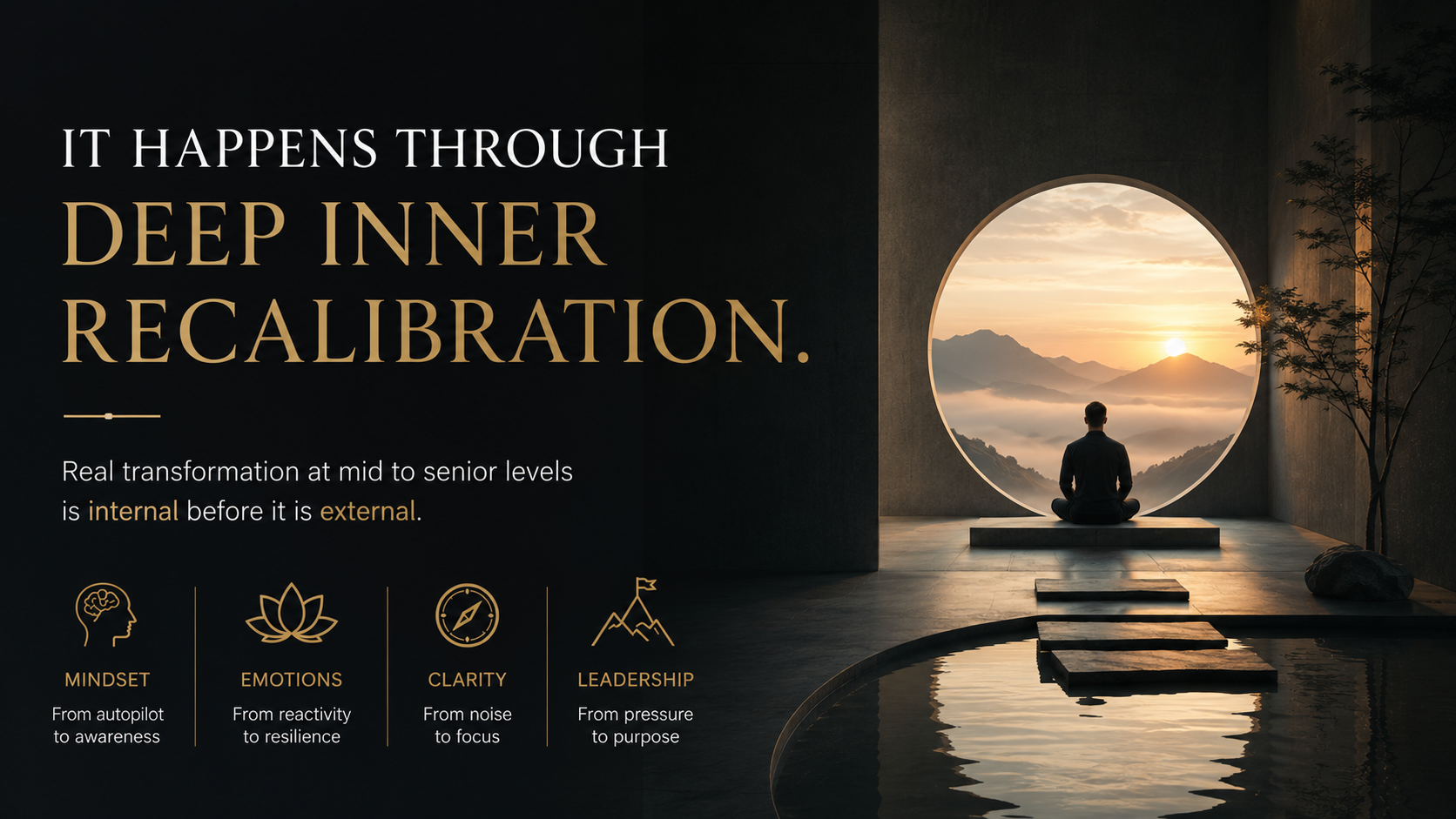
It is internal recalibration.
The Invisible Ceiling Most Professionals Never See
Research from Harvard Business Review has repeatedly shown that technical competence alone is rarely what limits senior professionals. Instead, progression stalls because of psychological rigidity, emotional fatigue, identity attachment and cognitive overload.
In simpler terms:
The mindset that helped you succeed earlier in your career often becomes the very thing limiting your next level of growth.
Consider this:
- The manager who built success through control struggles to lead empowered teams.
- The high performer who relied on speed struggles in environments requiring strategic patience.
- The executive whose identity is tied to achievement struggles when reinvention becomes necessary.
- The founder who built a company through intensity eventually burns out operating from constant pressure.
These are not skill problems.
They are internal architecture problems.
And they cannot be solved through productivity hacks, motivational quotes or another leadership framework downloaded from LinkedIn.
They require something deeper.
A recalibration of how a person thinks, processes pressure, interprets identity and operates under uncertainty.
Why Success Can Quietly Become a Trap
One of the least discussed realities of professional success is this:
Success reinforces patterns.
The more rewarded you become for a certain way of thinking, behaving or leading, the harder it becomes to question whether that pattern is still useful.
Psychologists call this “functional fixedness.”
In leadership, it often appears as:
- overreliance on past expertise
- resistance to uncertainty
- inability to adapt emotionally
- defensive decision-making
- chronic overcontrol
- avoidance of vulnerability
This is particularly dangerous in modern professional environments where industries evolve faster than experience alone can keep up with.
Kodak is a classic organizational example.
The company invented digital photography technology in 1975. Yet its leadership remained psychologically attached to film because film had historically defined success.
The issue was not lack of intelligence.
It was identity rigidity.
The organization could not recalibrate internally fast enough to respond externally.
The same pattern happens to individuals every day.
A senior executive continues operating from an outdated leadership style because it once worked.
A founder remains trapped in survival-mode intensity long after the business has matured.
A high-achieving professional keeps optimizing productivity while emotionally disconnecting from meaning, creativity and strategic clarity.
Externally, they still look successful.
Internally, they are slowly fragmenting.
The Neuroscience of Recalibration
Modern neuroscience offers powerful insight into why this happens.
The human brain is designed to automate successful patterns.
Repeated thoughts and behaviors strengthen neural pathways through a process called neuroplasticity.
This is useful when learning skills.
But it also means:
- stress responses become automated
- overthinking becomes automated
- emotional defensiveness becomes automated
- people-pleasing becomes automated
- perfectionism becomes automated
Over time, professionals stop consciously choosing how they operate.
They simply repeat conditioned responses under pressure.
This explains why many experienced leaders struggle with:
- chronic mental fatigue
- decision exhaustion
- emotional reactivity
- inability to disconnect from work
- reduced creativity
- low psychological flexibility
Research from Stanford University has shown that chronic cognitive overload significantly reduces strategic thinking quality and adaptability.
In other words:
The more mentally overloaded you become, the more you default to familiar patterns — even when those patterns no longer serve you.
That is why transformation at senior levels is rarely informational.
It is neurological and psychological.
You are not simply learning something new.
You are rewiring how you operate.
The Leadership Shift Nobody Prepares You For
Early career growth rewards effort.
Senior leadership rewards clarity.
This distinction changes everything.
At junior levels:
- execution matters most
- responsiveness matters most
- output creates visibility
At senior levels:
- judgment matters more
- emotional regulation matters more
- strategic thinking matters more
- presence matters more
- adaptability matters more
Yet many professionals continue trying to solve senior-level challenges with junior-level operating systems.
They work harder instead of thinking differently.
They optimize time instead of recalibrating identity.
They chase efficiency while ignoring emotional exhaustion.
The result is a strange modern phenomenon:
Professionals who are highly accomplished externally but internally disconnected from energy, creativity and meaning.
McKinsey research during the pandemic years revealed that senior leaders experienced significantly higher levels of emotional exhaustion than many frontline employees — largely because they carried invisible cognitive and psychological burdens continuously.
Decision fatigue.
Responsibility fatigue.
Identity pressure.
Emotional suppression.
Constant uncertainty.
These pressures accumulate quietly.
And eventually, performance alone can no longer compensate.
Real Transformation Is Internal Before It Is External
Many people assume transformation begins with visible action.
In reality, sustainable transformation begins internally first.
Consider Satya Nadella’s transformation of Microsoft.
When Nadella became CEO in 2014, Microsoft was still profitable but culturally stagnant. Internally, the organization operated from defensiveness, hierarchy and fixed thinking.
Nadella introduced something radically different:
a growth mindset culture grounded in empathy, curiosity and learning.
The transformation was not purely strategic.
It was psychological.
He shifted how people thought, related, collaborated and adapted.
That internal recalibration eventually drove external innovation.
Similarly, executive coaching research from the International Coaching Federation consistently shows that sustainable leadership improvement is strongly tied to increased self-awareness, emotional intelligence and cognitive flexibility — not just tactical competence.
The leaders who evolve successfully are rarely the ones who know the most.
They are the ones most willing to re-examine themselves honestly.
The Four Dimensions of Deep Inner Recalibration
For mid-to-senior professionals, recalibration often happens across four critical dimensions.
1. Identity Recalibration
Many professionals unconsciously tie self-worth to achievement.
“I am valuable because I perform.”
This creates chronic psychological pressure because identity becomes dependent on external outcomes.
Eventually:
rest feels unsafe,
uncertainty feels threatening,
and failure feels personal.
Recalibration begins when identity expands beyond professional performance alone.
2. Emotional Recalibration
High performers are often rewarded for suppressing emotion.
But suppressed emotion does not disappear.
It accumulates physiologically and cognitively.
Research from Yale’s Center for Emotional Intelligence shows that emotional awareness directly improves decision-making quality, resilience and leadership effectiveness.
Strong leaders do not eliminate emotion.
They develop the capacity to process it intelligently.
3. Cognitive Recalibration
Many professionals operate from constant mental noise.
Notifications.
Meetings.
Pressure.
Urgency.
Comparison.
Overthinking.
Deep work by neuroscientist Dr. Amishi Jha demonstrates that attention is now one of the most valuable leadership resources in modern environments.
Clarity is not accidental.
It is trained.
4. Strategic Recalibration
At senior levels, the challenge is not merely execution.
It is discernment.
What deserves energy?
What should be ignored?
What truly matters long-term?
This requires psychological distance from constant reactivity.
Without recalibration, professionals become trapped in perpetual operational survival.
Why Most Professionals Avoid This Work
Because internal recalibration is uncomfortable.
It requires confronting:
- outdated identities
- emotional avoidance
- hidden fears
- ego attachment
- dependency on validation
- burnout disguised as ambition
External work is easier because it feels measurable.
Internal work feels uncertain.
Yet ironically, the professionals who avoid internal recalibration often plateau the fastest.
Not because they lack intelligence.
But because they become psychologically inflexible.
And in rapidly changing environments, flexibility matters more than certainty.
The Future Belongs to Adaptable Minds
The next era of leadership will not belong solely to the most technically skilled professionals.
It will belong to those who can:
- think clearly under uncertainty
- regulate themselves under pressure
- adapt without losing identity
- remain curious despite success
- lead without emotional exhaustion
- reinvent before crisis forces reinvention
This is not self-help.
It is strategic evolution.
Because eventually every professional reaches a point where external achievement alone stops creating fulfillment, clarity or sustainable growth.
And at that point, the next breakthrough is no longer external.
It happens through deep inner recalibration.
If you are navigating that transition — professionally, mentally or personally — the conversation is different now.
And perhaps, more important than ever.
Click here when you want to have a conversation with us…