
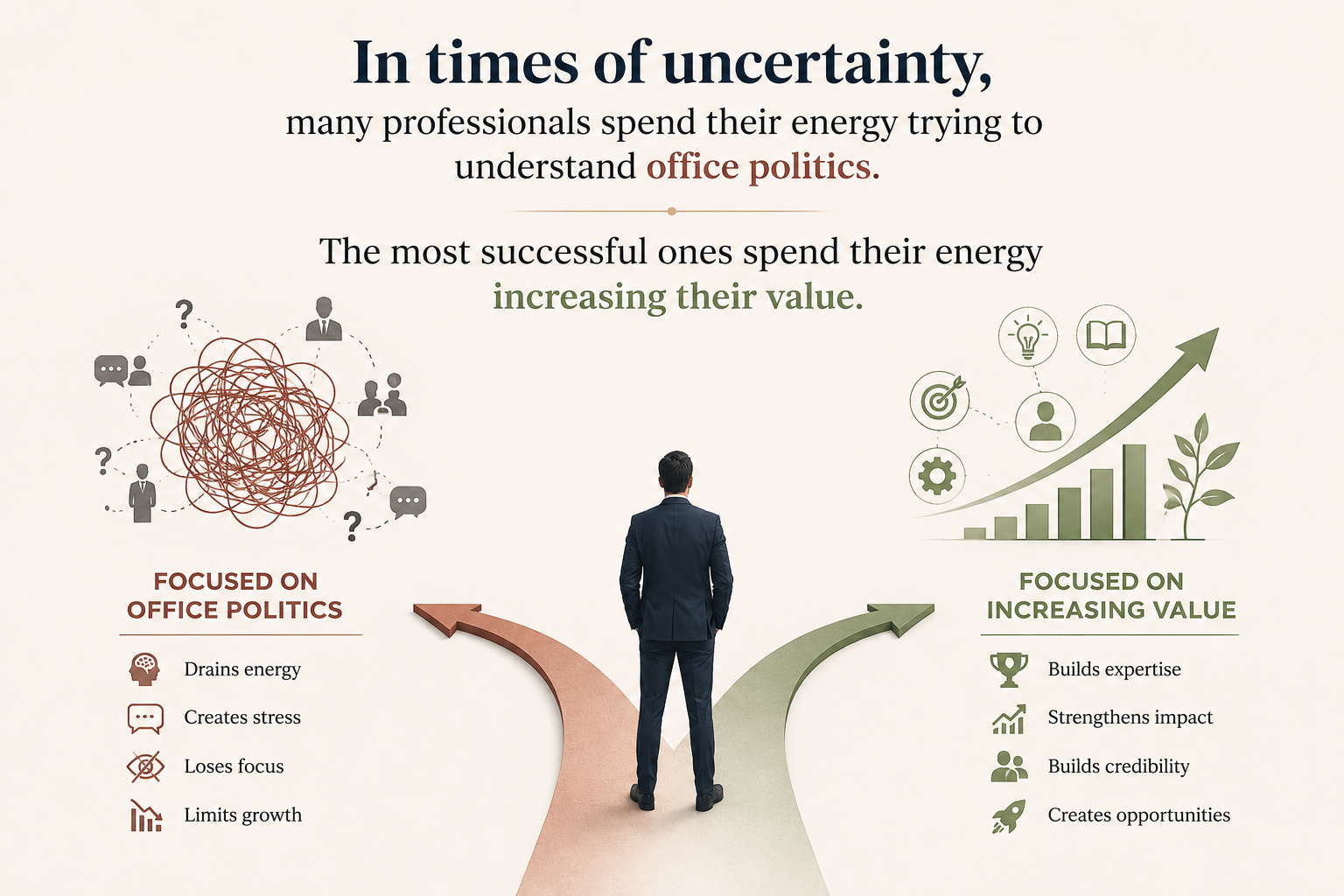
In times of uncertainty, many professionals spend their energy trying to understand office politics. The most successful ones spend their energy increasing their value.
There is a pattern playing out in organizations across the world.
As uncertainty increases, office politics seems to become more visible.
A leadership change triggers speculation. A restructuring creates anxiety. A business slowdown fuels insecurity. Budget cuts, role changes and whispers of layoffs begin to dominate conversations. Suddenly, people who were once focused on customers, innovation and performance find themselves discussing power dynamics, influence and organizational manoeuvring.
If you are a mid- or senior-level professional, you have probably witnessed this firsthand.
You may have seen people trying to protect their positions. You may have noticed colleagues becoming territorial. You may have observed information being selectively shared, credit being strategically claimed or decisions being influenced by factors that have little to do with merit.
While office politics has always existed, uncertainty tends to amplify it.
The question is not whether office politics exists.
The real question is this:
How much of your attention are you willing to give it?
Because in every organization facing uncertainty, two types of professionals emerge.
The first group becomes increasingly focused on politics.
The second group becomes increasingly focused on increasing their value.
Over time, the difference between these two groups becomes remarkable.
The Silent Cost of Playing the Wrong Game
Most professionals underestimate the cost of constantly thinking about office politics.
It rarely begins dramatically.
Instead, it starts with small mental habits.
You replay conversations.
You analyse leadership decisions.
You wonder why someone was promoted.
You speculate about organizational changes.
You spend time trying to understand hidden agendas.
Before long, a significant portion of your mental bandwidth is consumed by things over which you have very little control.
This creates a dangerous illusion.
You feel productive because you are thinking.
But in reality, you are often investing energy without creating value.
Every hour spent worrying about politics is an hour not spent strengthening your expertise.
Every conversation spent discussing organizational drama is a conversation not spent building meaningful relationships.
Every emotional reaction to uncertainty is energy unavailable for growth.
The problem is not that office politics exists.
The problem is when it becomes the primary focus of your attention.
What Research Reveals About Uncertainty
Research on job insecurity has consistently shown that uncertainty affects more than just morale.
One of the most significant effects is a reduction in an individual’s sense of control.
When people feel that important outcomes are no longer fully within their influence, stress levels rise. Decision quality can decline. Emotional exhaustion increases. Attention becomes fragmented.
From a neuroscience perspective, uncertainty is often interpreted by the brain as a potential threat.
When the brain perceives threat, it naturally shifts resources toward protection and survival.
This response may have been useful thousands of years ago when humans faced physical dangers.
In today’s workplace, however, the threat is often psychological rather than physical.
The result?
Professionals can become trapped in cycles of worry, hypervigilance and emotional fatigue.
The irony is that the more uncertain the environment becomes, the more important it becomes to focus on what remains within your control.
And one of the most powerful things within your control is your personal value.
Two Professionals. One Organization.
Imagine two managers working in the same company.
Both are competent.
Both have similar experience.
Both are exposed to the same uncertainty.
Manager A becomes consumed by politics.
Every leadership announcement is analysed.
Every promotion becomes a source of comparison.
Every rumour becomes a topic of discussion.
Manager A spends significant energy trying to understand who is influencing whom.
Manager B notices the same environment but chooses a different path.
Manager B invests time in strengthening expertise.
Improves communication skills.
Builds relationships across functions.
Develops greater visibility.
Learns new capabilities.
Focuses on contribution rather than speculation.
Fast forward five years.
Manager A may know every detail about the political history of the organization.
Manager B has become more valuable.
And value travels.
It travels across roles.
It travels across organizations.
It travels across industries.
Political influence is often temporary.
Personal value compounds.
The Five Assets Politics Cannot Easily Take Away
In uncertain times, these five assets become increasingly important.
1. Capability
The marketplace rewards people who solve meaningful problems.
The more capable you become, the more options you create for yourself.
Technology changes.
Organizations change.
Markets change.
Capability remains a powerful differentiator.
Ask yourself:
What expertise am I developing that makes me more valuable than I was a year ago?
2. Credibility
Credibility is built through consistency.
It is the reputation people develop about you when you are not in the room.
Can people rely on you?
Do you deliver?
Do your actions match your words?
Credibility takes years to build and moments to damage.
Protect it carefully.
3. Communication
Many talented professionals remain invisible because they struggle to communicate their value.
Communication is not simply about speaking.
It is about influencing.
Aligning.
Building trust.
Creating clarity.
Helping others understand your contribution.
In uncertain environments, communication becomes a career multiplier.
4. Relationships
Relationships are often misunderstood.
Networking is not collecting contacts.
It is building trust over time.
Strong professional relationships create opportunities, information flow, collaboration and support.
When challenges arise, people rarely navigate them alone.
Relationships matter.
5. Adaptability
Perhaps no capability is more important today.
The ability to learn, adjust and respond effectively to change has become a competitive advantage.
Organizations increasingly reward professionals who can evolve faster than circumstances change around them.
The Leadership Shift
Many professionals believe empowerment comes from gaining more control over external circumstances.
The reality is often different.
Empowerment begins when you focus on the areas where your influence is strongest.
This requires a shift:
From fear to ownership.
From reaction to response.
From blame to contribution.
From survival to growth.
This shift does not happen overnight.
But it changes everything.
Because when your attention moves from politics to personal value, your energy becomes more productive.
Your confidence becomes less dependent on external validation.
And your career becomes more resilient.
The BUILD Framework
Whenever uncertainty increases, remember the BUILD framework.
B – Build Expertise
Commit to becoming better at what you do.
Learning is no longer optional.
It is career protection.
U – Upgrade Visibility
Great work deserves visibility.
Help stakeholders understand your contribution.
Do not assume your work speaks for itself.
I – Invest in Relationships
Build trust before you need it.
Strong relationships create long-term advantages.
L – Lead Yourself
Manage your emotions.
Protect your energy.
Strengthen your mindset.
Leadership begins with self-leadership.
D – Develop Adaptability
Stay curious.
Stay flexible.
Keep learning.
The professionals who adapt fastest often create the most opportunities.
Five Questions Worth Reflecting On
As you read this, consider the following:
- Where is most of my mental energy currently going?
- What skill have I neglected because I have been distracted by circumstances?
- How visible is my contribution?
- What reputation am I building every day?
- If my role changed tomorrow, what value would I take with me?
The answers to these questions may reveal more about your future than any organizational chart.
The Career Insurance Nobody Talks About
Most people look for security in the organization.
The most resilient professionals create security within themselves.
They invest in capabilities.
They strengthen communication.
They build relationships.
They develop credibility.
They become adaptable.
This is not a guarantee against uncertainty.
Nothing is.
But it significantly increases your ability to navigate uncertainty successfully.
Because while organizations may change, personal value continues to travel with you.
While titles may change, capability remains.
While politics may rise and fall, credibility endures.
And while circumstances may be uncertain, growth remains a choice.
Final Reflection
As uncertainty rises, many professionals become students of office politics.
The leaders who thrive become students of growth.
They understand that politics may influence a role.
But value influences a career.
They know that speculation rarely creates opportunities.
Contribution does.
And they recognize that the most powerful response to uncertainty is not fear.
It is becoming more valuable than yesterday.
If workplace uncertainty, leadership challenges, career transitions or organizational dynamics are occupying your mind, perhaps the most important investment you can make right now is in yourself.
Learn more or start a confidential conversation here: