

History rarely announces itself while it’s happening.
There are moments—quiet, almost forgettable at the time—that later reveal themselves as turning points. Not because they were dramatic, but because they exposed something deeper. Something structural. Something most people weren’t looking at.
One such moment happened in 1831.
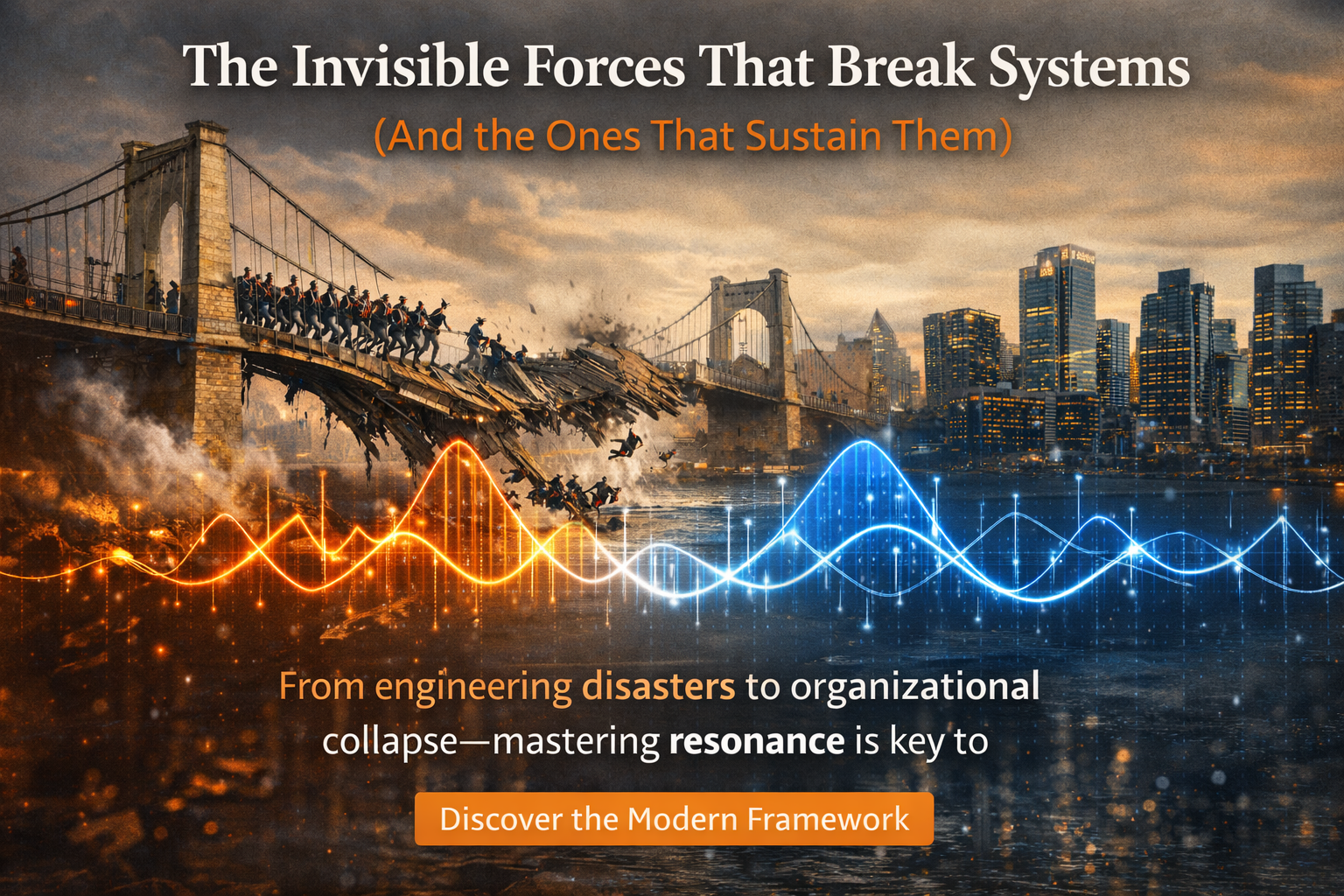
A group of soldiers marched across a suspension bridge in England. They were disciplined, synchronized, precise—the embodiment of order. Halfway across, the bridge began to vibrate. Subtly at first. Then visibly. Then catastrophically.
It collapsed.
Not because the materials were inferior.
Not because the engineers were careless.
But because of something far more subtle: the soldiers were marching in rhythm with the bridge’s natural frequency. Each step added a small amount of energy. Individually insignificant. Collectively, devastating.
The solution, once understood, was almost laughably simple: break the rhythm. From that point forward, soldiers were instructed to march out of step when crossing bridges.
A minor behavioral change prevented structural failure.
The Pattern Beneath the Incident
It’s tempting to treat this as an isolated engineering curiosity. It isn’t.
Nearly two decades later, in France, another bridge collapsed under eerily similar circumstances. This time, the stakes were higher. Hundreds of soldiers were crossing during a storm. The bridge was already under stress—oscillating under wind forces.
Their movements—uncoordinated at first—began to synchronize unconsciously as they tried to stabilize themselves.
The result: over 200 lives lost.
Again, not a single-point failure.
A system failure driven by alignment of forces.
What Executives Often Miss
At first glance, these are engineering stories.
But if you look closely, they are not about bridges.
They are about systems under load.
They are about feedback loops.
They are about alignment—both constructive and destructive.
And most importantly, they are about invisible forces.
This is where the analogy becomes uncomfortably relevant.
Because modern organizations are not mechanical systems—but they behave like them in critical ways.
Your Organization Has a “Natural Frequency” Too
Every organization develops rhythms.
- Decision-making cadence
- Communication patterns
- Incentive structures
- Cultural norms around urgency and response
Individually, these feel benign. Even efficient.
But over time, they synchronize.
And when they do, they create amplification effects.
Sometimes positive—momentum, clarity, execution speed.
But often, dangerously negative.
- Teams reinforcing bad assumptions
- Leaders unintentionally amplifying pressure cycles
- Performance metrics driving short-term behavior at long-term cost
- Escalation loops that intensify instead of resolve
No single action causes failure.
But the system begins to resonate with its own internal pressures.
The Illusion of “Pushing Harder”
One of the most persistent myths in leadership is that performance problems are solved by increasing effort.
Push harder.
Move faster.
Demand more.
In stable systems, that can work.
In resonant systems, it accelerates failure.
Because when a system is already oscillating, adding more force—no matter how well-intentioned—doesn’t stabilize it.
It amplifies the oscillation.
This is why you see high-performing teams suddenly burn out.
Why successful organizations drift into dysfunction.
Why strategies that once worked begin to fail without obvious cause.
The issue isn’t effort.
It’s alignment.
A Different Kind of Leadership Awareness
The executives who navigate this well operate differently.
They don’t just look at:
- Metrics
- Outputs
- Execution timelines
They look at patterns.
They ask:
- What rhythms are emerging in this system?
- Where are feedback loops reinforcing themselves?
- What pressures are compounding silently?
- Where might synchronization be creating risk instead of efficiency?
This is a fundamentally different lens.
It shifts leadership from reactive to systemic.
Another Story: The Tacoma Narrows Bridge
In 1940, the Tacoma Narrows Bridge in Washington State collapsed in dramatic fashion. Unlike earlier incidents, this one was captured on film.
The bridge didn’t simply break.
It twisted. Oscillated. Undulated in the wind like a ribbon.
Engineers had accounted for strength.
What they underestimated was aeroelastic flutter—a feedback loop between wind forces and structural response.
The bridge didn’t fail because it wasn’t strong enough.
It failed because it was dynamically unstable.
Strength vs Stability
This distinction matters more than most executives realize.
- Strength is about capacity
- Stability is about behavior under stress
Organizations often optimize for strength:
- More resources
- More talent
- More aggressive targets
But they neglect stability:
- How decisions propagate
- How pressure distributes
- How teams respond under sustained load
A strong but unstable system is fragile.
A stable system, even with constraints, is resilient.
The Hidden Cost of Misaligned Systems
When organizational rhythms are misaligned, the symptoms don’t appear immediately.
They show up as:
- Slower decision-making despite more meetings
- Increased effort with diminishing returns
- Talent fatigue without clear burnout signals
- Strategic drift despite clear goals
These are not execution problems.
They are systemic ones.
And they are notoriously hard to diagnose because they don’t originate in a single place.
They emerge from interaction.
Breaking Step: A Leadership Discipline
The instruction given to soldiers—break step—seems simple.
But applied to leadership, it becomes profound.
Breaking step means:
- Interrupting harmful cycles
- Introducing asymmetry into rigid systems
- Challenging synchronized thinking
- Creating space for variation and recovery
It’s not about disorder.
It’s about preventing destructive alignment.
In practice, this might look like:
- Slowing down a decision process that’s accelerating blindly
- Rotating perspectives in leadership discussions
- Redesigning incentives that reinforce short-term loops
- Creating deliberate pauses in high-pressure cycles
These are subtle moves.
But they change the system’s behavior.
Why This Matters More Now Than Ever
Modern organizations operate in environments that are:
- Faster
- More interconnected
- More feedback-driven
This increases the likelihood of resonance effects.
What once took years to build can now emerge in weeks.
Cultural patterns, market responses, internal dynamics—they synchronize rapidly.
Which means:
Small misalignments scale faster.
Hidden stresses accumulate quicker.
Failures, when they happen, feel sudden—but are anything but.
From Mechanical Systems to Human Systems
The lesson from bridges is not about engineering.
It’s about recognizing that:
Systems fail not just because of what they are made of—but because of how they behave over time.
Human systems—organizations, teams, leadership structures—are even more complex.
They contain:
- Emotions
- Incentives
- Perception biases
- Informal networks
Which makes their “resonance patterns” harder to see—but more impactful.
A Shift in Perspective
Most executive frameworks focus on:
- Strategy
- Execution
- Performance optimization
Few focus deeply on:
- System dynamics
- Feedback behavior
- Rhythm alignment
Yet these are often the underlying drivers of success or failure.
The difference between organizations that scale sustainably and those that don’t is rarely visible in their strategies.
It’s visible in how their systems behave under pressure.
The Question Worth Asking
If you step back and look at your own organization:
- Where are rhythms reinforcing themselves?
- Where might alignment be creating hidden risk?
- What cycles are accelerating without intervention?
And perhaps most importantly:
Where might you need to “break step”?
Where This Leads
Understanding these dynamics isn’t intuitive.
It requires a different lens—a way of seeing performance not just as output, but as a function of system behavior.
That’s exactly what this explores in more depth:
👉 https://highperformancealchemy.com/rrr/
If you are leading complex systems—and at your level, you are—the ability to recognize and shape these invisible forces isn’t optional.
It’s the difference between systems that scale…
and systems that eventually collapse under their own rhythm.