
Uncertainty Is No Longer the Exception. It’s the Operating System

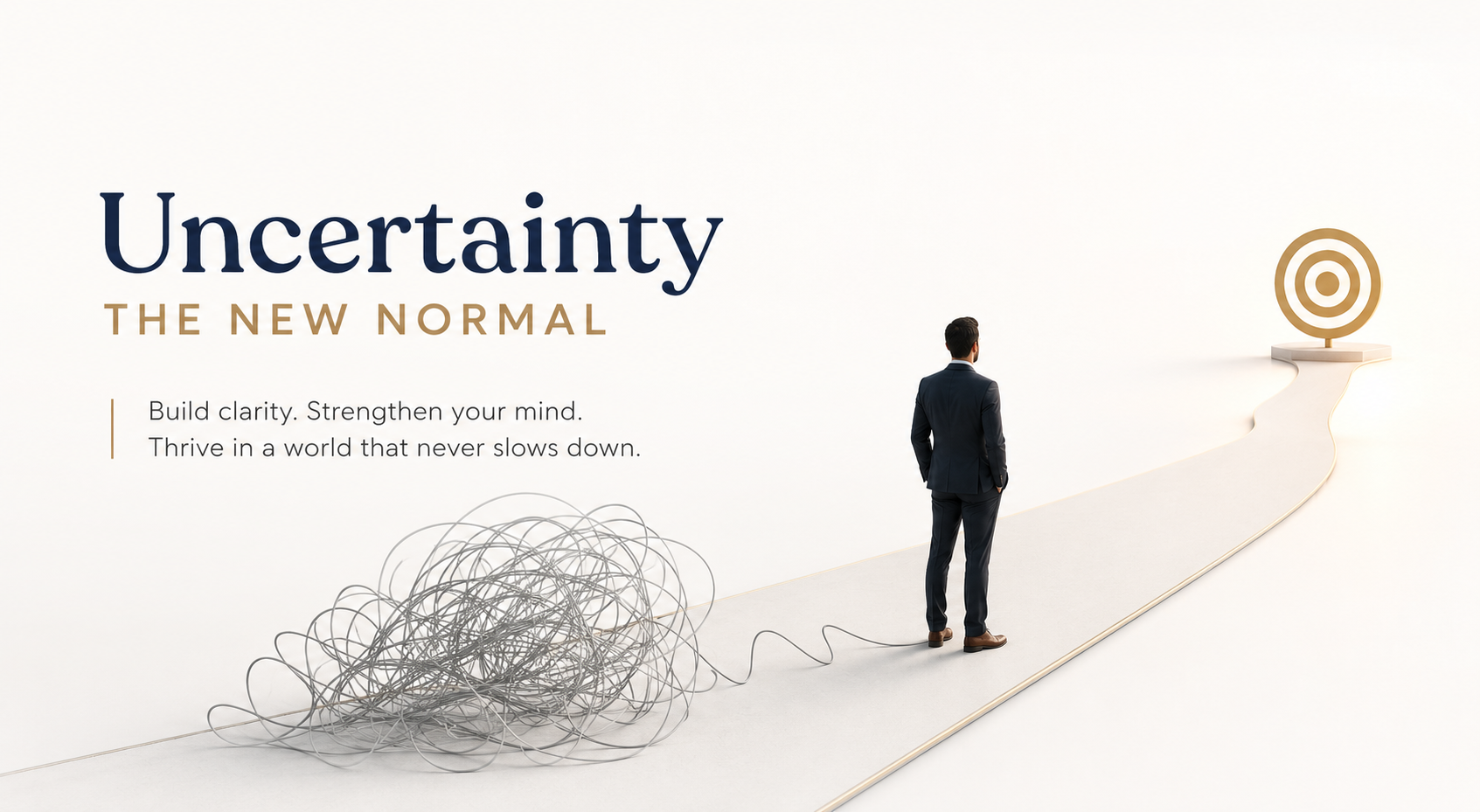
Uncertainty Is No Longer the Exception. It’s the Operating System

There was a time when uncertainty arrived in waves.

A recession.
A merger.
A difficult boss.
A career setback.

You dealt with it, recovered and eventually things settled down.

That pattern no longer exists.

Today, uncertainty doesn’t visit occasionally.

It stays.

Markets shift overnight. Artificial intelligence changes job descriptions faster than organisations can rewrite them. Entire industries are restructuring. Promotions take longer. Expectations keep increasing while resources keep shrinking.

Many professionals are waiting for things to “become normal again.”

But what if this is normal?

Twenty years ago, experience itself created security.

Today, experience is only the starting point.

Organisations increasingly reward people who can:

  • Learn quickly.
  • Make decisions despite incomplete information.
  • Adapt without losing confidence.
  • Influence others during change.
  • Remain emotionally composed under pressure.

Notice something?

None of these are technical skills.

They are human capabilities.

And human capabilities become the true competitive advantage when technical knowledge becomes easier to acquire.

This is where neuroscience becomes fascinating.

Your brain is fundamentally a prediction machine.

Every second, it tries to answer one simple question:

The more predictable your environment, the less energy your brain needs.

When uncertainty becomes constant, your brain starts working overtime.

It scans for threats.

It overthinks.

It creates worst-case scenarios.

It struggles to prioritise.

It seeks certainty—even if that certainty is inaccurate.

This isn’t weakness.

It’s biology.

The problem is that the modern workplace continuously feeds uncertainty faster than the brain evolved to process it.

People often assume that pressure creates better performance.

Occasionally it does.

Continuous pressure doesn’t.

When stress becomes chronic, several things begin to happen.

You postpone important conversations.

You avoid difficult decisions.

You become busier but accomplish less.

You react rather than respond.

You confuse movement with progress.

You start protecting your current position instead of preparing for your future one.

Ironically, the more uncertain the world becomes, the more people cling to familiar habits.

Unfortunately, yesterday’s habits rarely solve tomorrow’s problems.

Most professionals calculate financial risk.

Few calculate cognitive risk.

Think about it.

How many opportunities have disappeared because:

  • You delayed applying for a role.
  • You didn’t speak confidently in a leadership meeting.
  • You hesitated to build your personal brand.
  • You stayed in a role simply because it felt safer.
  • You avoided networking because you were “too busy.”

None of these decisions appear dramatic.

Yet over five years, they quietly reshape an entire career.

The biggest cost of uncertainty isn’t what happens around you.

It’s how uncertainty slowly changes the way you think.

Professional coaching is often misunderstood.

Many imagine motivational conversations.

Others imagine someone giving advice.

Neither captures what effective coaching actually does.

A skilled coach doesn’t remove uncertainty.

A coach helps you function effectively within it.

That difference is enormous.

The goal isn’t to predict the future.

The goal is to build someone who can handle multiple possible futures.

A coach becomes a thinking partner.

Someone who notices patterns you no longer see.

Someone who asks questions your brain has stopped asking.

Someone who interrupts unhelpful assumptions before they become permanent beliefs.

Someone who helps you make decisions from clarity instead of fear.

One of the biggest misconceptions is that coaching is only for people who are struggling.

Look closely at high-performing athletes.

Elite CEOs.

Olympic champions.

Top performers.

Most already perform well.

They work with coaches because performance eventually becomes limited by thinking—not knowledge.

The higher you rise professionally, the fewer people challenge your assumptions honestly.

Feedback becomes filtered.

People hesitate to disagree.

Blind spots quietly expand.

Coaching restores something incredibly valuable:

Objective reflection.

Technical expertise will always matter.

But increasingly, organisations will promote people who can create certainty for others while navigating uncertainty themselves.

Teams don’t simply need answers.

They need confidence.

They need calm.

They need leaders who think clearly when everyone else is overwhelmed.

That doesn’t happen accidentally.

It develops intentionally.

Perhaps the better question is no longer:

“Will uncertainty reduce?”

Perhaps the question should be:

“Am I becoming the kind of professional who can thrive regardless of what changes next?”

Because uncertainty isn’t waiting for anyone.

The professionals who continue growing won’t necessarily be the smartest.

They will be the ones who continually upgrade how they think, decide, communicate and lead.

In a world where uncertainty has become the operating system, investing in your own thinking may be one of the safest career decisions you can make.

If you are navigating career uncertainty, leadership transitions or simply want to strengthen the way you think and perform under pressure, explore neuroscience-informed coaching and practical insights at
 www.highperformancealchemy.com.

Why Smart Leaders Need Better Questions

Why Smart Leaders Need Better Questions

For most professionals, career progression is measured through visible metrics.

Larger teams.

Larger budgets.

Broader responsibilities.

Greater influence.

Yet the most significant shift in senior leadership is often invisible.

The nature of the problems changes.

Early-career success is largely driven by expertise.

Senior leadership success is increasingly driven by judgment.

And judgment is ultimately a function of thinking.

Not intelligence.

Not experience.

Thinking.

The ability to navigate ambiguity, challenge assumptions, integrate competing perspectives, anticipate second-order consequences and make high-quality decisions under uncertainty.

This is where many accomplished professionals encounter an unexpected challenge.

The very experience that helped them succeed can begin to constrain how they see.

Research by Nobel Prize-winning psychologist Daniel Kahneman demonstrated that expertise often increases confidence faster than it increases accuracy.

As expertise grows, mental models become stronger.

Decisions become faster.

Patterns become easier to recognise.

This is essential for leadership.

However, expertise creates a hidden risk.

Leaders stop examining assumptions that have previously produced success.

The organisation changes.

Markets change.

Customers change.

Technology changes.

Yet the leader’s mental model often remains surprisingly stable.

This phenomenon is known as cognitive entrenchment.

The deeper the expertise, the harder it can become to see alternative possibilities.

Imagine standing inside a glass boardroom overlooking a city skyline.

Every year, a thin layer of tint is added to the glass.

The change is imperceptible.

No single layer matters.

But after twenty years, the city appears fundamentally different.

Not because the city changed.

Because the lens changed.

Leadership experience works in much the same way.

Every success.

Every failure.

Every promotion.

Every crisis.

Adds another layer to how leaders interpret reality.

The challenge is that leaders rarely notice the lens itself.

They only notice what they see through it.

Modern neuroscience suggests that the brain functions less like a camera and more like a prediction engine.

According to research from neuroscientist Karl Friston, the brain continuously generates predictions about reality and then looks for evidence that confirms those predictions.

This dramatically reduces cognitive effort.

It also creates vulnerability.

Leaders often believe they are evaluating reality objectively.

In practice, they may be evaluating reality through highly sophisticated assumptions built over decades.

The higher the stakes, the greater the risk.

Because strategic errors rarely emerge from lack of intelligence.

They emerge from unquestioned assumptions.

Most executives spend considerable time improving strategy, operations, talent and execution.

Far fewer invest equivalent effort in examining the quality of the thinking that drives those decisions.

Yet every strategy originates in thought.

Every decision originates in thought.

Every culture originates in thought.

Every transformation originates in thought.

Perhaps the most valuable question for any leader is not:

“What should I do next?”

But rather:

“What assumptions am I making that no longer deserve my confidence?”

Because the leaders who create extraordinary outcomes are rarely those with the most answers.

They are the ones who continually upgrade the quality of the questions they ask themselves.

In an increasingly complex world, better thinking may be the ultimate competitive advantage. Continue the conversation at 

www.highperformancealchemy.com

When More Becomes Less

When More Becomes Less

There is an old proverb:

“When there is no room in the cup, even good tea spills.”

Most professionals think their challenge is time.

It isn’t.

The challenge is capacity.

Not organisational capacity.

Mental capacity.

Think about the last few years.

You have gained experience.

Built expertise.

Expanded responsibilities.

Improved your skills.

Possibly increased your income.

Yet there is a good chance you feel more stretched today than you did five or ten years ago.

That seems strange.

Shouldn’t experience make life easier?

Shouldn’t expertise make work smoother?

Shouldn’t seniority create more freedom?

Instead, many professionals find themselves busier than ever.

The reason is simple.

Success attracts additions.

The more competent you become, the more things arrive on your plate.

People seek your input.

Teams seek your guidance.

Clients seek your attention.

Organisations seek your involvement.

And because you are capable, saying yes becomes almost automatic.

The challenge is that life has a hidden law.

Everything you add takes up space.

Even good things.

Especially good things.

A new opportunity.

A strategic initiative.

A leadership responsibility.

A networking commitment.

A learning programme.

A side project.

None of these are bad.

Yet together they can create something unexpected.

Mental congestion.

We talk a lot about time management.

Very few people talk about attention management.

The difference matters.

Most professionals do not wake up feeling overwhelmed because they have too little time.

They wake up feeling overwhelmed because too many things are competing for their attention.

Attention is a finite resource.

And modern work has become exceptionally good at consuming it.

An email arrives.

A message notification appears.

A meeting invitation lands.

A project escalates.

A stakeholder calls.

Individually these seem insignificant.

Collectively they create fragmentation.

Research from the field of cognitive psychology consistently shows that switching attention between tasks comes with a cost. The brain does not seamlessly move from one activity to another. It spends energy reorienting itself each time.

The result?

People finish the day feeling busy but strangely unsatisfied.

A calendar can be full while progress remains elusive.

That is because activity and impact are not the same thing.

One of the most dangerous assumptions in professional life is this:

“If I can fit it in, I should do it.”

Many leaders operate this way.

The calendar has a free slot.

The meeting gets accepted.

The request arrives.

The commitment gets added.

The invitation appears.

The answer becomes yes.

But perhaps the better question is:

Just because it fits, does it belong?

That single question changes everything.

Imagine walking into your home one evening carrying ten shopping bags.

Then someone hands you an eleventh.

You might still be physically capable of carrying it.

But that doesn’t mean you should.

Professional life works the same way.

Capability often gets mistaken for capacity.

Just because you can carry something does not mean you should continue carrying it.

Many mid-career and senior professionals are exhausted not because they lack resilience.

They are exhausted because they have become collectors.

Collectors of commitments.

Collectors of obligations.

Collectors of responsibilities.

Collectors of unfinished mental loops.

The irony is that much of this accumulation happens gradually.

Nobody wakes up one morning and decides to create complexity.

Complexity arrives one small decision at a time.

One extra responsibility.

One extra meeting.

One extra expectation.

One extra project.

Until eventually the day feels crowded before it even begins.

This is where a simple shift becomes powerful.

Instead of asking:

“What should I add?”

Ask:

“What no longer deserves space?”

The answer may surprise you.

A recurring meeting.

A draining conversation.

An outdated process.

A commitment that has served its purpose.

An expectation you never consciously agreed to carry.

Sometimes progress is not created by acceleration.

Sometimes it is created by removal.

Consider how architects create beautiful spaces.

They do not start with clutter and then admire it.

They remove.

Refine.

Simplify.

Create room.

The value comes from what remains after unnecessary elements are removed.

The same principle applies to professional life.

Clarity is rarely found by adding more information.

It is often found by removing distractions.

Energy is rarely created by working harder.

It is often created by carrying less.

Fulfilment is rarely discovered through accumulation.

It is often discovered through intentional selection.

Perhaps that is why some of the most effective leaders appear calm despite enormous responsibilities.

They are not necessarily doing less.

They are simply protecting space for what matters most.

Space to think.

Space to decide.

Space to create.

Space to recover.

Space to lead.

In a world obsessed with addition, subtraction has become a competitive advantage.

And perhaps the most important question for the second half of your career is not:

“What more can I achieve?”

But:

“What can I remove so that what truly matters can finally breathe?”

For more insights on leadership, human performance and personal excellence, visit www.highperformancealchemy.com

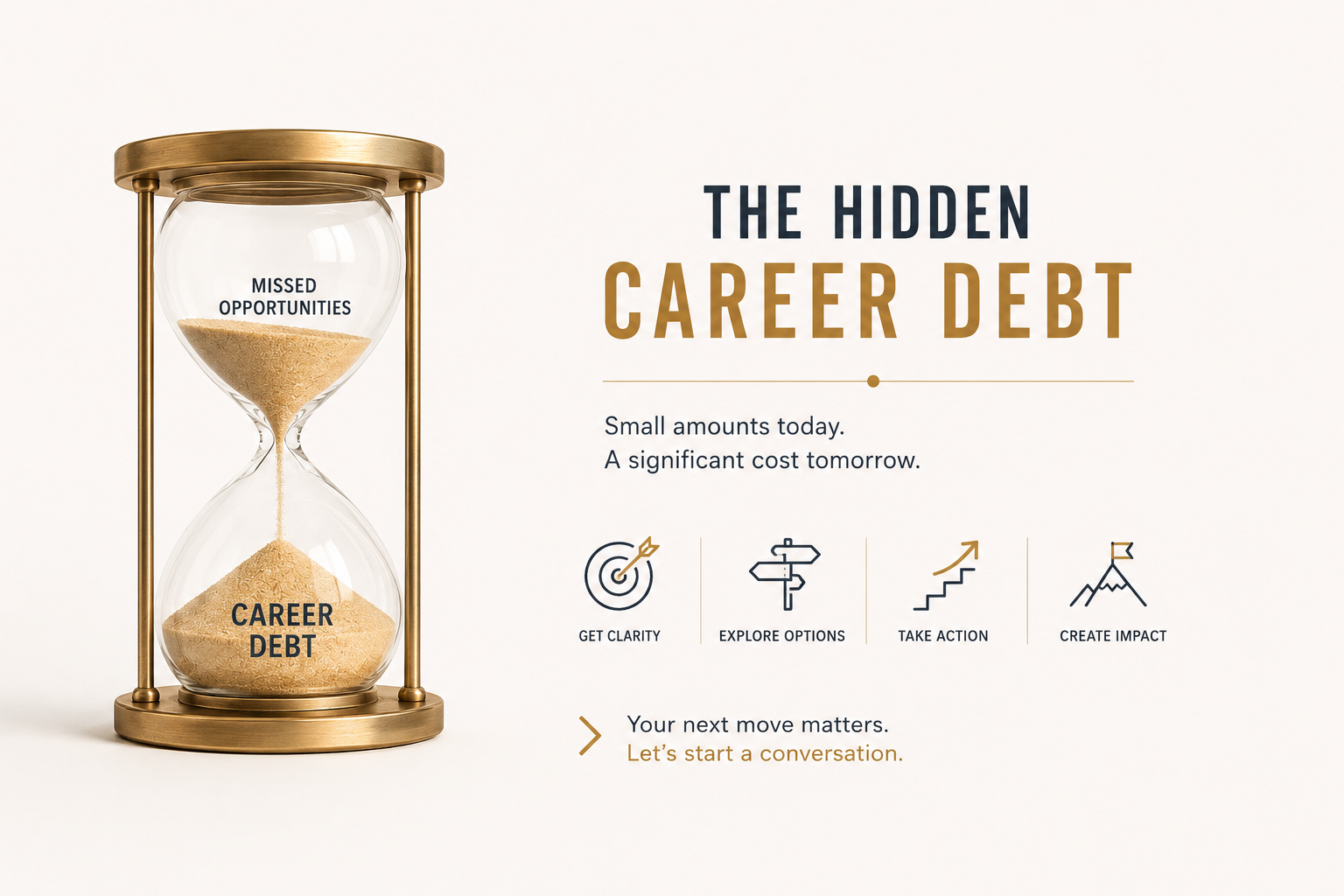
The Hidden Career Debt

The Hidden Career Debt

Imagine waking up one morning to discover that someone has been silently withdrawing money from your bank account for years.

Not enough to trigger an alert.

Not enough to cause immediate panic.

Just enough to slowly weaken your financial position until one day you realize that the balance you thought you had doesn’t exist.

Most people would call that a crisis.

Yet this is exactly what is happening to thousands of mid and senior professionals around the world.

The difference?

The account being drained isn’t financial.

It’s professional.

And the debt being accumulated isn’t visible on any statement.

It is Career Debt.

Career debt is the gap between where your career could be and where it actually is because of delayed decisions.

Every postponed conversation.

Every delayed application.

Every avoided networking opportunity.

Every leadership skill left undeveloped.

Every visibility opportunity ignored.

Every year spent hoping things will improve on their own.

All of these create small amounts of debt.

Individually they appear harmless.

Collectively they become expensive.

Just like financial debt compounds with interest, career debt compounds with time.

The longer you ignore it, the harder it becomes to recover.

Ten years ago, many professionals could build successful careers by doing excellent work and waiting to be noticed.

The world rewarded expertise.

Today the rules have changed.

Organizations restructure faster.

Industries evolve quicker.

Technology disrupts entire functions.

AI is redefining expectations.

Leadership roles are becoming broader.

Business environments are more volatile.

Being competent is no longer enough.

The professionals who thrive are those who actively manage their careers.

Unfortunately, many experienced professionals are still operating with yesterday’s career strategy.

They continue to rely on visibility systems that no longer exist.

They wait for managers to initiate discussions.

They expect organizations to provide direction.

They assume loyalty guarantees security.

These assumptions are becoming increasingly dangerous.

1. The Debt of Delay

This is the most common form.

You know you should do something.

You simply keep postponing it.

Examples include:

  • Updating your professional profile
  • Building industry relationships
  • Learning emerging skills
  • Exploring new opportunities
  • Having difficult conversations

Months become years.

Years become missed opportunities.

The debt grows quietly.

2. The Debt of Comfort

Many professionals confuse comfort with stability.

Comfort feels safe.

Growth feels uncertain.

As a result, they remain in familiar environments long after those environments stop helping them grow.

The irony?

Comfort often creates greater risk than change.

Organizations evolve.

Markets evolve.

Technology evolves.

If you remain static while everything around you changes, your comfort zone slowly becomes a danger zone.

3. The Debt of Invisibility

One of the biggest surprises many professionals face is discovering that performance and visibility are not the same thing.

You may be delivering exceptional work.

But if key stakeholders don’t know your value, opportunities may pass you by.

Invisibility debt accumulates when professionals:

  • Avoid networking
  • Avoid self-advocacy
  • Avoid speaking opportunities
  • Avoid strategic relationships
  • Avoid sharing expertise

They assume results will speak for themselves.

Sometimes they do.

Often they don’t.

4. The Debt of Uncertainty

This debt appears when professionals spend years reacting instead of deciding.

They wait for certainty before acting.

They wait for perfect timing.

They wait for complete clarity.

They wait for confidence.

The challenge is that certainty rarely arrives first.

Action often creates clarity.

Not the other way around.

Many people assume procrastination is a time management problem.

It often isn’t.

In reality, procrastination is frequently an emotional management problem.

The brain is designed to avoid uncertainty.

When faced with ambiguity, it naturally seeks comfort and familiarity.

This made sense thousands of years ago.

It is less helpful when navigating modern careers.

Your brain doesn’t distinguish between a tiger in the jungle and an uncertain career decision.

Both can trigger caution.

Both can activate avoidance.

Both can encourage delay.

As a result, highly capable professionals sometimes postpone actions that could significantly improve their future.

Not because they lack intelligence.

Not because they lack ambition.

But because uncertainty feels uncomfortable.

Most professionals calculate the cost of making a mistake.

Few calculate the cost of doing nothing.

Let’s consider a simple example.

Suppose a professional delays exploring a new opportunity for two years.

During that period they might lose:

  • Higher compensation
  • Better learning opportunities
  • Expanded leadership exposure
  • Stronger professional networks
  • Increased visibility
  • Improved confidence

The financial impact may be measurable.

The opportunity impact is often much larger.

Yet because these losses are invisible, they rarely receive attention.

Career debt thrives in invisibility.

For decades, the formula was simple:

Work Hard + Stay Loyal = Career Growth

For many professionals, that equation no longer works consistently.

A more relevant equation today may be:

Capability + Visibility + Adaptability + Intentional Action = Sustainable Career Growth

Notice what’s missing.

Waiting.

Hope is not a strategy.

Avoidance is not a strategy.

Wishful thinking is not a strategy.

Intentional action is.

Most people define career security incorrectly.

They believe security comes from:

  • A company
  • A title
  • A manager
  • A department
  • An organization

True career security comes from something else.

It comes from your ability to create value in changing environments.

It comes from adaptability.

It comes from relationships.

It comes from learning.

It comes from self-awareness.

It comes from the confidence that you can navigate uncertainty.

When professionals build these capabilities, they become less dependent on circumstances and more capable of shaping outcomes.

Take a moment and ask yourself:

What important career conversation have I been postponing?

What opportunity have I delayed exploring?

What skill have I intended to develop but haven’t?

What relationship should I be nurturing?

What visibility opportunity have I avoided?

What decision have I been waiting too long to make?

Your answers may reveal where your career debt is accumulating.

Awareness is the first step.

Action is the second.

There is a popular saying that the best time to plant a tree was twenty years ago.

The second-best time is today.

The same applies to careers.

You cannot recover yesterday’s missed opportunities.

You cannot rewrite previous decisions.

You cannot reclaim lost time.

But you can decide what happens next.

You can reduce career debt.

You can build career assets.

You can create momentum.

You can move from reacting to designing.

The future rarely changes because people wait.

It changes because people act.

The biggest threat to most careers today is not AI.

It is not economic uncertainty.

It is not organizational change.

It is not competition.

The biggest threat is the silent accumulation of career debt caused by delayed action.

Every postponed decision has a cost.

Every avoided conversation has a cost.

Every opportunity ignored has a cost.

The question is not whether you are accumulating career debt.

The question is whether you are aware of it.

And more importantly—

What will you do about it today?

If you find yourself uncertain about your next career move, leadership journey or professional direction, start by having a conversation.

Sometimes clarity is not found by thinking longer.

It is found by thinking differently.

You can learn more or start a confidential conversation here:

Contact Us

When Office Politics Increases, Your Personal Value Must Increase Faster

When Office Politics Increases, Your Personal Value Must Increase Faster

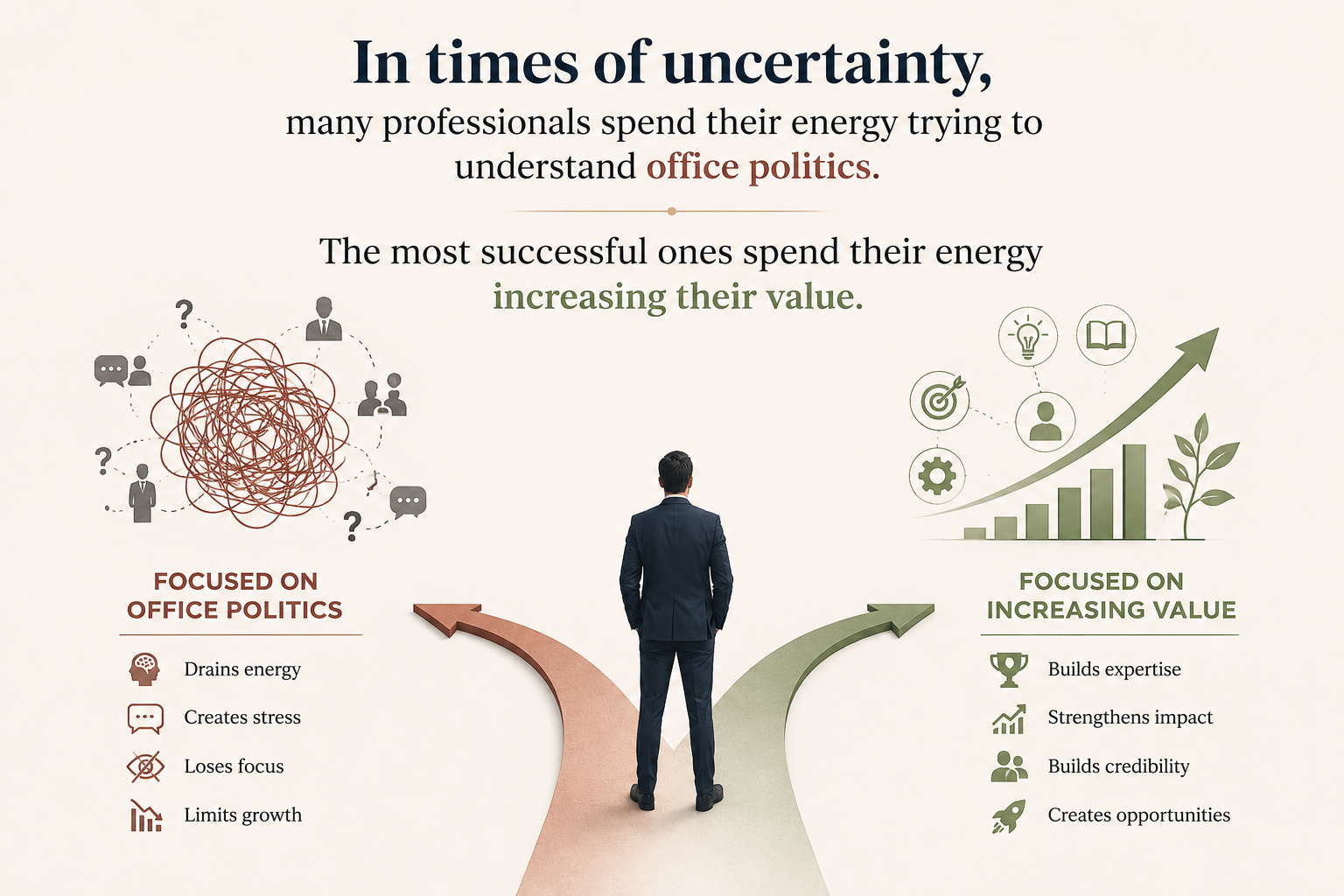
In times of uncertainty, many professionals spend their energy trying to understand office politics. The most successful ones spend their energy increasing their value.

There is a pattern playing out in organizations across the world.

As uncertainty increases, office politics seems to become more visible.

A leadership change triggers speculation. A restructuring creates anxiety. A business slowdown fuels insecurity. Budget cuts, role changes and whispers of layoffs begin to dominate conversations. Suddenly, people who were once focused on customers, innovation and performance find themselves discussing power dynamics, influence and organizational manoeuvring.

If you are a mid- or senior-level professional, you have probably witnessed this firsthand.

You may have seen people trying to protect their positions. You may have noticed colleagues becoming territorial. You may have observed information being selectively shared, credit being strategically claimed or decisions being influenced by factors that have little to do with merit.

While office politics has always existed, uncertainty tends to amplify it.

The question is not whether office politics exists.

The real question is this:

Because in every organization facing uncertainty, two types of professionals emerge.

The first group becomes increasingly focused on politics.

The second group becomes increasingly focused on increasing their value.

Over time, the difference between these two groups becomes remarkable.

Most professionals underestimate the cost of constantly thinking about office politics.

It rarely begins dramatically.

Instead, it starts with small mental habits.

You replay conversations.

You analyse leadership decisions.

You wonder why someone was promoted.

You speculate about organizational changes.

You spend time trying to understand hidden agendas.

Before long, a significant portion of your mental bandwidth is consumed by things over which you have very little control.

This creates a dangerous illusion.

You feel productive because you are thinking.

But in reality, you are often investing energy without creating value.

Every hour spent worrying about politics is an hour not spent strengthening your expertise.

Every conversation spent discussing organizational drama is a conversation not spent building meaningful relationships.

Every emotional reaction to uncertainty is energy unavailable for growth.

The problem is not that office politics exists.

The problem is when it becomes the primary focus of your attention.

Research on job insecurity has consistently shown that uncertainty affects more than just morale.

One of the most significant effects is a reduction in an individual’s sense of control.

When people feel that important outcomes are no longer fully within their influence, stress levels rise. Decision quality can decline. Emotional exhaustion increases. Attention becomes fragmented.

From a neuroscience perspective, uncertainty is often interpreted by the brain as a potential threat.

When the brain perceives threat, it naturally shifts resources toward protection and survival.

This response may have been useful thousands of years ago when humans faced physical dangers.

In today’s workplace, however, the threat is often psychological rather than physical.

The result?

Professionals can become trapped in cycles of worry, hypervigilance and emotional fatigue.

The irony is that the more uncertain the environment becomes, the more important it becomes to focus on what remains within your control.

And one of the most powerful things within your control is your personal value.

Imagine two managers working in the same company.

Both are competent.

Both have similar experience.

Both are exposed to the same uncertainty.

Manager A becomes consumed by politics.

Every leadership announcement is analysed.

Every promotion becomes a source of comparison.

Every rumour becomes a topic of discussion.

Manager A spends significant energy trying to understand who is influencing whom.

Manager B notices the same environment but chooses a different path.

Manager B invests time in strengthening expertise.

Improves communication skills.

Builds relationships across functions.

Develops greater visibility.

Learns new capabilities.

Focuses on contribution rather than speculation.

Fast forward five years.

Manager A may know every detail about the political history of the organization.

Manager B has become more valuable.

And value travels.

It travels across roles.

It travels across organizations.

It travels across industries.

Political influence is often temporary.

Personal value compounds.

In uncertain times, these five assets become increasingly important.

1. Capability

The marketplace rewards people who solve meaningful problems.

The more capable you become, the more options you create for yourself.

Technology changes.

Organizations change.

Markets change.

Capability remains a powerful differentiator.

Ask yourself:

What expertise am I developing that makes me more valuable than I was a year ago?

2. Credibility

Credibility is built through consistency.

It is the reputation people develop about you when you are not in the room.

Can people rely on you?

Do you deliver?

Do your actions match your words?

Credibility takes years to build and moments to damage.

Protect it carefully.

3. Communication

Many talented professionals remain invisible because they struggle to communicate their value.

Communication is not simply about speaking.

It is about influencing.

Aligning.

Building trust.

Creating clarity.

Helping others understand your contribution.

In uncertain environments, communication becomes a career multiplier.

4. Relationships

Relationships are often misunderstood.

Networking is not collecting contacts.

It is building trust over time.

Strong professional relationships create opportunities, information flow, collaboration and support.

When challenges arise, people rarely navigate them alone.

Relationships matter.

5. Adaptability

Perhaps no capability is more important today.

The ability to learn, adjust and respond effectively to change has become a competitive advantage.

Organizations increasingly reward professionals who can evolve faster than circumstances change around them.

Many professionals believe empowerment comes from gaining more control over external circumstances.

The reality is often different.

Empowerment begins when you focus on the areas where your influence is strongest.

This requires a shift:

From fear to ownership.

From reaction to response.

From blame to contribution.

From survival to growth.

This shift does not happen overnight.

But it changes everything.

Because when your attention moves from politics to personal value, your energy becomes more productive.

Your confidence becomes less dependent on external validation.

And your career becomes more resilient.

Whenever uncertainty increases, remember the BUILD framework.

B – Build Expertise

Commit to becoming better at what you do.

Learning is no longer optional.

It is career protection.

U – Upgrade Visibility

Great work deserves visibility.

Help stakeholders understand your contribution.

Do not assume your work speaks for itself.

I – Invest in Relationships

Build trust before you need it.

Strong relationships create long-term advantages.

L – Lead Yourself

Manage your emotions.

Protect your energy.

Strengthen your mindset.

Leadership begins with self-leadership.

D – Develop Adaptability

Stay curious.

Stay flexible.

Keep learning.

The professionals who adapt fastest often create the most opportunities.

As you read this, consider the following:

  1. Where is most of my mental energy currently going?
  2. What skill have I neglected because I have been distracted by circumstances?
  3. How visible is my contribution?
  4. What reputation am I building every day?
  5. If my role changed tomorrow, what value would I take with me?

The answers to these questions may reveal more about your future than any organizational chart.

Most people look for security in the organization.

The most resilient professionals create security within themselves.

They invest in capabilities.

They strengthen communication.

They build relationships.

They develop credibility.

They become adaptable.

This is not a guarantee against uncertainty.

Nothing is.

But it significantly increases your ability to navigate uncertainty successfully.

Because while organizations may change, personal value continues to travel with you.

While titles may change, capability remains.

While politics may rise and fall, credibility endures.

And while circumstances may be uncertain, growth remains a choice.

As uncertainty rises, many professionals become students of office politics.

The leaders who thrive become students of growth.

They understand that politics may influence a role.

But value influences a career.

They know that speculation rarely creates opportunities.

Contribution does.

And they recognize that the most powerful response to uncertainty is not fear.

It is becoming more valuable than yesterday.

If workplace uncertainty, leadership challenges, career transitions or organizational dynamics are occupying your mind, perhaps the most important investment you can make right now is in yourself.

Learn more or start a confidential conversation here:

Contact Us

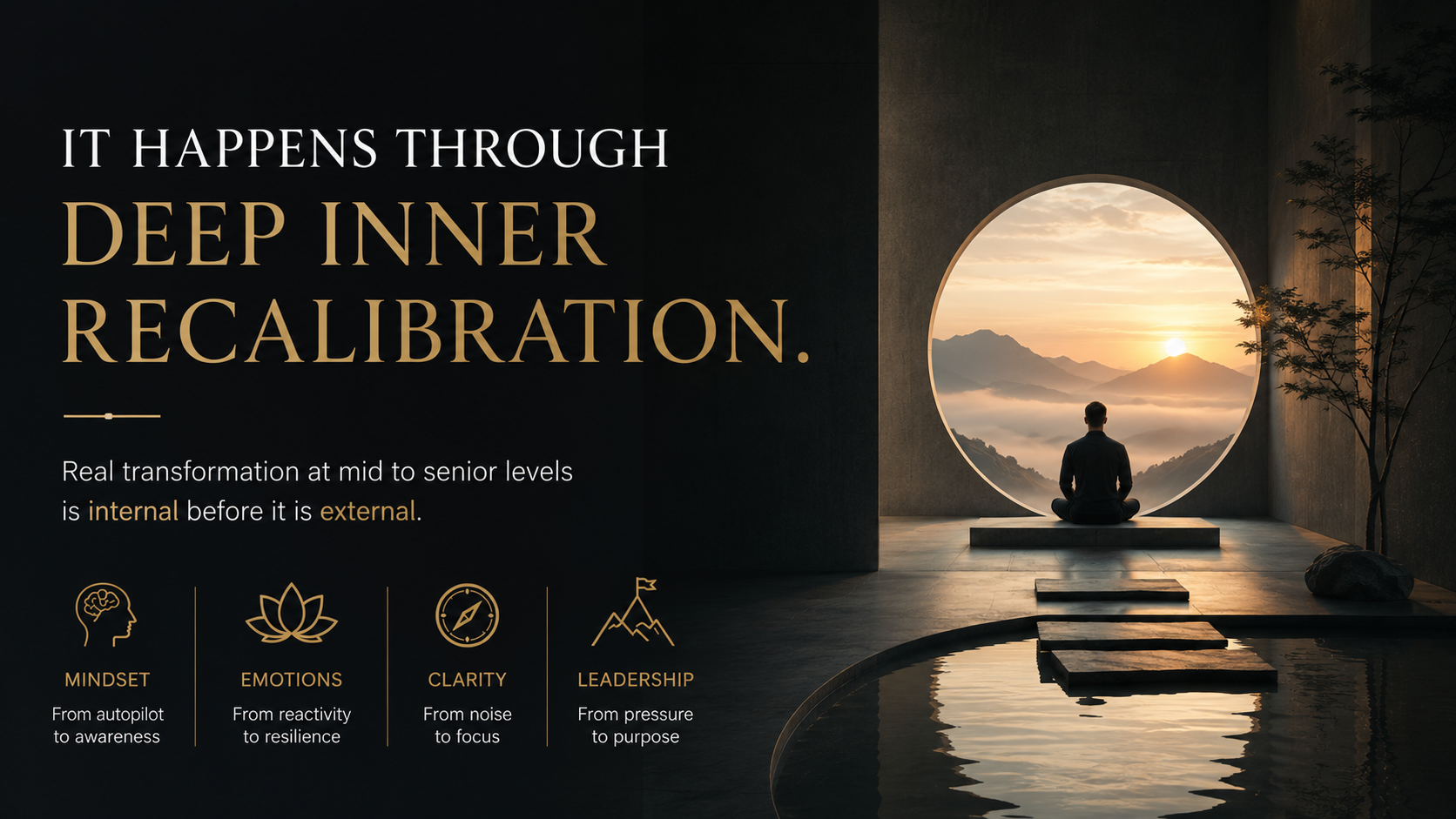
It Happens Through Deep Inner Recalibration

It Happens Through Deep Inner Recalibration

Most professionals believe growth is external.

A better strategy.
A stronger network.
A bigger role.
A higher salary.
A more prestigious title.

And for the first half of a career, that assumption often works.

Skill creates momentum.
Execution creates visibility.
Consistency creates opportunity.

But somewhere between mid-level competence and senior-level leadership, something changes quietly.

The rules stop being external.

At higher levels of responsibility, growth stops being about doing more — and starts becoming about becoming different.

That transition is where many experienced professionals struggle, even if they appear highly successful from the outside.

Because the real challenge is no longer performance.

It is internal recalibration.

Research from Harvard Business Review has repeatedly shown that technical competence alone is rarely what limits senior professionals. Instead, progression stalls because of psychological rigidity, emotional fatigue, identity attachment and cognitive overload.

In simpler terms:

The mindset that helped you succeed earlier in your career often becomes the very thing limiting your next level of growth.

Consider this:

  • The manager who built success through control struggles to lead empowered teams.
  • The high performer who relied on speed struggles in environments requiring strategic patience.
  • The executive whose identity is tied to achievement struggles when reinvention becomes necessary.
  • The founder who built a company through intensity eventually burns out operating from constant pressure.

These are not skill problems.

They are internal architecture problems.

And they cannot be solved through productivity hacks, motivational quotes or another leadership framework downloaded from LinkedIn.

They require something deeper.

A recalibration of how a person thinks, processes pressure, interprets identity and operates under uncertainty.

One of the least discussed realities of professional success is this:

Success reinforces patterns.

The more rewarded you become for a certain way of thinking, behaving or leading, the harder it becomes to question whether that pattern is still useful.

Psychologists call this “functional fixedness.”

In leadership, it often appears as:

  • overreliance on past expertise
  • resistance to uncertainty
  • inability to adapt emotionally
  • defensive decision-making
  • chronic overcontrol
  • avoidance of vulnerability

This is particularly dangerous in modern professional environments where industries evolve faster than experience alone can keep up with.

Kodak is a classic organizational example.

The company invented digital photography technology in 1975. Yet its leadership remained psychologically attached to film because film had historically defined success.

The issue was not lack of intelligence.

It was identity rigidity.

The organization could not recalibrate internally fast enough to respond externally.

The same pattern happens to individuals every day.

A senior executive continues operating from an outdated leadership style because it once worked.

A founder remains trapped in survival-mode intensity long after the business has matured.

A high-achieving professional keeps optimizing productivity while emotionally disconnecting from meaning, creativity and strategic clarity.

Externally, they still look successful.

Internally, they are slowly fragmenting.

Modern neuroscience offers powerful insight into why this happens.

The human brain is designed to automate successful patterns.

Repeated thoughts and behaviors strengthen neural pathways through a process called neuroplasticity.

This is useful when learning skills.

But it also means:

  • stress responses become automated
  • overthinking becomes automated
  • emotional defensiveness becomes automated
  • people-pleasing becomes automated
  • perfectionism becomes automated

Over time, professionals stop consciously choosing how they operate.

They simply repeat conditioned responses under pressure.

This explains why many experienced leaders struggle with:

  • chronic mental fatigue
  • decision exhaustion
  • emotional reactivity
  • inability to disconnect from work
  • reduced creativity
  • low psychological flexibility

Research from Stanford University has shown that chronic cognitive overload significantly reduces strategic thinking quality and adaptability.

In other words:
The more mentally overloaded you become, the more you default to familiar patterns — even when those patterns no longer serve you.

That is why transformation at senior levels is rarely informational.

It is neurological and psychological.

You are not simply learning something new.

You are rewiring how you operate.

Early career growth rewards effort.

Senior leadership rewards clarity.

This distinction changes everything.

At junior levels:

  • execution matters most
  • responsiveness matters most
  • output creates visibility

At senior levels:

  • judgment matters more
  • emotional regulation matters more
  • strategic thinking matters more
  • presence matters more
  • adaptability matters more

Yet many professionals continue trying to solve senior-level challenges with junior-level operating systems.

They work harder instead of thinking differently.

They optimize time instead of recalibrating identity.

They chase efficiency while ignoring emotional exhaustion.

The result is a strange modern phenomenon:

Professionals who are highly accomplished externally but internally disconnected from energy, creativity and meaning.

McKinsey research during the pandemic years revealed that senior leaders experienced significantly higher levels of emotional exhaustion than many frontline employees — largely because they carried invisible cognitive and psychological burdens continuously.

Decision fatigue.
Responsibility fatigue.
Identity pressure.
Emotional suppression.
Constant uncertainty.

These pressures accumulate quietly.

And eventually, performance alone can no longer compensate.

Many people assume transformation begins with visible action.

In reality, sustainable transformation begins internally first.

Consider Satya Nadella’s transformation of Microsoft.

When Nadella became CEO in 2014, Microsoft was still profitable but culturally stagnant. Internally, the organization operated from defensiveness, hierarchy and fixed thinking.

Nadella introduced something radically different:
a growth mindset culture grounded in empathy, curiosity and learning.

The transformation was not purely strategic.

It was psychological.

He shifted how people thought, related, collaborated and adapted.

That internal recalibration eventually drove external innovation.

Similarly, executive coaching research from the International Coaching Federation consistently shows that sustainable leadership improvement is strongly tied to increased self-awareness, emotional intelligence and cognitive flexibility — not just tactical competence.

The leaders who evolve successfully are rarely the ones who know the most.

They are the ones most willing to re-examine themselves honestly.

For mid-to-senior professionals, recalibration often happens across four critical dimensions.

1. Identity Recalibration

Many professionals unconsciously tie self-worth to achievement.

“I am valuable because I perform.”

This creates chronic psychological pressure because identity becomes dependent on external outcomes.

Eventually:
rest feels unsafe,
uncertainty feels threatening,
and failure feels personal.

Recalibration begins when identity expands beyond professional performance alone.

2. Emotional Recalibration

High performers are often rewarded for suppressing emotion.

But suppressed emotion does not disappear.
It accumulates physiologically and cognitively.

Research from Yale’s Center for Emotional Intelligence shows that emotional awareness directly improves decision-making quality, resilience and leadership effectiveness.

Strong leaders do not eliminate emotion.

They develop the capacity to process it intelligently.

3. Cognitive Recalibration

Many professionals operate from constant mental noise.

Notifications.
Meetings.
Pressure.
Urgency.
Comparison.
Overthinking.

Deep work by neuroscientist Dr. Amishi Jha demonstrates that attention is now one of the most valuable leadership resources in modern environments.

Clarity is not accidental.

It is trained.

4. Strategic Recalibration

At senior levels, the challenge is not merely execution.

It is discernment.

What deserves energy?
What should be ignored?
What truly matters long-term?

This requires psychological distance from constant reactivity.

Without recalibration, professionals become trapped in perpetual operational survival.

Because internal recalibration is uncomfortable.

It requires confronting:

  • outdated identities
  • emotional avoidance
  • hidden fears
  • ego attachment
  • dependency on validation
  • burnout disguised as ambition

External work is easier because it feels measurable.

Internal work feels uncertain.

Yet ironically, the professionals who avoid internal recalibration often plateau the fastest.

Not because they lack intelligence.

But because they become psychologically inflexible.

And in rapidly changing environments, flexibility matters more than certainty.

The next era of leadership will not belong solely to the most technically skilled professionals.

It will belong to those who can:

  • think clearly under uncertainty
  • regulate themselves under pressure
  • adapt without losing identity
  • remain curious despite success
  • lead without emotional exhaustion
  • reinvent before crisis forces reinvention

This is not self-help.

It is strategic evolution.

Because eventually every professional reaches a point where external achievement alone stops creating fulfillment, clarity or sustainable growth.

And at that point, the next breakthrough is no longer external.

It happens through deep inner recalibration.

If you are navigating that transition — professionally, mentally or personally — the conversation is different now.

And perhaps, more important than ever.

Click here when you want to have a conversation with us…

What If Your Biggest Bottleneck Isn’t Effort — It’s Recovery?

What If Your Biggest Bottleneck Isn’t Effort — It’s Recovery?

We live in a culture that worships effort.

Push harder. Grind longer. Sleep less. Outwork everyone. Stay hungry.

From boardrooms to gyms to social media feeds, the message is relentless: success belongs to the people who can endure the most pressure and sustain the highest intensity.

And for a while, that belief seems true.

You work harder. You get promoted. You train more. You improve. You put in more hours. You see more results.

Until one day you don’t.

You wake up tired after a full night’s sleep. You stare at tasks you once enjoyed and feel resistance. Your performance plateaus. Your focus slips. Creativity disappears. Small problems start feeling heavier than they should.

So you do what most people do:

You push harder.

And that’s often where the real problem begins.

Because what if your biggest bottleneck isn’t effort?

What if it’s recovery?

Most people think performance is built entirely through stress.

Stress your muscles, they grow.

Stress your mind, it adapts.

Stress your business, it expands.

But this is only half the equation.

Performance isn’t stress alone.

Performance = Stress + Recovery

Stress creates the stimulus.

Recovery creates the adaptation.

Without recovery, stress accumulates but growth doesn’t.

Imagine going to a gym and doing the same intense workout every day without rest.

Heavy squats.

Heavy deadlifts.

Maximum effort.

No breaks.

Initially, you might feel powerful. Motivated. Productive.

Then soreness becomes exhaustion.

Energy drops.

Performance falls.

Eventually your body starts resisting what once helped it grow.

Not because training stopped working.

Because recovery disappeared.

The same thing happens outside the gym.

Except we don’t recognize it.

Today many people live in a state of constant activation.

Emails before breakfast.

Notifications during lunch.

Meetings stacked back-to-back.

Late-night work.

Weekend obligations.

Mental tabs left open constantly.

Even “rest” has become stimulating.

Scrolling social media.

Streaming content.

Checking messages.

Consuming information.

Our bodies sit still.

But our nervous systems never stop moving.

And that’s dangerous because humans were never designed for uninterrupted stress.

We were built for cycles.

Stress.

Recovery.

Stress.

Recovery.

Expansion.

Contraction.

Day.

Night.

Activity.

Rest.

Nature already understands this rhythm.

We often forget it.

A classic example comes from endurance sports.

Many amateur runners assume elite athletes improve by simply running more miles.

But top marathoners don’t just train harder.

They recover harder.

Olympic runners often spend enormous amounts of time sleeping, resting, receiving therapy, managing nutrition and reducing unnecessary stress.

Some elite athletes reportedly sleep ten to twelve hours during peak training.

To outsiders this can seem excessive.

Shouldn’t champions be training every waking minute?

But elite coaches understand something most people miss:

Training creates fatigue.

Recovery creates capability.

Without recovery, today’s effort steals tomorrow’s performance.

This isn’t just athletic science.

It happens inside organizations every day.

Consider the executive who once thrived under pressure.

They built their reputation through energy, speed, responsiveness and relentless work ethic.

Initially, these traits create success.

More meetings.

More responsibility.

More leadership opportunities.

Eventually the workload expands faster than recovery can support.

Then subtle changes emerge:

Decision quality declines.

Creativity decreases.

Patience shortens.

Energy fluctuates.

Focus fragments.

The person appears busy but effectiveness quietly erodes.

The tragedy is that burnout often doesn’t feel like collapse at first.

It feels like needing to work harder.

Imagine carrying a smartphone that never drops below 100%.

No charging needed.

No battery drain.

Unlimited performance.

Sounds absurd because everyone understands batteries require recharge cycles.

Yet we somehow expect ourselves to operate differently.

You wouldn’t blame your phone for needing power.

You wouldn’t say:

“Come on. Work harder.”

You’d plug it in.

Because depletion isn’t weakness.

It’s design.

Humans operate similarly.

Recovery isn’t a luxury.

Recovery is charging.

And most people are trying to live on permanent low battery mode.

Poor recovery doesn’t always show up dramatically.

Sometimes it appears quietly.

You reread the same email three times.

You lose patience faster.

Your workouts become inconsistent.

Your ideas become repetitive.

You feel busy all day but accomplish little.

You struggle to switch off.

You wake up already tired.

Over time, these small signs compound.

And because they emerge gradually, they become normalized.

Many people have forgotten what fully recovered feels like.

They aren’t functioning at 100%.

They have adapted to 60% and call it normal.

One of the most fascinating examples of recovery thinking came from tennis legend Roger Federer.

Federer reportedly spent less time on court than many rivals.

He wasn’t obsessed with maximizing training hours.

Instead, he prioritized strategic recovery and sustainable longevity.

Over decades, while many players accumulated injuries and fatigue, Federer remained competitive deep into his career.

He understood an idea many high performers eventually discover:

More isn’t always better.

Better recovery often makes more possible.

Many people resist recovery because they confuse it with inactivity.

Recovery sounds passive.

Lazy.

Unproductive.

But true recovery is active.

Intentional.

Strategic.

Recovery isn’t doing nothing.

Recovery is restoring capacity.

That might mean:

Sleep.

Silence.

Movement.

Nature.

Reflection.

Meditation.

Deep conversation.

Time away from stimulation.

Different people recover differently.

But everyone needs recovery.

People often say:

“I rested all weekend but still feel exhausted.”

Because escape and recovery are not always the same thing.

A weekend full of alcohol, social obligations, travel, scrolling and overstimulation might feel enjoyable.

But enjoyment and restoration are different experiences.

You can be entertained without being renewed.

You can be busy relaxing.

Recovery asks a different question:

Did this restore energy?

Or merely distract from depletion?

Forests naturally experience cycles.

Periods of growth.

Periods of stillness.

Periods of renewal.

In some ecosystems, occasional fires even create conditions for healthier future growth.

But constant fire destroys ecosystems.

The land never has time to regenerate.

Human performance works similarly.

Stress alone eventually becomes destruction.

Recovery creates regeneration.

Without renewal, intensity becomes erosion.

One of the biggest barriers isn’t lack of time.

It’s psychology.

Many high achievers secretly tie their worth to productivity.

Rest creates discomfort.

Stillness feels unearned.

Silence creates guilt.

So they continue moving.

Not because movement helps.

Because stopping feels unsafe.

But recovery requires permission.

Permission to pause before collapse forces it.

Permission to step away before depletion becomes dysfunction.

Permission to understand that restoration is part of performance—not separate from it.

Across industries, sustained high performers often share recovery behaviors.

Not identical routines.

But consistent principles.

They create boundaries.

They protect sleep.

They disconnect intentionally.

They understand energy as a finite resource.

Many successful leaders build recovery into schedules before crises demand it.

Because once exhaustion arrives, recovery becomes repair.

Preventive recovery is far more effective.

There isn’t one universal recovery formula.

For one person recovery might mean solitude.

For another it might mean connection.

Some people recharge through movement.

Others through stillness.

Some through nature.

Others through creativity.

The goal isn’t copying someone else’s routine.

The goal is noticing:

What genuinely restores me?

Because if performance is output, recovery is input.

And inputs determine everything downstream.

Pause for a moment and consider:

When was the last time you felt deeply recovered?

Not entertained.

Not distracted.

Recovered.

What activities consistently restore your energy?

What drains you?

What signals tell you you are approaching depletion?

What would change if recovery became part of your strategy rather than an afterthought?

Because perhaps your next breakthrough doesn’t require more effort.

Maybe it requires more restoration.

We often admire people who endure endlessly.

Who never stop.

Who keep going no matter what.

But perhaps strength deserves a broader definition.

Maybe strength isn’t only the ability to push harder.

Maybe strength is also the wisdom to recover intentionally.

Because the goal isn’t simply to survive pressure.

The goal is to thrive under it.

And thriving requires rhythm.

Stress and recovery.

Effort and restoration.

Intensity and renewal.

Because without recovery, effort eventually becomes self-sabotage.

But with recovery?

Recovery transforms effort into growth.

And that changes everything.

The question isn’t:

“How much more can you push?”

The better question may be:

Ready to move beyond effort and build sustainable high performance? Start the conversation here: 

Connect with High Performance Alchemy

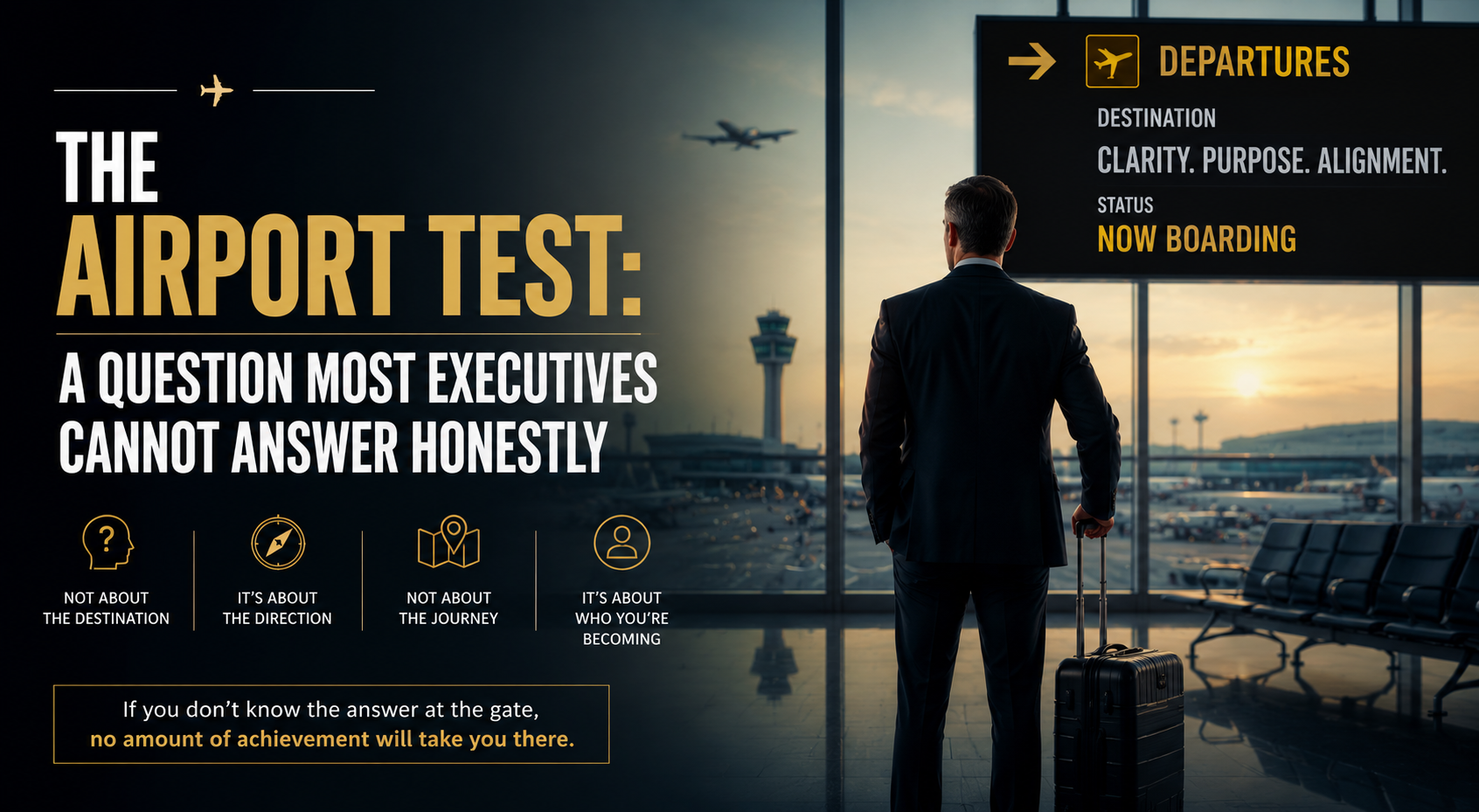
The Airport Test : A Question Most Executives Cannot Answer Honestly

The Airport Test : A Question Most Executives Cannot Answer Honestly

Imagine this.

You are alone at an international airport. Not rushing. Not on calls. No meetings. No notifications. No urgency.

Your flight is delayed by 4 hours.

You sit near the glass window watching aircraft take off one after another.

And for the first time in months, there is absolutely nothing demanding your attention.

No targets. No teams. No presentations. No performance.

Just silence.

Now here’s the strange part.

Why does that silence feel uncomfortable?

Most mid to senior-level professionals cannot sit with stillness anymore. Not because they are weak. Because somewhere along the way, movement became identity.

Busyness became validation. Pressure became purpose. Stress became proof of importance.

And slowly, without realizing it, life stopped feeling lived…and started feeling managed.

If your external success disappeared tomorrow, what would still remain of you?

Not your title. Not your company. Not your designation. Not your LinkedIn headline.

You.

Just you.

Would you still know who that person is?

That question unsettles more executives than market uncertainty ever will. Because most professionals spend decades building a career without noticing they are also constructing a psychological dependency on performance.

Imagine your life is a hotel room.

Every year, you add something new into it.

A bigger role. A higher salary. More responsibilities. Another device. Another subscription. Another ambition. Another expectation.

Now walk into that room mentally.

Look around carefully.

Is it still a place you can breathe in?

Or has it quietly become storage for accumulated pressure?

That is what modern executive life often looks like internally.

Not collapse.

Just overcrowding.

Smart people can survive unhealthy situations for a very long time.

That’s the problem.

They adapt.

They normalize mental fatigue, emotional numbness, chronic urgency, fragmented attention and invisible loneliness.

Until one day they notice something strange:

They no longer remember what “calm” feels like.

1. When was the last time you felt mentally clear?

Not productive.

Clear.

There’s a difference.

Productivity can happen under stress. Clarity cannot.

A lot of leaders today are functioning with overloaded minds while calling it “normal.”

That’s dangerous.

Because overloaded minds eventually lose depth.

You begin reacting instead of thinking. Responding instead of reflecting. Surviving instead of leading.

2. Who are you when nobody needs anything from you?

This question hits harder than expected.

Because many professionals have unconsciously built self-worth around usefulness.

Being needed. Being depended on. Being valuable.

But eventually, constant usefulness becomes emotional captivity.

You become available to everyone except yourself.

3. What are you postponing until “later”?

Peace? Health? Relationships? Stillness? Meaning? Rest?

Most executives treat life like a waiting room.

“Once this quarter ends…”
“Once this transition is over…”
“Once things stabilize…”

But modern work never stabilizes.

The chaos simply changes shape.

And one day people wake up successful but disconnected from their own lives.

Burnout is not always dramatic.

Sometimes burnout looks like losing curiosity, feeling emotionally flat, struggling to feel excited, becoming impatient faster, needing constant stimulation or secretly fantasizing about disappearing for a while.

And because high performers still “function,” nobody notices.

Including them.

Too many tabs open.

One playing music somewhere. Three frozen. Five demanding attention. Two updating constantly.

That’s how many executives live mentally every day.

Now imagine trying to make life-changing decisions in that condition.

No wonder people feel exhausted.

The issue is not capability.

The issue is cognitive overcrowding.

Most professionals think they need motivation, discipline, better habits or sharper strategies.

But what they actually need may be internal space, emotional honesty, psychological recalibration, nervous system recovery and clarity without noise.

Because you cannot hear yourself clearly while constantly performing.

At senior levels, everyone appears composed.

But privately, many feel uncertain, disconnected, afraid of becoming irrelevant, tired of carrying invisible pressure and secretly wanting permission to pause.

Yet nobody says it first.

Because everyone is busy performing certainty for each other.

What if your next level in life is not about becoming more…but removing what no longer belongs?

The unnecessary pressure. The constant urgency. The mental clutter. The identity built only around achievement.

What if the real breakthrough is simplification?

Not externally.

Internally.

Don’t ask:
“How do I become more successful?”

Ask:
“What is silently draining the quality of my life right now?”

That answer changes everything.

Because the goal is not just high performance.

The goal is sustainable, meaningful, internally aligned performance.

Very few people are taught how to build that.

Which is why so many accomplished professionals feel lost despite appearing successful.

If some part of this felt uncomfortably accurate, start here:

High Performance Alchemy – RRR

Not for more pressure.

For clarity.

The Hidden Leadership Plateau

The Hidden Leadership Plateau

Why Mid–Senior Leaders Stall — and How to Break Through

At mid to senior level, leadership becomes paradoxical.

You have earned your position. You have delivered results. You are trusted. On paper, everything points upward.

And yet—something shifts.

Decisions feel heavier. Time feels tighter. The margin for error disappears. What once felt like momentum now feels like pressure.

This is the leadership plateau.

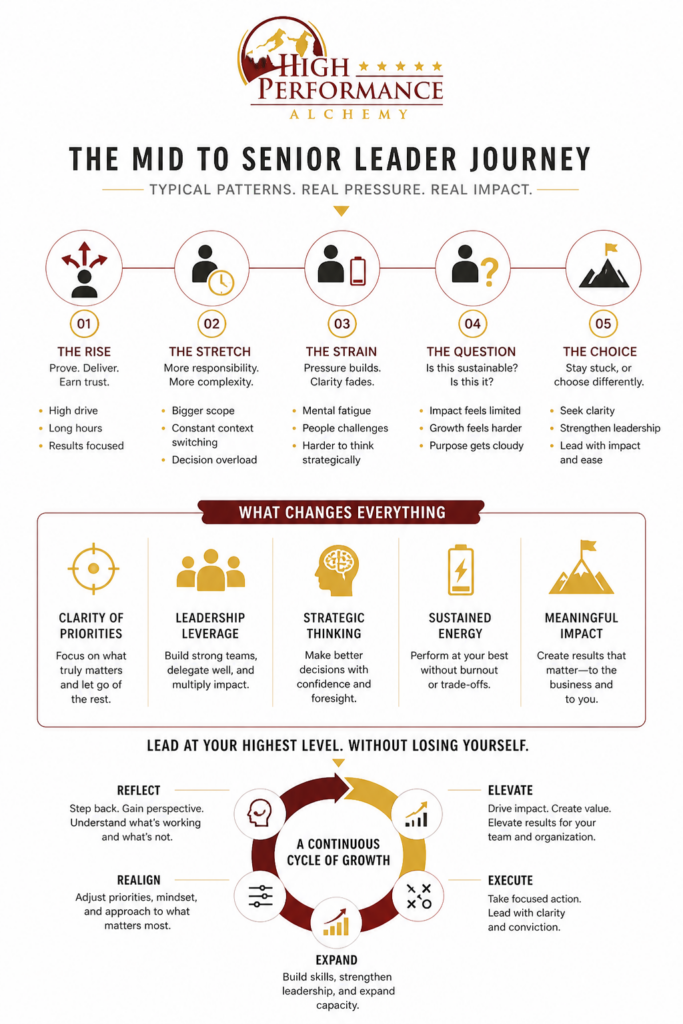
It’s not burnout. It’s not incompetence. It’s something far more subtle—and far more dangerous.

It’s the moment where capability continues to rise… but clarity does not.

Across industries, roles and geographies, high-performing leaders tend to follow a remarkably similar trajectory:

You prove yourself. You execute. You deliver consistently.
Your value is clear: you get things done.

You are given more scope. More responsibility. Bigger decisions.
Your calendar fills. Your visibility increases.

The cracks begin to show—not externally, but internally.
You are juggling competing priorities, navigating ambiguity and making decisions with incomplete information.

A quiet but persistent thought emerges:
“Is this sustainable?”
“Am I actually operating at my best?”

Stay in the cycle—or step out of it.

Most leaders never consciously make this choice. They default.

And that’s where performance plateaus.

Conventional thinking says leaders struggle because they lack skills.

Research—and real-world experience—suggests otherwise.

A study published in the Harvard Business Review found that as leaders move up, technical competence becomes less predictive of success, while cognitive clarity, emotional regulation and strategic focus become critical differentiators.

Similarly, McKinsey’s work on executive performance highlights that top leaders are not those who do more—but those who decide better, faster and with greater alignment.

So if it’s not skill…

What is it?

Senior leaders make hundreds of decisions weekly—many of them high-stakes.

Over time, this leads to decision fatigue:

  • Slower thinking
  • Reduced confidence
  • Over-reliance on familiar patterns

The result? Leaders either overthink… or default to autopilot.

Neither leads to breakthrough performance.

You are not just managing tasks—you are managing:

  • Stakeholder expectations
  • Organizational politics
  • Strategic ambiguity
  • Team dynamics

Your brain is constantly context-switching.

Neuroscience research shows that frequent context switching can reduce productivity by up to 40% and significantly impair deep thinking.

At the senior level, this isn’t just inefficient—it’s costly.

As you rise, your circle shrinks.

You have fewer peers you can speak candidly with.
Fewer spaces where you can think out loud without consequence.

So what happens?

You carry more—alone.

And that weight compounds over time.

The leaders who break through this plateau don’t work harder.

They operate differently.

They understand that not everything deserves attention.
They focus on what truly moves the needle—and let go of the rest.

They don’t just react. They step back.
They build intentional space for reflection, strategy and clarity.

They stop being the bottleneck.
They build teams, systems and structures that multiply their impact.

They recognize that performance isn’t about hours worked—but about cognitive and emotional capacity.

There’s a misconception that coaching is about fixing problems.

At the senior level, it’s not.

It’s about unlocking performance that already exists—but isn’t fully accessed.

A study by the International Coaching Federation (ICF) found that:

  • 86% of companies saw a positive ROI from coaching
  • 70% of individuals improved work performance
  • 80% reported increased self-confidence

But beyond the statistics, the real value lies in something less tangible:

Clarity.

When leaders engage in the right kind of coaching, five key shifts occur:

Leaders move from reacting to everything…
to focusing on what truly matters.

They stop doing more—and start enabling more.

They make decisions with greater confidence and foresight.

They perform at a high level—without constant depletion.

Their work aligns not just with business goals—but with personal purpose.

“I didn’t realize how much mental noise I was carrying until it was gone.”
— VP, Technology

“The biggest shift wasn’t in what I did—it was in how I thought. Everything became clearer.”
— Director, Operations

“I stopped being the bottleneck. My team stepped up—and so did our results.”
— Senior Manager, Finance

“For the first time in years, I feel like I’m leading with intention, not just reacting.”
— Head of Strategy

It’s easy to normalize the plateau.

After all, you are still performing. Still delivering. Still progressing.

But over time, the hidden costs accumulate:

  • Missed opportunities for strategic impact
  • Reduced innovation and creativity
  • Increased stress and fatigue
  • Diminished leadership presence

And perhaps most importantly:

A growing gap between your current performance and your true potential

Breaking through isn’t about adding more.

It’s about removing what’s in the way.

  • The noise
  • The overload
  • The unnecessary complexity

And replacing it with:

  • Clarity
  • Focus
  • Intentional action

This isn’t a dramatic transformation.

It’s a series of precise, high-leverage shifts.

For mid to senior leaders, the next level isn’t about climbing higher.

It’s about operating differently at the level you are already in.

It’s about:

  • Thinking more clearly
  • Leading more intentionally
  • Performing more sustainably

Because at this stage, success isn’t defined by how much you do.

It’s defined by how effectively you think, decide and lead.

Most leaders don’t fail because they lack capability.

They stall because they are operating in systems—both external and internal—that no longer serve them.

The leaders who break through are the ones who recognize this early…

And choose to do something about it.

If you are at that point—the question isn’t whether you can do more.

It’s whether you are ready to operate at your true level.

Ready to break the plateau and lead at your true level?


Explore your next step→ https://highperformancealchemy.com/rrr/

Clarity Is a Result, Not a Starting Point

Clarity Is a Result, Not a Starting Point

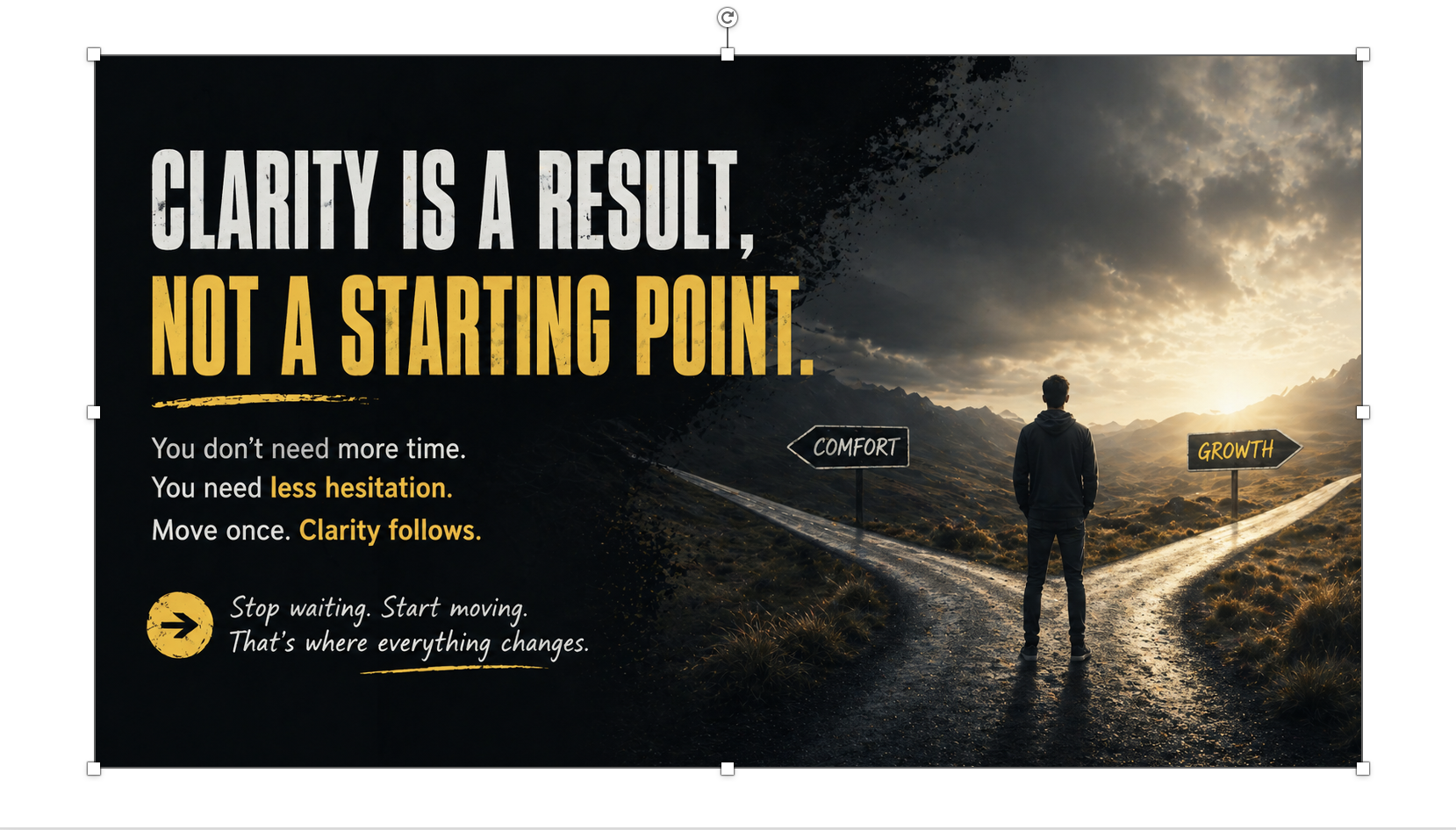
You don’t have a clarity problem.
You have a moment you are avoiding.

And the longer you sit with it,
the more your mind upgrades it into something that sounds intelligent—
uncertainty, overthinking,
“I just need a bit more time.”

But if you are honest,
and you stop for a second,
you already know what the next move is.

Not the full plan.
Not the five-year vision.
Just the next uncomfortable step.

And that’s exactly the one you keep postponing.

This is where everything gets distorted.

You assume confusion means you need better thinking,
better structure,
better answers.

But what’s actually happening is simpler—
and harder to admit.

You are clear enough to act.
You are just not comfortable enough to act.

So instead of calling it discomfort,
you call it confusion.

Because confusion feels safer.
More rational.
More in control.

But the truth is,
you are holding two things at the same time.

You want to move forward.
And you want to protect yourself
from what that movement might trigger—
judgment,
failure,
change,
exposure.

That tension creates friction.

And instead of resolving it by choosing,
you extend it by thinking.

More angles.
More inputs.
More time.

And it feels productive.

But it isn’t.

It’s just a sophisticated delay.

There’s research behind this.

When people are given more options
or more variables to consider,
their ability to decide actually drops.

The brain shifts
from making progress
to avoiding regret.

That’s the shift you don’t notice.

You think you are trying to make the right decision.
But what you are really doing
is trying not to make a wrong one.

And that’s why you stay where you are.

So the issue isn’t that you don’t know enough.

It’s that you have made certainty
a requirement before action.

And that rule doesn’t work anymore.

Not in a world that changes this fast.

If you wait for that feeling,
you will keep waiting.

While people who feel just as unsure as you
quietly move ahead.

Clarity doesn’t arrive before you act.

It shows up
because you act.

You have seen this in your own life.

The things you delayed felt heavy.
Complicated.
Unclear.

But the moment you finally did something about them—
even imperfectly—

the noise reduced.

Not everything became perfect.

But it became clearer.

That didn’t happen because you thought more.

It happened because you moved.

So the real shift is small,
but brutal.

You stop trying to eliminate uncertainty.

And you start acting inside it.

You stop asking,
“What’s the perfect move?”

And start asking,
“What am I avoiding because it feels uncomfortable?”

That question cuts through everything.

Because it points directly
to the edge you have been circling.

And the solution isn’t dramatic.

You don’t need a full reset.
You don’t need a breakthrough.

You need to shorten the gap
between knowing
and doing.

That gap is where doubt grows.
Where fear multiplies.
Where momentum dies.

The longer you stay there,
the heavier everything feels.

The faster you move—
even in small ways—
the lighter it gets.

Because momentum doesn’t come from clarity.

It comes from movement.

And once you move, even once,
something shifts internally.

You start trusting yourself again.

Decisions feel less heavy.

You stop needing as much external validation.

Not because life got easier.

But because you stopped waiting for it to.

So bring it back to yourself.

Right now,
there’s something you keep returning to.

Something that hasn’t gone away.

That’s not random.

That’s a signal.

And every time you delay it,
you weaken your relationship
with your own judgment.

If there’s one thing to take care of,
it’s this:

Stop trying to feel certain
before you move.

You don’t need more clarity.

You need less hesitation
between awareness
and action.

That’s where everything changes.

If this feels uncomfortably accurate,
like you have been sitting in this space longer than you should,

go a level deeper here:

https://highperformancealchemy.com/rrr